MI5 Lobbied to Weaken Hillsborough Law, Leaked Emails Show
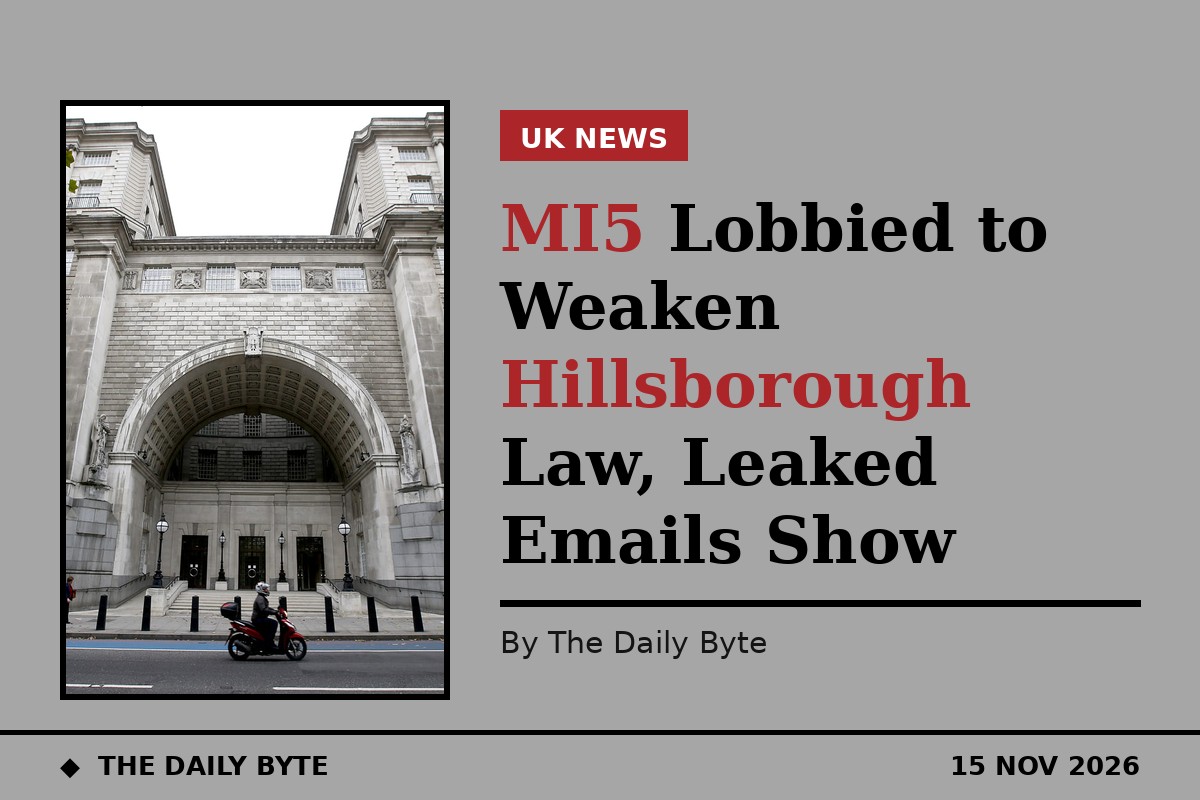
Leaked emails show that MI5, Britain's domestic intelligence agency, ran a covert campaign to weaken or kill the Hillsborough Law, the legislation that would make it a criminal offence for public officials to lie to public inquiries. The correspondence, reported by investigative outlet The Grayzone, shows MI5 Director General Ken McCallum privately lobbying ministers and peers for an exemption for the security service, or for the bill to be rejected outright.
According to the report, McCallum acknowledged in one email that the legislation was difficult to oppose in public because it was, in his words, a very hard bill to oppose politically, since it looks like one is against telling the truth. He nevertheless pressed ahead, arguing that the law could cause serious damage to national security, tie intelligence officers up in court cases and discourage international partners from sharing sensitive information.
What the Hillsborough Law would do
The Public Office (Accountability) Bill, known as the Hillsborough Law, would create a legal duty of candour, making it a criminal offence for government officials to lie to, or conceal information from, public inquiries and investigations. The proposed penalties run from two to 14 years in prison. The bill completed its committee stage in the House of Lords on 21 October and is now due for a vote in the upper chamber, where peers can delay it for up to a year or seek amendments.
The law is named after the Hillsborough stadium disaster of April 1989, in which 97 Liverpool supporters were killed. Later inquiries and inquests found that police had falsified and suppressed evidence to shift blame onto the victims. Families of the victims have campaigned for decades for a law forcing state officials to tell the truth. The measure was promised in Labour's 2024 election manifesto, and the Commons passed the legislation in July.
The lobbying campaign described in the emails
The leaked emails, as reported by The Grayzone, show McCallum using a private, pseudonymous email address to keep his predecessor, Baroness Eliza Manningham-Buller, informed about his lobbying. In one message, McCallum said he had sought to negotiate a bearable version of the Hillsborough Law directly with Prime Minister Andy Burnham before Burnham had even taken office.
Manningham-Buller, who is now a member of the House of Lords, was joined in the effort by fellow former MI5 directors general Andrew Parker and Jonathan Evans, both also peers. According to the report, the former spy chiefs kept a list of allies in the Lords who could be relied on to weaken the bill or vote it down, and discussed which peers to target. The report says MI5 believed at one stage it had convinced ministers of the need to carve the agency out of the law, until pressure from victims' families led to the duty being applied to MI5 in the bill's final form.
Why MI5 opposed the duty of candour
The emails show MI5 arguing that the duty of candour model proposed by the government gave campaigners 90 per cent of what they wanted, but that families kept ratcheting their demands in ways the agency said risked a disproportionate effect on national security. One MI5 official wrote that the agency was in a good place with ministers on the need to carve us out of it, and suggested publishing a code of ethics to demonstrate that the security service already policed itself.
The agency's opposition comes against a background of controversies over its record on telling the truth. An official investigation found MI5 missed significant opportunities to prevent the 2017 Manchester Arena bombing, in which 22 people were killed. The Operation Kenova investigation, whose findings were published in December 2025, criticised MI5 for concealing the extent of its relationship with Stakeknife, an IRA informant who was also a serial killer. And in July 2026, the Investigatory Powers Commissioner's Office reported that senior MI5 officials had given the BBC the identity of another informant, known as Agent X, and then repeatedly denied having done so.
The Hillsborough Law now faces its decisive test in the House of Lords, where the campaigners fear the intelligence services will seek an exemption or a delay that could kill the bill. The leaked emails, if authentic, suggest those fears are well founded.
Sources: The Grayzone and Press TV.


