Mistral Opens Singapore Hub for Sovereign AI
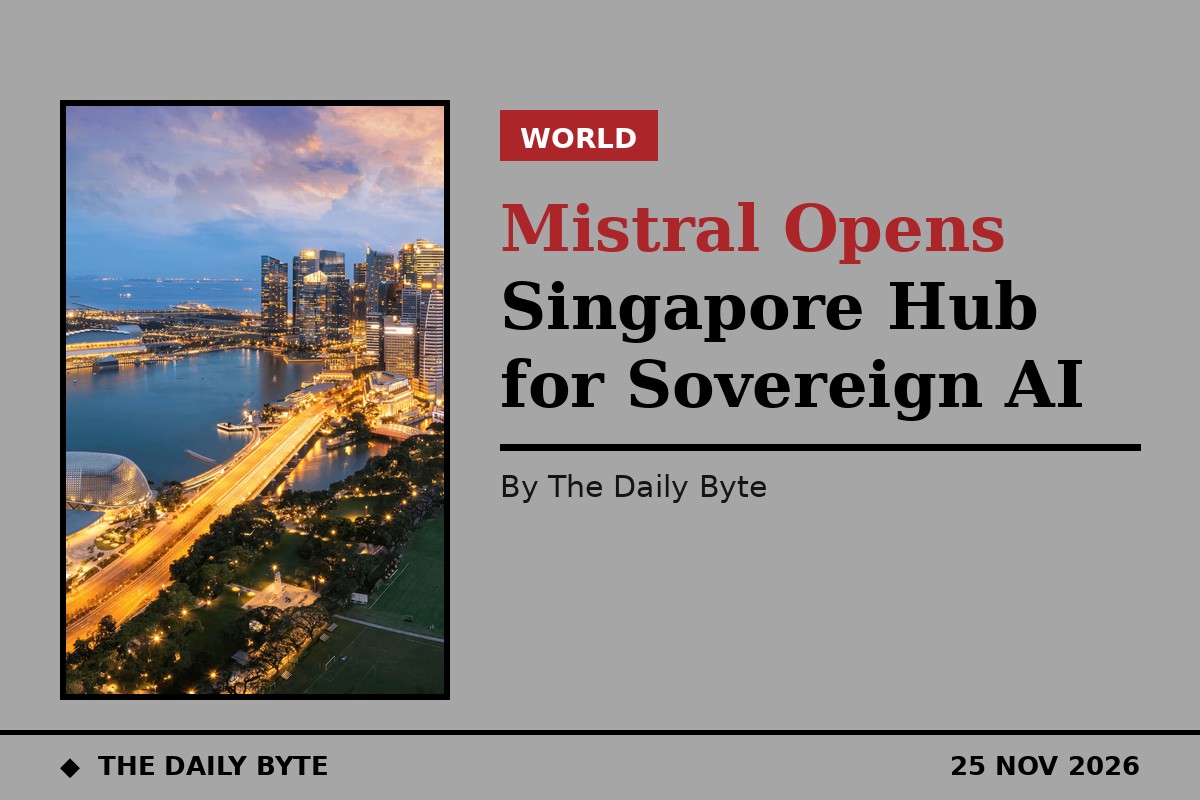
French AI company Mistral has opened its Asia Pacific headquarters in Singapore, setting up a research hub to build sovereign AI models for governments and businesses across the region. The office opened on Friday 20 November at Asia Square Tower 1, and Mistral plans to more than double its regional workforce to 200 people by 2027. Singapore's Economic Development Board, which published Mistral's announcement, says the hub will operate as an extension of the company's Science Hub.
The hub will focus on three areas: the public sector, high-tech manufacturing and robotics. Most of the new hires will work in science, engineering, applied AI and robotics, and Mistral says the office will develop, train and deploy what it calls sovereign AI models. The company already employs more than 900 people worldwide, so a 200-strong Asia Pacific team would be roughly a fifth of its workforce. TechNode reported the opening on 20 November, confirming the headcount target and the three focus areas.
What sovereign AI means in practice
Sovereign AI, as Mistral uses the term, means a government or business keeps control of the AI systems it depends on: where its data is stored, how models are adapted, and who can audit them. The company frames this as control across four dimensions: data sovereignty, intelligence sovereignty, compute sovereignty and operational sovereignty. Its answer is open-weight models, which customers can download, fine-tune and run on their own servers without sending data back to Paris.
Mistral is not arriving cold in Singapore. Its collaborations with DSO National Laboratories, the defence research agency, and with the Home Team Science and Technology Agency, known as HTX, were among its earliest model-customisation partnerships anywhere in the world. With HTX it built Phoenix, the agency's first fully sovereign AI model family, and the two are also working on embodied AI. HTX chief AI officer Ang Chee Wee said the partnership had let the agency ground new technology in operational work on public safety, and that the new headquarters would make collaboration "even more seamless". In robotics, the hub will work on models including Robostral Navigate, an 8-billion-parameter model that lets robots navigate using only a single camera.
Why Singapore, and why now
Singapore has spent years positioning itself as a hub for frontier AI, and Mistral is following OpenAI and Anthropic, which already have offices there, with a bigger commitment: a full regional headquarters rather than a sales outpost. Pee Beng Kong, executive vice president at the Economic Development Board, said the investment would strengthen Singapore's position as a hub for frontier AI innovation and create opportunities for Singaporeans to work on cutting-edge technology.
The timing is pointed. New US rules that took effect on 19 November require licences for exports of certain advanced AI chips to Singapore and four other countries, a reminder that access to computing power is now a matter of trade policy as well as engineering. Mistral's pitch is that open-weight models plus local deployment give governments a way through that squeeze. Its chief executive and co-founder, Arthur Mensch, said the ambition was to establish Singapore as a strategic location for empowering governments and enterprises across Asia Pacific "to retain ownership of their infrastructure and intelligence, and translate these into lasting economic value and industrial competitiveness". Whether that promise holds will depend on what the Singapore hub actually ships, but the hiring target and the defence and public-safety partnerships give it a concrete base to build from.