Morocco Mobilises MAD 22bn for Defence Industry
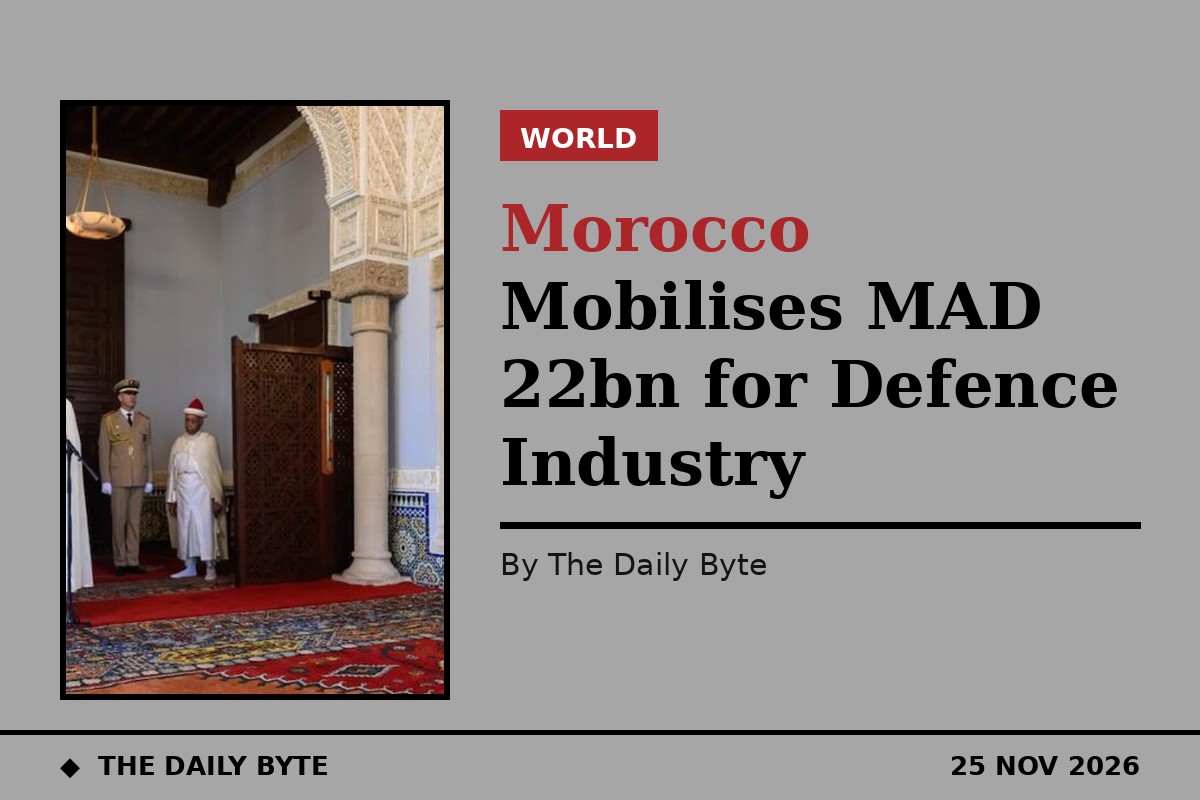
Morocco has moved its plan to build a home-grown defence industry from a roadmap into signed financing deals, with nearly MAD 22 billion (about $2.2 billion) of public backing mobilised. King Mohammed VI chaired the signing ceremony at the Royal Palace in Rabat on Wednesday, 25 November, where the government signed two framework agreements covering the financing of the sector's development roadmap and the mobilisation of Morocco's private and financial sectors behind it.
The first agreement brings together the ministries responsible for the interior, economy and finance, industry and national defence administration, alongside the Moroccan Agency for Investment and Export Development (AMDIE), the Caisse de Dépôt et de Gestion, the Hassan II Fund for Economic and Social Development and Mohammed VI Polytechnic University. The second extends the framework to the financial sector and business organisations, including Bank Al-Maghrib, the Professional Grouping of Moroccan Banks, the General Confederation of Moroccan Enterprises (CGEM), the Moroccan Capital Market Authority, the Casablanca Stock Exchange and the Moroccan Association of Capital Investors.
Ali Seddiki, director general of AMDIE, told the ceremony that public-sector mobilisation for the project had reached about MAD 22 billion. The figure sits alongside a MAD 4 billion contribution from the Hassan II Fund announced when the King chaired a working session on the roadmap on 18 November, although the exact relationship between the two figures has not been spelled out in the material released so far.
What the strategy aims to deliver by 2035
The roadmap, known as "Offre Maroc", sets three headline targets for 2035: meeting about 40 percent of the equipment needs of the Royal Armed Forces and security services through domestic production; generating at least MAD 50 billion in annual sector revenue, with more than 65 percent expected to come from exports; and creating around 50,000 direct and indirect jobs.
The plan prioritises drones and autonomous systems, land and naval systems, defence electronics, cyberdefence and artificial intelligence. A new agency, the Defense Industry Facilitation and Acceleration Agency (DIFAA), has been created to run the strategy, promoting investment, managing support programmes and helping to develop a domestic industrial base. It will also deploy policy tools including industrial offsets, public procurement, land allocation, skills development and innovation support, according to the royal palace statement.
Morocco's push comes from a low base. The country was Africa's largest arms importer over 2021-2025, according to Stockholm International Peace Research Institute data, and operates one of the continent's largest military drone fleets. The strategy is designed to cut that reliance on imports while building an export industry.
Zones, laws and early projects
The legal groundwork predates the roadmap. Law No. 10.20, promulgated in 2020, sets the conditions for manufacturing defence and security equipment in Morocco, including a requirement for Moroccan majority ownership of authorised companies, subject to possible exemptions. Two defence industrial acceleration zones already exist, and the roadmap adds new zones at Benguerir and Benslimane, alongside a specialised training academy.
Early projects show the direction of travel. India's Tata Advanced Systems is working with Morocco to manufacture WhAP 8x8 armoured vehicles in Berrechid, with a gradual increase in locally sourced components, and Moroccan company MMI is involved in making military turrets and remotely operated weapon systems.
For now, the targets remain projections rather than results. The information released at the ceremony does not detail the composition of the MAD 22 billion envelope, the conditions companies must meet to draw on it, or any confirmed export contracts. Whether the agreements turn investor interest into factories and orders will depend on the financing terms, procurement rules and technology-transfer deals that follow. Reuters reported the signing ceremony and the MAD 22 billion figure, while Diplomatique set out the two agreements and the 2035 targets in detail.