Mouldy Flats for Vulnerable Sold as Ethical Deals
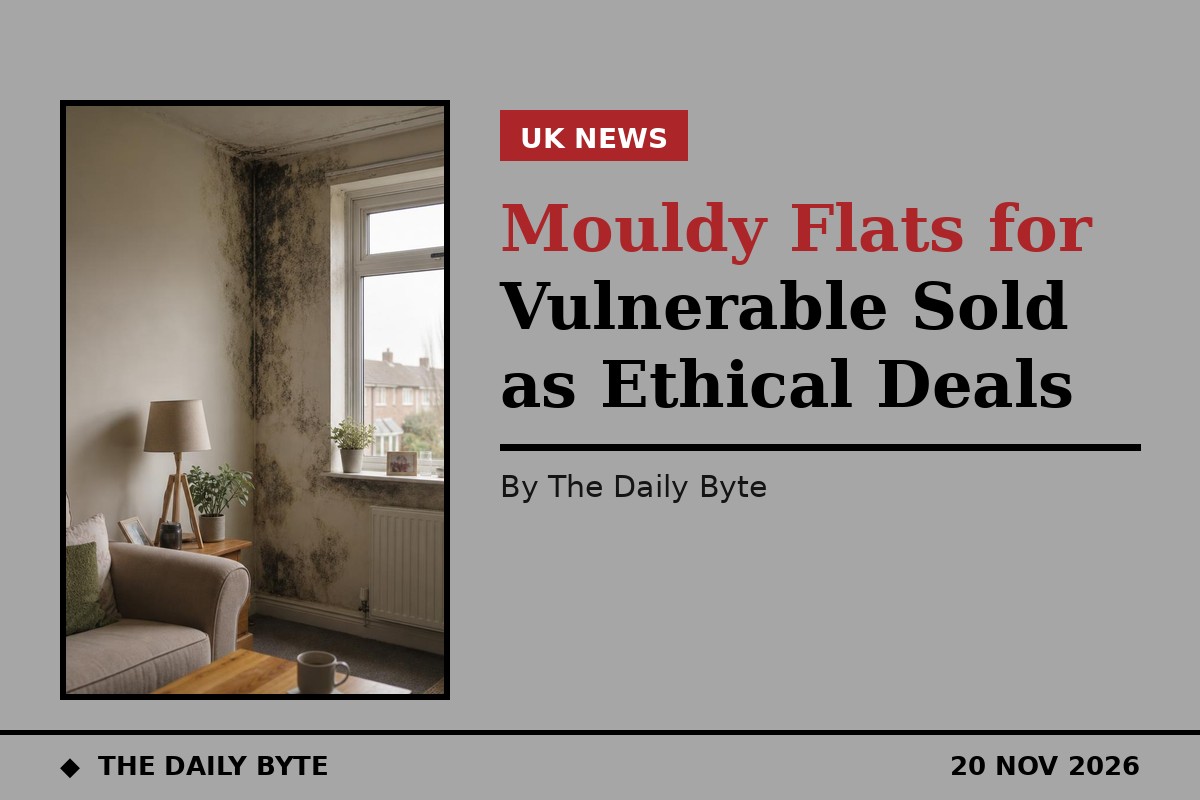
Mouldy, rat-infested flats housing vulnerable people are being sold to overseas investors as "government-backed" ethical investments, a BBC investigation has found.
The BBC found more than 40 companies marketing supported housing properties to buyers in the UK and abroad, including in Asia, Africa and Europe, as businesses profit from a government system meant to house and support vulnerable people.
"This building is hell on Earth," said Phil, describing the black mould and rats at Castleview House, a block of flats in Runcorn, Cheshire, where he lives. Yet to an estate agent in the Czech Republic, the flat he rents through his benefits was an exciting business opportunity.
Marketing material from the agent, Britské Reality — British Real Estate in English — described the flat as a government-funded source of income, where tenants were taken care of and the property was in excellent condition. A Czech investor, Jan Hála, bought it in May 2025 for £163,150, more than double the £75,000 cost of similar apartments in the block. Phil had no idea his home had been sold until the BBC contacted him.
How the system works
The flats are advertised as supported accommodation, housing for people with mental health or drug problems, and people fleeing domestic violence. Providers offering what is known as supported exempt accommodation can charge the taxpayer more than the usual housing benefit cap, because they have higher running costs. Tenants are entitled to care, support and supervision, although how much is not defined.
About a dozen of the companies found by the BBC work with property developer Lee Jones, whose company sold Phil's flat. Jones's firm, The Investment Room, converted Castleview House from an office block into more than 200 flats in 2019, then partnered with Nurture Housing Association, granting it a 25-year lease on some flats to house people on benefits. Jones has a close business relationship with Nurture's chief executive, Chris Smith.
"Total dishonesty"
Marketing material for investors said Nurture was providing "specialist supported housing". According to the Regulator of Social Housing, that would mean a high level of care, equivalent to living in a care home. But Nurture had not been registered as a specialised supported housing provider, and the regulator said its claim was "shocking".
In a statement, Nurture acknowledged that Castleview House is managed under a "general housing management model" and does not form part of its supported housing portfolio. It said the Czech advert related to "historic marketing material" produced by third parties.
Phil, who has severe depression and anxiety, said he had never been sectioned under the Mental Health Act, despite marketing material claiming residents received aftercare under section 117 of the Act, and had never had any support or care from Nurture. "Whoever marketed this property, the way they've worded it is total dishonesty," he said.
Jones told the BBC the properties his companies provide are "good quality accommodation" and that he has no responsibility for the communal areas of Castleview House since he sold the freehold in 2021. He denied his relationship with Smith amounted to a conflict of interest. Hála and Britské Reality did not respond to requests for comment.
"No-one is directly accountable"
In Cricklewood, north London, Mo, who has mental health issues, was housed in a studio flat after becoming homeless. The converted house containing his flat was bought by Gemelli London 2 Limited for £1.83 million in January last year. Mo says his provider, Windrush Alliance, receives nearly £2,000 a month via Barnet Council for the flat, while he receives £340 in universal credit and must pay Windrush a £120 monthly service charge out of that. Last year his ceiling collapsed after a leak went unrepaired for more than a year.
In Bradford, the BBC visited City Exchange and Colonnade House, two former office blocks Jones has converted into housing, where residents showed reporters cockroach infestations, faulty fire alarms, broken lifts, leaks and black mould.
Labour MP Abena Oppong-Asare, who chairs the Housing Select Committee, said it was "outrageous" that supported housing properties were being marketed as investments "particularly where there's public funds involved". She added: "The way that the current system works is there's different levels of involvement by different organisations and companies and no-one is directly accountable."
None of the companies or individuals involved are breaking the law, but critics say they are exploiting a lack of regulation. Three years after the Supported Housing Act was passed in England, which would license providers and give councils powers to shut down failures, it still has not been implemented. Jasmine Basran, head of policy and campaigns at housing charity Crisis, said it had "taken too long" and described the sector as showing "the worst kind of exploitation".
Sources: BBC News investigation via Finwire; EuropeSays.


