NZ Asbestos Play Sand Report Exposes Safety Failures
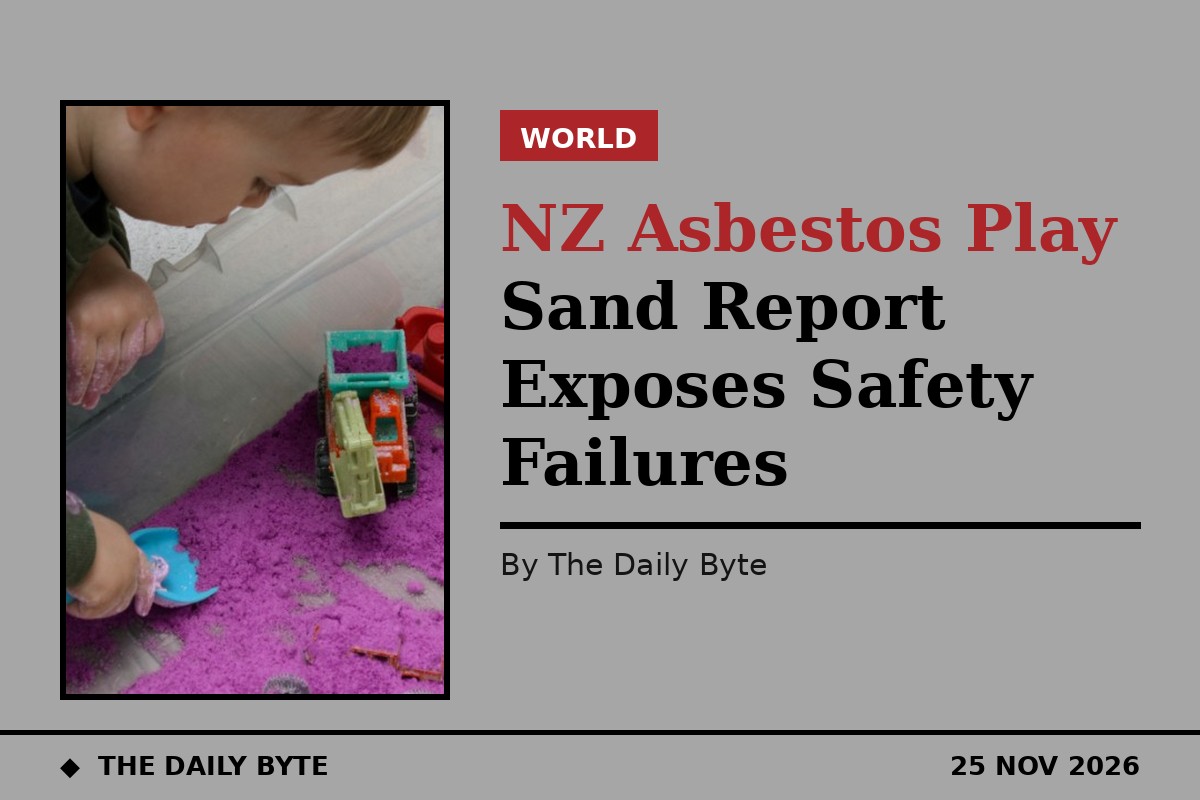
Eight tonnes of coloured play sand contaminated with asbestos has been sold in New Zealand over the past decade, and not a single business has faced a penalty, according to a Consumer NZ report released on Wednesday, 25 November. The report exposes serious gaps in the country's product safety system.
Coloured play sand is manufactured from crushed rock, and some of that rock contains naturally occurring asbestos veins. By law, businesses must ensure goods are safe before they go on sale, but there is no compulsory asbestos testing for coloured play sand in New Zealand, and Customs has stopped only one lot of asbestos-contaminated products in 10 years, a shipment of crayons.
The problem was discovered by chance. A laboratory found unfamiliar fibres in coloured sand during routine work and sent it for more sensitive testing. When the finding was discussed on an industry podcast, Robert McAllister of the Faculty of Asbestos Management of Australia and New Zealand alerted WorkSafe. Further tests found tremolite asbestos in four Kmart sand products. The first voluntary recall notice was published by the Ministry of Business, Innovation and Employment on 15 November 2025, and there have been 25 recalls for coloured play sand since then.
The 'low risk' wording nobody signed off
Recall notices have repeatedly described the risk as low, but Consumer NZ found that wording was never signed off by a health official or risk assessor. In a voluntary recall, the business managing the recall writes the notice, including the hazard statement, and the ministry publishes it but cannot rewrite it.
Kmart's recall notice told customers the risk of asbestos becoming airborne was low. That wording traces back to an Australian recall, where lab testing was reviewed by an assessor who never saw or tested the sand. Internal emails released under the Official Information Act show ministry officials were uneasy about the guidance, with one asking whether Kmart could be made to say it was its own advice, not a universal truth.
Five days after the first Kmart recall notice, WorkSafe told Kmart in writing that the sand was friable, because it could be crumbled by hand, and that recalled sand required Class A asbestos removal.
Health officials privately unsure of the risk
Health New Zealand says there is no safe level of asbestos exposure, and related disease can take 15 to 40 years to appear. About 220 people die from asbestos-related diseases in New Zealand each year, similar to the annual road toll. Yet internal documents show health officials privately said they could not determine a level of risk, and on 27 November 2025 the Ministry of Health's own advisory group stated there was no consensus on the risk because there was not enough data.
On 11 December 2025, toxicologist Professor Ian Shaw and law professor Alex Sims published a briefing recommending regular health monitoring for exposed children. Records show that on 13 January 2026, Chief Science Advisor Dr Ian Town emailed Chief Medical Officer Dr Joe Bourne, calling the briefing unhelpful and writing that he had managed to get them to change the advice. There is still no monitoring programme planned for people exposed to the recalled sand.
Testing led by AUT's Dr Terri-Ann Berry in July found asbestos fibres could become airborne during simulated play with some of the sand tested. Christchurch parents Elle Chrisp and David Dingwall, who bought coloured sand for their twins, took Kmart to the Disputes Tribunal, which in August ordered the retailer to pay $15,185.42 for testing, relocation, replacement items and remediation.
Reform is coming, but slowly
None of the suppliers whose play sand tested positive held the permit required to import asbestos-containing products, making them illegally imported. On 18 June, the Commerce Commission opened an investigation into play sand; no enforcement outcome has yet been made public.
In October, the government issued an unsafe goods notice introducing mandatory pre-sale asbestos testing for toys and craft products containing sand, in force from 1 February 2027 for 18 months. Consumer NZ called it a step forward but narrow, and warned the contamination is likely broader than found, since manufactured sand is used in paperweights, toys and doorstops. In Australia, CHOICE urged shoppers to avoid craft and play sand products this Christmas.
FAQ
How much contaminated play sand was sold? Eight tonnes in the past decade, Consumer NZ says, with 25 recalls since November 2025.
Is there a safe level of asbestos exposure? Health New Zealand says there is no safe level; related disease can take 15 to 40 years to appear.
What should people do with recalled sand? Wear gloves and a mask, seal it in a plastic bag and take it to a tip that accepts asbestos waste. Mandatory pre-sale testing begins on 1 February 2027.