Watchdog Finds Defra Breaking Law on Wild Birds
The government is breaking the law by failing to protect Britain's wild birds, the environmental watchdog has ruled, as bird numbers fall to their lowest level on record. The Office for Environmental Protection (OEP) confirmed on Wednesday 18 November that the Department for Environment, Food and Rural Affairs (Defra) and Natural England are failing to meet their legal requirements to protect wild birds.
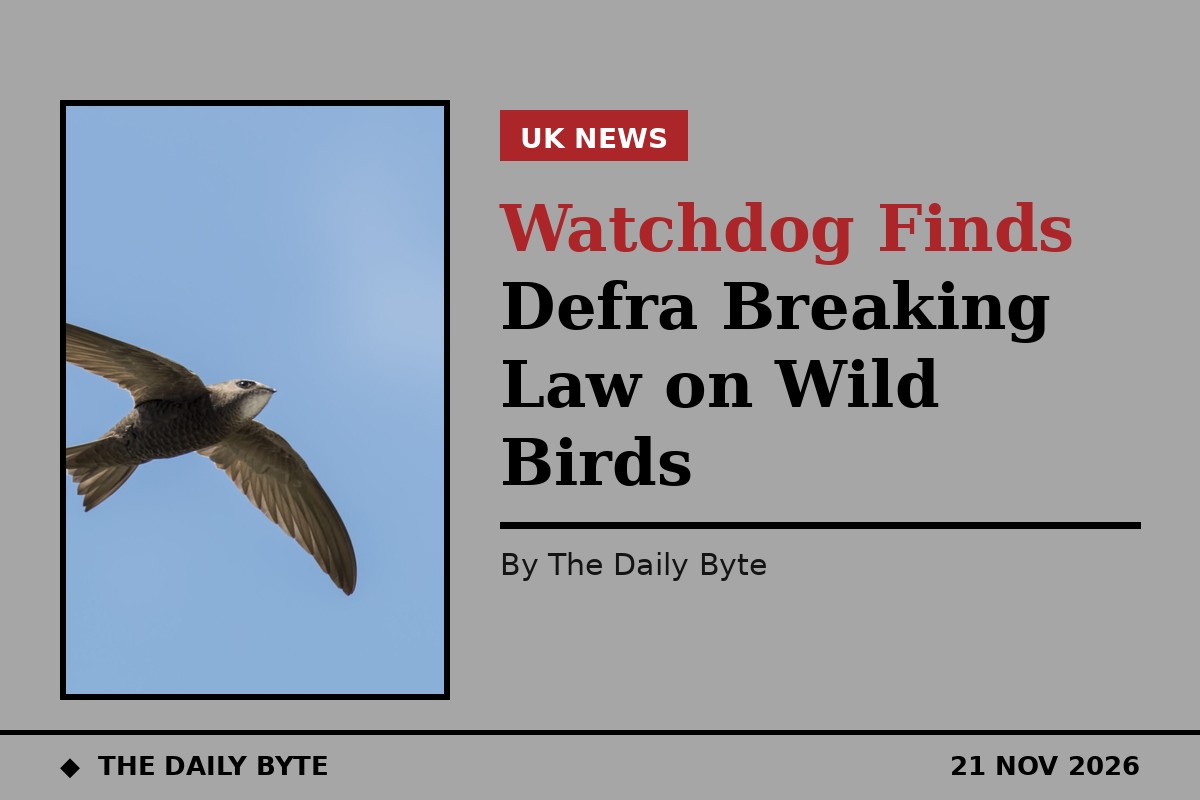
Latest statistics show that UK wild bird populations have dropped to their lowest level on record, with 45% of the 132 native breeding species in decline over a five-year period. In the last five decades, Britain has lost more than 73 million wild birds from its landscape, according to the British Trust for Ornithology. Among the species in decline are swifts, turtle doves, tree sparrows, wood warblers and bullfinches.
Protected sites left waiting since 2001
The OEP has issued Defra and Natural England with decision notices setting out where they have failed to comply with environmental law and what action they must take to meet their legal obligations. In part, the failures relate to measures recommended as far back as 2001 to make sure the network of Special Protection Areas is sufficient, which remain unimplemented.
Ministers have legal responsibilities to take action to recover bird populations to healthy levels, as well as specific duties to designate Special Protection Areas, where birds and their habitats are legally protected. The watchdog found that the Environment Secretary, Angela Eagle, has failed to classify new protected areas, extend existing sites or add species to those that are protected, and has failed to take the action required to maintain or restore wild bird populations to appropriate levels and ensure they have sufficient habitat.
Natural England, the government's independent nature adviser, was also found to be in breach of environmental law. The watchdog said it had failed to take the action needed to maintain or restore wild bird populations and help them recover, and had not carried out a review of whether there is sufficient habitat for wild birds across England, a duty that came into force in 2012.
Deeply concerning declines
Helen Venn, the OEP's chief regulatory officer, said: "As a nation of bird-lovers, and with birds acting as important indicators for the state of our nature more widely, the latest statistics showing declines in the populations of some of our most treasured species are deeply concerning. This is why it is important that Defra and Natural England do carry out their legal responsibilities in a reasonable timeframe to deliver nature recovery and in relation to the classification and adaptation of SPAs on land."
She added: "Continued delay has left a significant number of sites for wild bird populations without the levels of protection they need and allowed the scale of the actions needed to deliver a sufficient SPA network to build up."
The OEP concluded in June 2025 that there may have been failures to comply with environmental law and issued Defra and Natural England with information notices setting out its findings. The decision notices are the next step in the investigation. Defra and Natural England have two months to respond, and the OEP will consider their responses before deciding its next steps. If the matter is not resolved, the watchdog can take it to court.
Northern Ireland also found in breach
In a parallel investigation, the OEP also found that Northern Ireland's Department of Agriculture, Environment and Rural Affairs (DAERA) has failed to comply with environmental law, and called on it to take steps to help wild birds. Its minister, Andrew Muir, said the findings "make for uncomfortable reading".
Conservationists welcomed the watchdog's move and said they expected to see urgent action, including the designation of new and extended Special Protection Areas and measures for species such as curlews, bitterns and hen harriers, which they said were most in need of help. The government is legally bound to expand and increase protected areas by 2030 as part of its commitment to protect at least 30% of land and seas for nature's recovery, but despite repeated promises, wild bird populations across the UK are showing no sign of widespread recovery.