Ofqual warns pupils using AI in coursework risk losing their whole GCSE or A-level
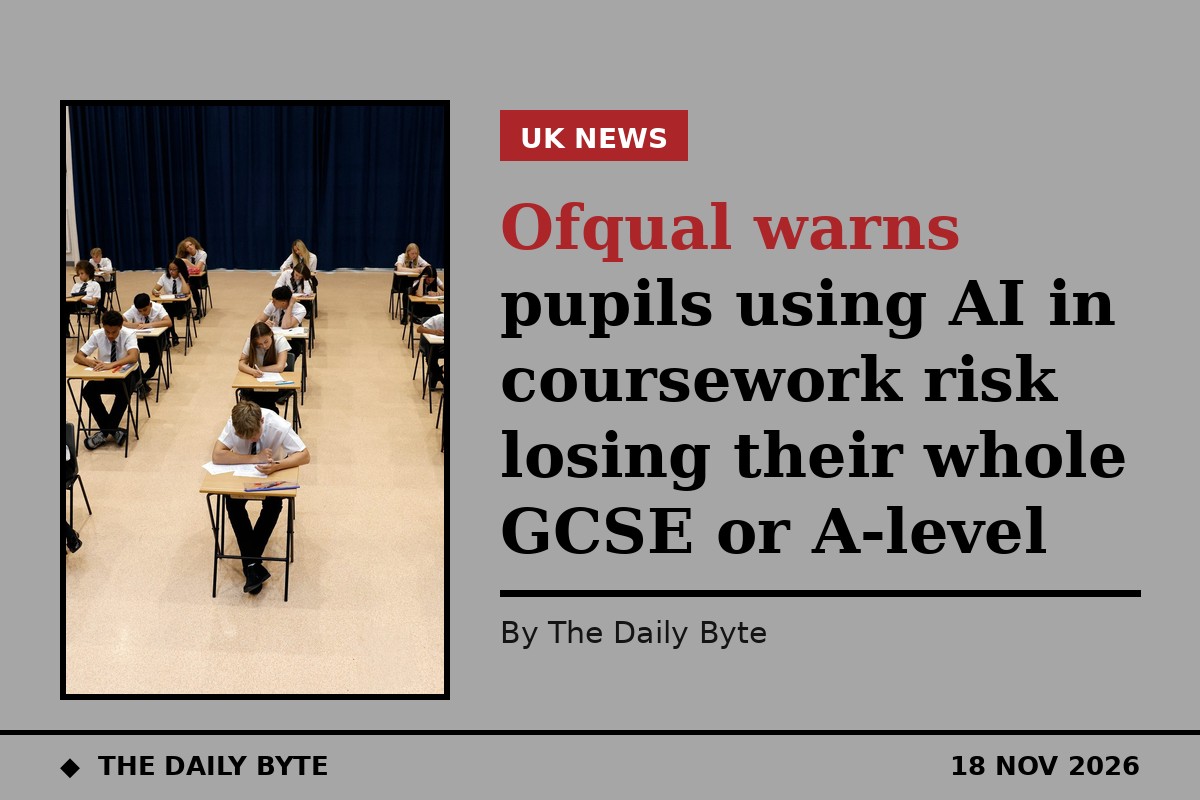
Students in England who use artificial intelligence to produce GCSE or A-level coursework and pass it off as their own risk losing the entire qualification, the head of England's exams regulator has warned, describing the possible consequences as "life-altering".
Sir Ian Bauckham, chief regulator at Ofqual, said pupils could be disqualified from GCSEs, A-levels and other qualifications if they try to use AI in assessed coursework without declaring it. Ofqual is launching a publicity campaign aimed at secondary school pupils as coursework submission deadlines approach, making clear that undeclared AI use will not be tolerated.
Speaking at the Schools and Academies Show in Birmingham on Wednesday 18 November, Sir Ian also warned that pupils can cheat in supervised exams through wearable technology and micro-devices, and called for retailers to be stopped from marketing such products explicitly for exam cheating.
What counts as cheating
Using AI as a source can be acceptable when it is properly referenced, according to the Joint Council for Qualifications, which represents the exam boards. But work produced by AI and presented as a pupil's own is malpractice, and even honestly declared AI use earns no marks, because the pupil has not met the marking criteria on their own.
Pupils sign a declaration that their coursework is their own work, and making a false declaration is itself a malpractice offence. Penalties under the exam boards' rules range from a warning and loss of marks to disqualification from a subject or from all exams in a series, and being barred from entering exams for a set period.
"If you are caught committing malpractice with an important, high-stakes qualification - an A level or a GCSE or any other qualification - in extreme cases you can lose the entire qualification, which, as I am sure you can imagine, can be life-altering for somebody's future," Sir Ian told the Press Association.
The scale of the problem
Ofqual recorded 100 proven cases of plagiarism involving AI misuse in GCSE, AS and A-level qualifications in England in summer 2025, up from 85 in 2024. Those 100 cases represented 75 per cent of all student plagiarism cases last summer.
The regulator also recorded 2,225 cases of cheating involving smart devices and mobile phones during the summer 2025 exam season. Sir Ian said detecting AI misuse in coursework was going to become more difficult as artificial intelligence gets better at covering its own tracks, and that teachers remain the most powerful defence because they can tell when coursework does not match a pupil's previous work.
A survey of more than 4,500 teachers in England, carried out by Teacher Tapp earlier this month for Ofqual, found that 70 per cent do not think unsupervised written coursework should count towards final GCSE and A-level grades, and 83 per cent think it should be carried out with greater supervision or other controls.
Coursework could be redesigned
Sir Ian said Ofqual was looking to strengthen the design of assessment in some qualifications, such as English and history A levels, where there is unsupervised written coursework. Options include greater supervision of non-exam assessments, a greater emphasis on referencing sources, and linking coursework formally to an examination, written or spoken, to confirm pupils genuinely did the work and understand it.
"We will need a radical rethink of the conditions under which it is done and the design of that coursework to make sure it is secure for the future and remains fit for purpose," he said. "Unsupervised extended essays, with no other forms of assessment associated with them? I'm afraid the time for that is likely to be quite short now."
He has written to exam boards this week to set out his expectation that invigilators be given training on the emerging risk posed by wearable technology ahead of the 2027 exams. "It is completely unacceptable for any retailer, online or otherwise, to market items explicitly for the purpose of exam cheating. This has to be challenged," he told the conference.
Wider context
Education minister Josh MacAlister said last week that smart glasses should not be allowed in school, and the government has launched a consultation on education technology and AI product safety.
The Guardian also reported Sir Ian's warning on 18 November 2026, and the Press Association's account of his remarks was carried by Hot Press Network.
Frequently asked questions
Can pupils use AI at all in coursework? AI can be used as a source if it is properly referenced, but work the AI produced cannot earn marks, and passing it off as your own is malpractice.
What is the worst penalty? In extreme cases a pupil can lose the entire GCSE or A-level qualification, and can also be barred from entering exams for a period.
Does this apply to exams as well as coursework? Yes. Ofqual is also warning about wearable technology such as smart glasses being used to cheat in supervised exams, and invigilators are to be trained to spot the risk ahead of the 2027 exams.
Source: Tes, 18 November 2026.


