Universities told: use AI-free exams or face sanctions
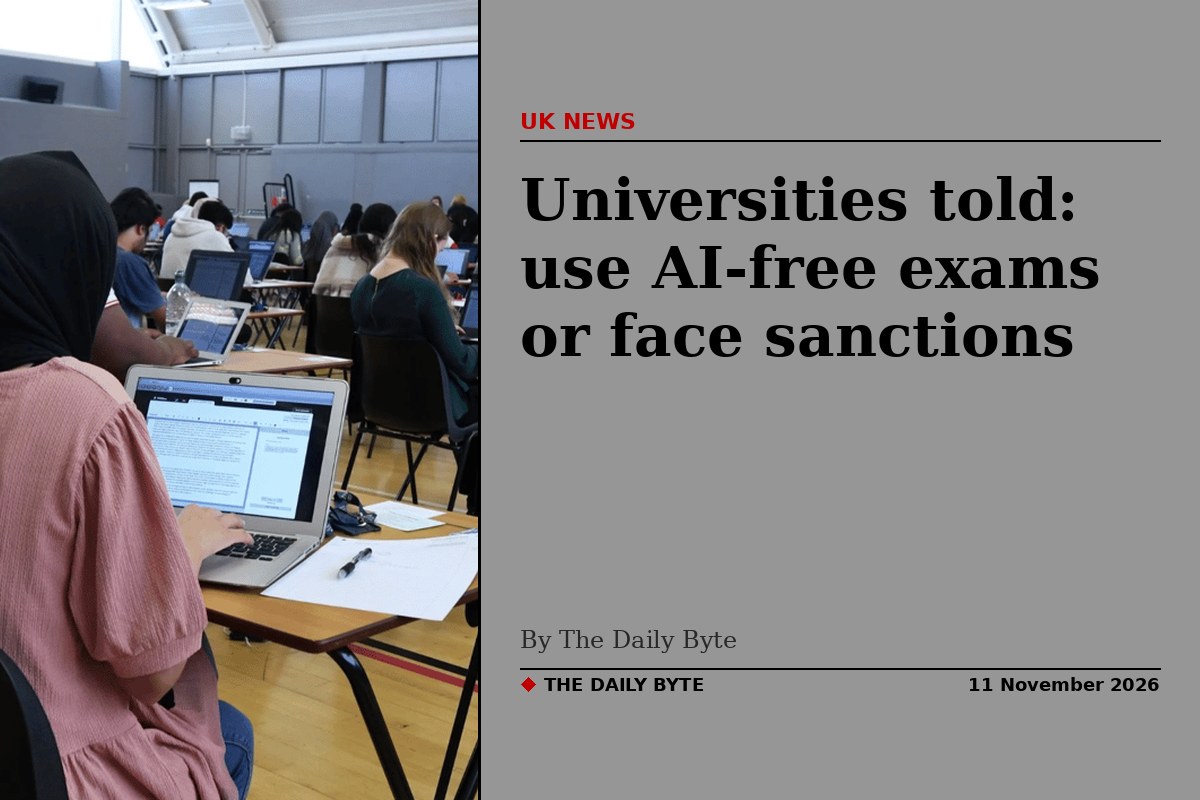
England's universities have been told to bring back far more AI-free assessment, including in-person and closed-book exams, after the higher education regulator warned that artificial intelligence is making it difficult to tell a student's own work from a chatbot's. The Office for Students (OfS) issued the warning on Tuesday 11 November 2026, alongside a joint report with Advance HE, and said institutions that fail to run reliable assessments could face sanctions.
The regulator's message is blunt: degrees must still prove what a graduate knows. Where unsupervised coursework can be completed to a high standard by AI tools, the OfS says universities should redesign the assessment, and in many cases that will mean secure formats that prevent AI use altogether.
What the research found
The report, titled Making AI Work for Students, draws on conversations with more than 300 students and staff at more than 120 universities and colleges. It found that AI use is now widespread on both sides of the lecture hall, and that the old assumption behind take-home coursework no longer holds.
Students told researchers that people they knew had completed assessments using large language models, sometimes in just a few minutes, and received similar grades to classmates who had done the work themselves. Staff said assessments did not consistently and reliably measure students' knowledge and skills, and some students said outright that the assessments run by their institution were not fit for purpose.
The OfS concluded that a significant proportion of assessments in the sector remain in unsupervised, non-controlled formats where students can reach AI tools while completing them. That, it said, poses significant risks to the validity of assessment and to the reputation of higher education as a whole.
What universities must do now
The regulator has published guidance on how its quality conditions of registration apply in the context of AI. Under condition B4, providers must already assess students effectively, with each assessment valid and reliable. The OfS says that will often require secure, AI-free formats such as in-person examinations, presentations, vivas, performance-based assessments, and tasks that ask students to demonstrate knowledge through practical or applied work.
It stopped short of ordering every university to scrap coursework. Where AI use is allowed in an assessment, the rules must be set out clearly through realistic, meaningful and transparent academic regulations. But the direction of travel is clear, and the regulator says it will hold institutions to account when they fall short.
Josh Fleming, the OfS director of strategy and delivery, called AI a generational risk to the system as it stands, threatening to undermine students' learning and institutions' ability to assess them. He said far greater efforts were needed to tackle the risks, including far greater use of AI-free assessment.
What happens if universities fall short
The OfS said it would use its regulatory levers where evidence suggests an institution has not met its requirements. Those levers include imposing specific conditions of registration, monetary penalties, or suspending access to student support funding and OfS grant funding. Concerns picked up through university submissions or other regulatory intelligence could also lead to a lower quality award or a further investigation into the quality of provision.
The warning comes under the regulator's new quality framework, announced last month, which ties assessment standards more tightly to the consequences institutions face. The Department for Education said universities should take the issue seriously and that the regulator should enforce existing standards while making its framework on AI explicit, strong and durable.
What it means for students
For students, the change is likely to mean more time in exam halls and more face-to-face assessment, including oral exams and presentations. Simon Banks, a vice-dean for education at King's College London, told Parliament the day before the report that universities needed to be able to certify students with confidence, but that the return to in-person assessment had to be designed with inclusivity built in from the start rather than added afterwards.
The research also found a split over AI in marking. Students were often critical of AI-generated feedback, saying expert teaching staff were central to what higher education offered. Teaching staff, by contrast, told researchers that AI feedback could be a useful starting point that freed them to spend more time interacting with students.
The OfS and Advance HE both stressed that the aim is not to ban AI from universities. Students see AI literacy as important for their future employment and want more chances to develop those skills. The regulator's argument is narrower: AI should be taught and used openly, but the work that earns a degree must still show what the student personally knows and can do. Sources: Office for Students and Times Higher Education.