Over 323,000 flee homes in four days in South Kivu
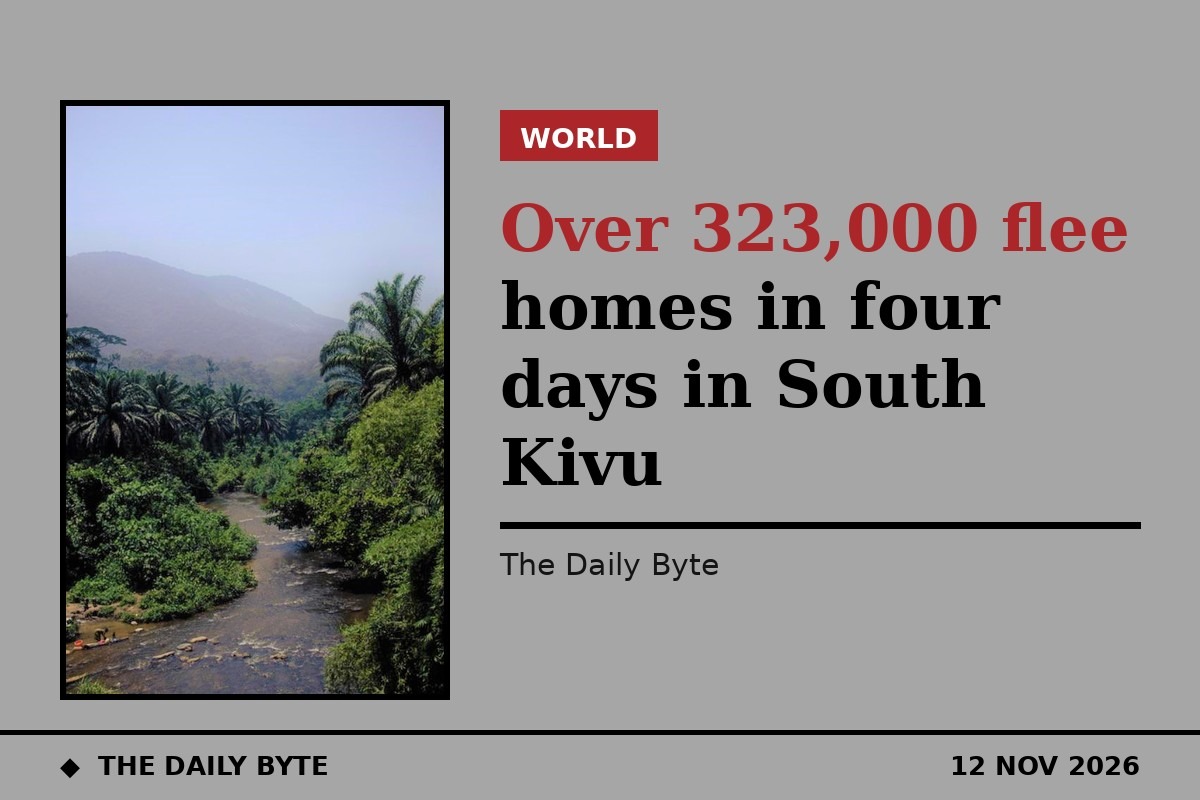
More than 323,000 people fled their homes in just four days in eastern Democratic Republic of Congo as fighting between the Congolese army and fighters of the Front for the Refoundation of the Nation (FRN) swept through parts of South Kivu province, the United Nations has said.
Preliminary estimates published by the UN Office for the Coordination of Humanitarian Affairs (OCHA) on Wednesday put the number of displaced people at more than 323,000, or about 54,000 households, in the territories of Kalehe and Kabare between 6 and 9 November, according to QNC News.
The violence began along the Miti-Civanga-Kalonge-Bunyakiri axis before spreading to Bitale, Cifunzi, Kalonge and Bulambika. On Saturday 7 November the FRN seized Kalonge and Bitale, the first village of Kalehe beyond Kahuzi-Biega National Park on national road 3, the route that links Bukavu to Kisangani through Walikale. Local sources cited in the humanitarian reporting said at least five civilians were killed at Bunyakiri as the fighting reached the area.
The FRN is a political and military movement led by former Congolese president Joseph Kabila, and its advance marks a sharp new escalation in a province that already hosts well over a million displaced people from earlier rounds of conflict.
Army says advance has been halted
The Congolese armed forces, the FARDC, said in a communiqué signed by spokesman General Sylvain Ekenge on 11 November that their troops had halted the advance at Bulambika and recovered several positions. The army said a counter-offensive was being prepared, according to reporting by DefenceMENA, which drew on RFI and Congolese outlets.
Reports differ on the exact sequence of events, and the FARDC disputes how much ground was lost. RFI, citing Congolese military sources, reported that FRN fighters moved through Kahuzi-Biega National Park before seizing localities on the RN3 road. Other local sources put the rebel advance at around 50 to 60 kilometres.
The territorial administrator of Kalehe, Thomas Bakenga, told RFI that more than 160,000 people had been displaced, some towards Hombo on the boundary between South and North Kivu and others into the forest. That earlier figure was more than doubled by the UN estimate published on Wednesday, and officials caution that the numbers remain preliminary and could change again as assessment teams reach areas that are still cut off.
No aid has reached the displaced
Humanitarian access to the displaced has been cut off. The main supply routes serving the area, the Miti-Civanga road and the Hombo-Bulambika road, were closed, and the United Nations said that as of 11 November no humanitarian assistance had yet reached the people who fled.
The priority needs identified for the displaced are emergency shelter and household items, food assistance, clean water and sanitation, health care, nutrition and protection. With families sheltering in the open and in overcrowded host communities, aid agencies warn of heightened risks of disease and protection abuses if access is not restored quickly.
The latest displacement adds to a humanitarian crisis that has already overwhelmed eastern Congo. South Kivu alone hosted nearly 1.5 million internally displaced people before this escalation, and the new fighting has forced families who had already fled earlier violence to move again. Sources: QNC News and DefenceMENA.