Pakistan Mobile Phone Imports Fall 7.2% to $598 Million
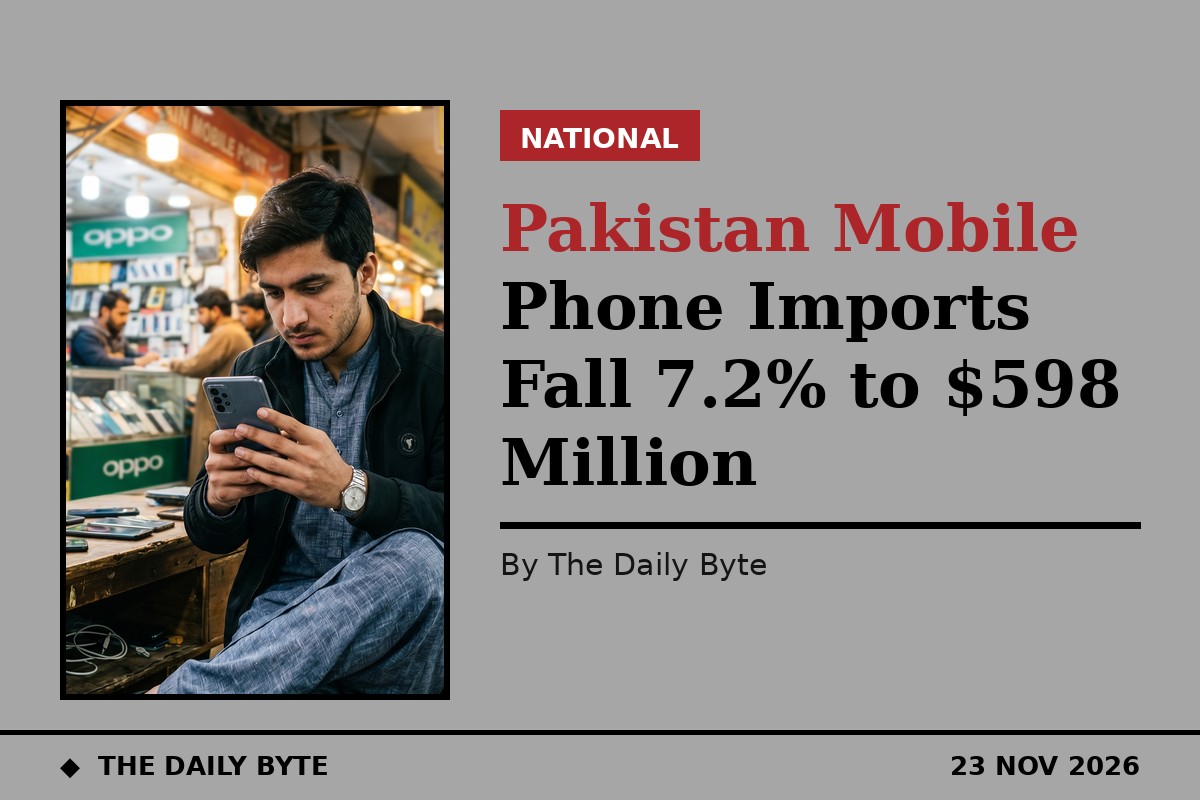
Pakistan spent less on imported mobile phones in the first four months of the current financial year, even as local factories assembled far more handsets than the country imported. Official trade data reported on Monday, 23 November 2026, put the July to October mobile phone import bill at $598.147 million, down 7.2 per cent from $644.574 million in the same period last year.
In rupee terms the fall was steeper. The four-month bill came to Rs166.205 billion, down 8.74 per cent from Rs182.117 billion a year earlier, according to the figures published by the Pakistan Bureau of Statistics and reported by Business Recorder. The numbers cover the first four months of fiscal year 2026-27, which runs from July to June.
October brought a sharp rebound
The four-month decline hides a very different October. Mobile phone imports in October alone reached $181.006 million, up 26.54 per cent from $143.046 million in September and up 25.21 per cent from $144.56 million in October 2025. In rupees, October imports were Rs50.22 billion, up 26.42 per cent on September and 23.39 per cent on a year earlier.
That monthly jump is the main reason the four-month fall is as small as it is. In the first quarter alone, from July to September, the import bill had fallen 16.6 per cent to $417.24 million. October's surge narrowed the gap, and it leaves open the question of whether buyers were restocking ahead of the winter shopping season or simply catching up after a quiet September.
Local assembly now dwarfs commercial imports
The other half of the story is what Pakistan makes itself. Local manufacturers and assembly plants produced 23.03 million handsets from January to October 2026, according to Pakistan Telecommunication Authority data cited in the coverage. Over the same ten months, only about 3.85 million devices came in through commercial imports.
The gap shows how far the balance has shifted. A few years ago Pakistan relied heavily on imported handsets; today most phones sold in the country are assembled locally, often from imported parts. That does not mean imports have stopped mattering. High-end models are still largely imported, and the import bill is measured in value, not in the number of handsets, so a shift towards pricier models can push the bill up even if fewer phones arrive.
The wider telecom import picture
Mobile phones are only part of the telecom import bill, and the wider picture moved in the opposite direction. Overall telecom equipment imports rose 7.30 per cent to $932.753 million in July to October, up from $869.27 million a year earlier. Mobile phones alone accounted for about 2.28 per cent of Pakistan's overall import bill of $26.29 billion in the same period.
The figures come from official trade data compiled from the Pakistan Single Window and validated by the Federal Board of Revenue, and they are published by the Pakistan Bureau of Statistics. The October figures are provisional, so the bureau may revise them in its next release, as it has done with earlier months this year.
What the numbers mean for buyers
For consumers, the figures point to a market where locally assembled phones set the pace. Greater local production has kept a wide range of handsets available without a matching rise in the import bill, and the October rebound suggests demand picked up as the year went on. But the value-based figures cannot say whether buyers are choosing more expensive phones or simply buying more of them, so October's rise is not proof on its own of stronger demand.
What is clear is the direction of the four-month trend: Pakistan is spending less on finished imported phones while assembling more at home. If that pattern holds, the import bill will stay under pressure even as the market grows, and the next monthly release will show whether October was a one-off restock or the start of a steadier recovery. TechJuice reported the figures in full, with the underlying data from the Pakistan Bureau of Statistics.