Oman Gives PSO $200m Credit Line for Fuel Imports
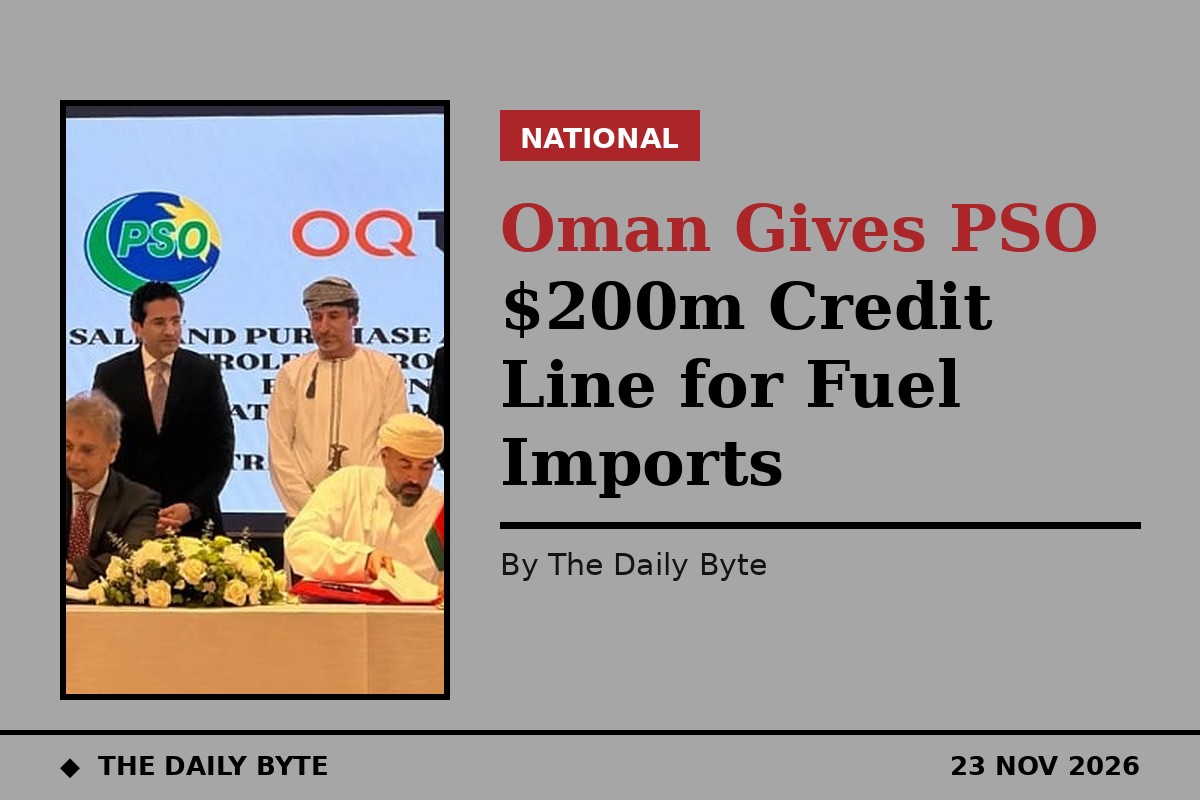
Pakistan and Oman have signed a petroleum supply agreement under which Oman's OQ Trading will extend a $200 million credit facility to Pakistan State Oil, giving the state-owned fuel importer fresh room to finance its purchases at a time of volatility in regional energy markets.
The sale and purchase agreement was signed in Muscat on Sunday, 22 November, between PSO and OQ Trading, Oman's global commodity trading company. Federal Minister for Petroleum Ali Pervaiz Malik and Oman's Minister of Energy and Minerals, Salim Al Aufi, witnessed the signing. The deal was reported in Pakistan on Monday, 23 November.
Under the agreement, OQ Trading will supply petroleum products to PSO and provide a credit limit of $200 million to finance those purchases. The arrangement sets up a structured commercial framework for fuel supplies between the two companies, and is intended to improve PSO's procurement flexibility and the reliability of supplies.
What the deal is meant to do
The agreement was approved earlier by the Economic Coordination Committee under an existing inter-governmental agreement between Pakistan and Oman. Its stated aims are to strengthen bilateral energy cooperation and to diversify the sources of Pakistan's petroleum imports.
The announcement presents the deal as a step towards greater energy security, with supplies arranged through a regular commercial framework rather than negotiated shipment by shipment. Both ministers expressed confidence that putting the agreement into practice would strengthen Pakistan-Oman relations and support Islamabad's efforts to secure its energy supplies from more than one source.
Before the signing, Mr Malik held a meeting with Mr Al Aufi in Muscat to explore ways of strengthening cooperation in the oil, gas and minerals sectors. The two ministers welcomed the establishment of a Pakistan-Oman Joint Working Group on Oil and Gas, and agreed to make effective use of that institutional mechanism to deepen engagement and advance cooperation across the energy and mining sectors.
An existing supplier, now on a formal footing
OQ Trading is not a new supplier to PSO. The Omani company has already emerged as a major gasoline supplier to the Pakistani state-owned company, delivering more than one million tonnes of gasoline during 2026, according to the Petroleum Division.
It has also expanded its presence in Pakistan's liquefied petroleum gas market, supplying both public-sector and private-sector buyers. Its LPG supplies to Pakistan are expected to exceed 120,000 metric tonnes by the end of 2026, reflecting Oman's growing role in meeting the country's energy requirements.
The announcement did not set out the interest rate, tenor, cargo volumes, delivery schedule or first drawdown date for the credit facility, and neither side has published the full text of the agreement. It also said nothing about domestic pump prices, so the deal should not be read as a change to what motorists pay.
The agreement comes as Pakistan's fuel import costs remain high. Pakistan's oil import bill rose 9.34 per cent to $5.63 billion in the first four months of the current fiscal year, July to October, as crude costs increased, according to figures reported on Monday. A credit line that lets PSO spread the cost of its purchases could therefore ease the financing pressure even if it does not change the price of the fuel itself.
For Oman, the deal formalises a trading relationship that has grown steadily through 2026. For Pakistan, it adds a contracted supply route with built-in financing at a moment when regional energy markets remain unsettled. Whether it delivers the promised reliability will depend on how the framework operates once shipments under the new agreement begin.