Pakistan, Portugal Agree Joint Trade Commission
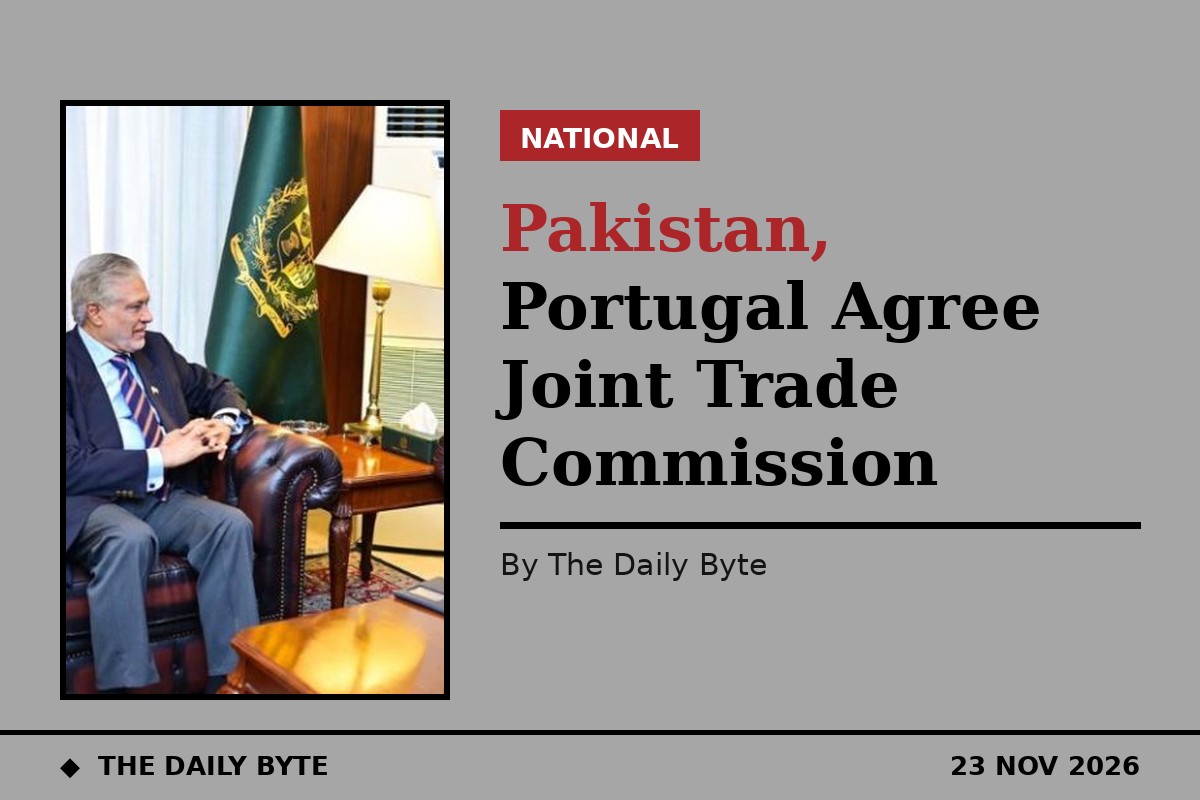
Pakistan and Portugal agreed on Monday to set up a joint ministerial commission to strengthen trade and investment, as Portuguese Foreign Minister Paulo Rangel concluded a two-day official visit to Islamabad with a pledge of Lisbon's full support for Pakistan's preferential EU trade status.
Deputy Prime Minister and Foreign Minister Ishaq Dar and Mr Rangel reached the agreement during delegation-level talks at the Ministry of Foreign Affairs in Islamabad on 23 November. The two countries marked 77 years of diplomatic relations during the visit, the first by a Portuguese delegation to Pakistan in 19 years.
Mr Rangel invited Mr Dar to Lisbon for the inaugural meeting of the new commission, an invitation the Pakistani deputy prime minister accepted. The commission is intended to give the two governments a standing forum for identifying obstacles to bilateral trade, promoting investment and reviewing progress on economic cooperation.
Two agreements signed
The visit also produced two signed agreements. Pakistan and Portugal agreed to exempt holders of diplomatic passports from visa requirements, a step intended to ease official visits and high-level engagement. They also signed an investment protection agreement between Pakistan's Board of Investment and Portugal's trade and investment agency, AICEP, to encourage closer business partnerships.
Mr Dar proposed holding the Pakistan-Portugal Business Forum on a regular basis so companies from both countries can identify trading partners and explore joint ventures. A business forum held on the sidelines of the visit brought together around 20 Portuguese companies to explore trade and investment opportunities, with business-to-business meetings covering agri-food, renewable energy, pharmaceuticals, information technology and textiles.
The two sides agreed to pursue cooperation across a wide range of sectors, including agriculture, olive cultivation and value addition, textiles, tourism, renewable energy, information technology, labour mobility, education, maritime connectivity and cultural exchanges. Mr Dar also called for stronger parliamentary exchanges, including a Pakistan-Portugal parliamentary friendship group.
GSP+ backing ahead of 2027 renewal
Portugal's support for Pakistan's Generalised Scheme of Preferences Plus (GSP+) status was a central theme of the talks. Mr Rangel told a joint press conference that Portugal gave Pakistan its full support on GSP+, and that the two countries could strengthen their engagement within the wider Pakistan-European Union relationship.
The assurance matters because Pakistan's current GSP+ arrangement is due to expire in 2027, after which Islamabad will seek renewal. An upcoming GSP+ monitoring mission will examine Pakistan's record under the 32 international conventions tied to the trade scheme, and Mr Dar thanked Portugal for its support while reaffirming Pakistan's commitment to meeting its obligations under the framework.
Pakistan also welcomed Portugal's support for its membership of the International Olive Council, and the two sides discussed cooperation on olive cultivation and processing as a practical area for agricultural trade.
Wider diplomacy and the UN
Mr Rangel also called on President Asif Ali Zardari and Prime Minister Shehbaz Sharif during his stay. At the Foreign Office, he praised Pakistan's role as a member of the United Nations Security Council and its efforts to promote peace, including on the Middle East, Gaza and Palestine, and described Pakistan's diplomatic engagement and mediation efforts as valuable contributions to international peace.
Portugal takes up its seat as a non-permanent member of the UN Security Council in January 2027, and the two sides agreed to keep in close consultation during its two-year term on the Council. They also agreed to strengthen coordination at multilateral forums more broadly.
Mr Rangel praised the Pakistani community in Portugal as dynamic and well integrated, and said his country wanted to deepen people-to-people and cultural ties. Mr Dar highlighted the role of the Special Investment Facilitation Council in supporting foreign investment and invited Portuguese companies to explore opportunities in Pakistan.
The commission, the business forum and the two signed agreements give the relationship a practical structure it has lacked. Whether that structure produces measurable trade growth will depend on the inaugural commission meeting in Lisbon and on the follow-up business contacts the two governments have promised to track through bilateral political consultations.