Pakistan, Türkiye Sign Judicial Cooperation MoU
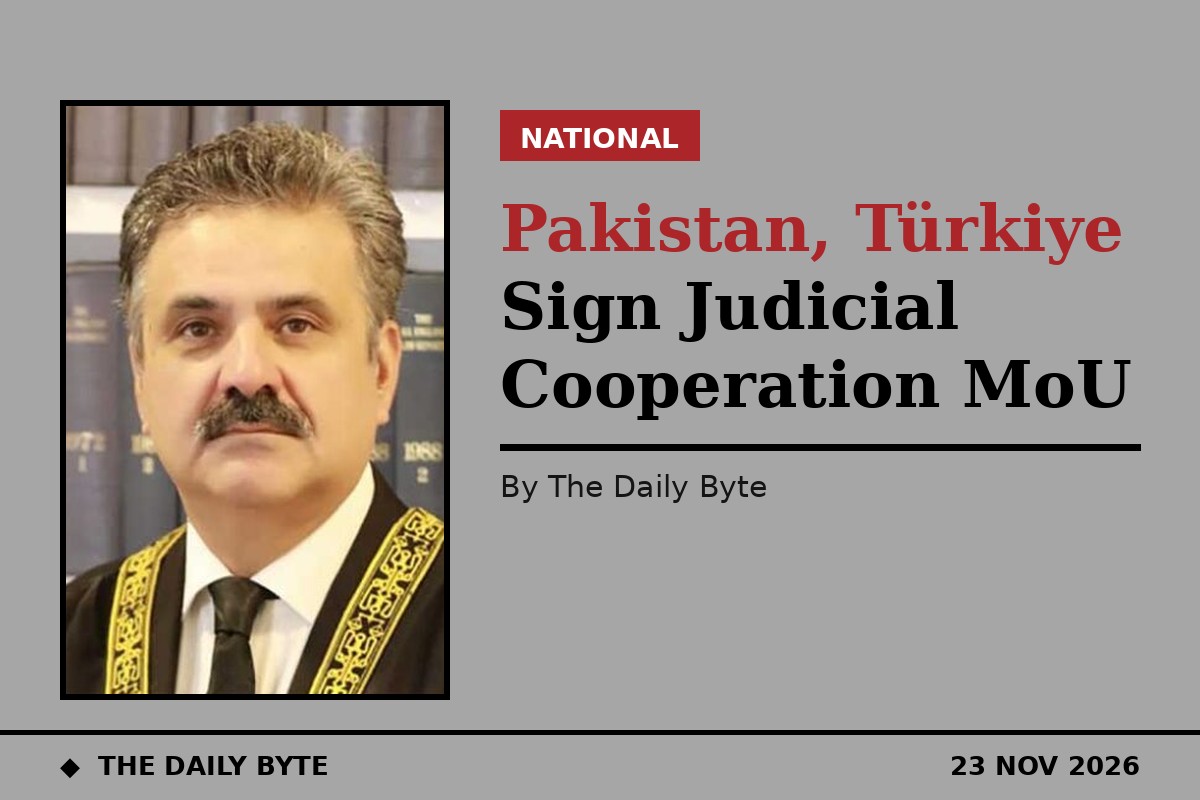
Pakistan and Türkiye signed a memorandum of understanding on judicial cooperation in Islamabad on Monday, giving the two countries' top courts a formal framework for working together on judge training, court technology and the challenges posed by artificial intelligence.
The agreement was signed at the Supreme Court of Pakistan by Chief Justice of Pakistan Justice Yahya Afridi and the President of the Court of Cassation of the Republic of Türkiye, Ömer Kerkez, who is leading a high-level Turkish judicial delegation on a visit to Pakistan from 23 to 27 November.
Judges of the Supreme Court, the chief justices of the Supreme Court of Azad Jammu and Kashmir and the high courts, the federal law minister, the Attorney General for Pakistan, members of the district judiciary and representatives of the legal fraternity attended the signing ceremony, which was broadcast live from the Supreme Court.
What the agreement covers
Under the memorandum, the two judiciaries will build structured cooperation around judicial exchanges, professional training, capacity building and the sharing of best practice in adjudication. A dedicated joint working group on judicial cooperation will oversee implementation and monitor progress.
One pillar of the agreement is academy-to-academy collaboration between the Federal Judicial Academy of Pakistan and the Justice Academy of Türkiye, covering faculty exchanges, joint training programmes and collaborative research.
The agreement also sets out specialist areas for joint work, including cybercrime, financial crime, constitutionalism, human rights, judicial ethics, climate justice, gender-responsive justice, alternative dispute resolution and the integration of technology into court work. The two sides will also share landmark judgments and hold joint seminars.
AI and e-courts at the centre
Chief Justice Afridi told the ceremony that the agreement turns long-standing goodwill between the two countries into structured institutional cooperation aimed at making justice more accessible, more predictable and more accountable. He has previously pointed to e-courts as a way of improving access to justice and making proceedings more efficient.
President Kerkez said the two legal systems shared values anchored in impartial justice, invoking the commitment to impartiality of Pakistan's founder, Muhammad Ali Jinnah, and the description of justice as an inestimable treasure by the poet-philosopher Allama Muhammad Iqbal.
He pointed to digitalisation, artificial intelligence, cross-border disputes and increasingly complex economic relations as urgent reasons for judges in both countries to deepen their shared expertise. The agreement's emphasis on AI readiness and court technology reflects that concern.
Welcoming the delegation, Chief Justice Afridi recalled the solidarity shown by the people of the subcontinent during Türkiye's struggle for independence, and the legacy of Abdur Rehman Peshawri, a figure remembered in both countries for his role in that period.
A week-long judicial visit
The Turkish delegation's visit runs until 27 November. Alongside its official engagements in Islamabad, the delegation is also scheduled to visit Taxila, Faisal Mosque and the Walled City of Lahore, reflecting the cultural and people-to-people dimension of the relationship.
The agreement follows a similar pattern of judicial diplomacy by Pakistan. Earlier in November, Pakistan signed a memorandum of understanding on judicial cooperation with South Korea, also focused on exchanges and capacity building between the two judiciaries.
For Pakistan's judiciary, the Türkiye agreement adds another institutional partner at a time when its courts are working through a reform agenda that includes digital case management and wider use of technology. For Türkiye's Court of Cassation, it opens a formal channel to a fellow judiciary facing comparable questions about how courts should handle cybercrime, financial crime and the arrival of artificial intelligence in legal practice.
Neither side has published the full text of the memorandum. What is clear from the ceremony is that the two courts intend the agreement to be a working one, with the joint working group and the academy partnership giving it a structure that will outlast the delegation's visit.