Princess of Wales Visits Bordon Hospital Baby Project
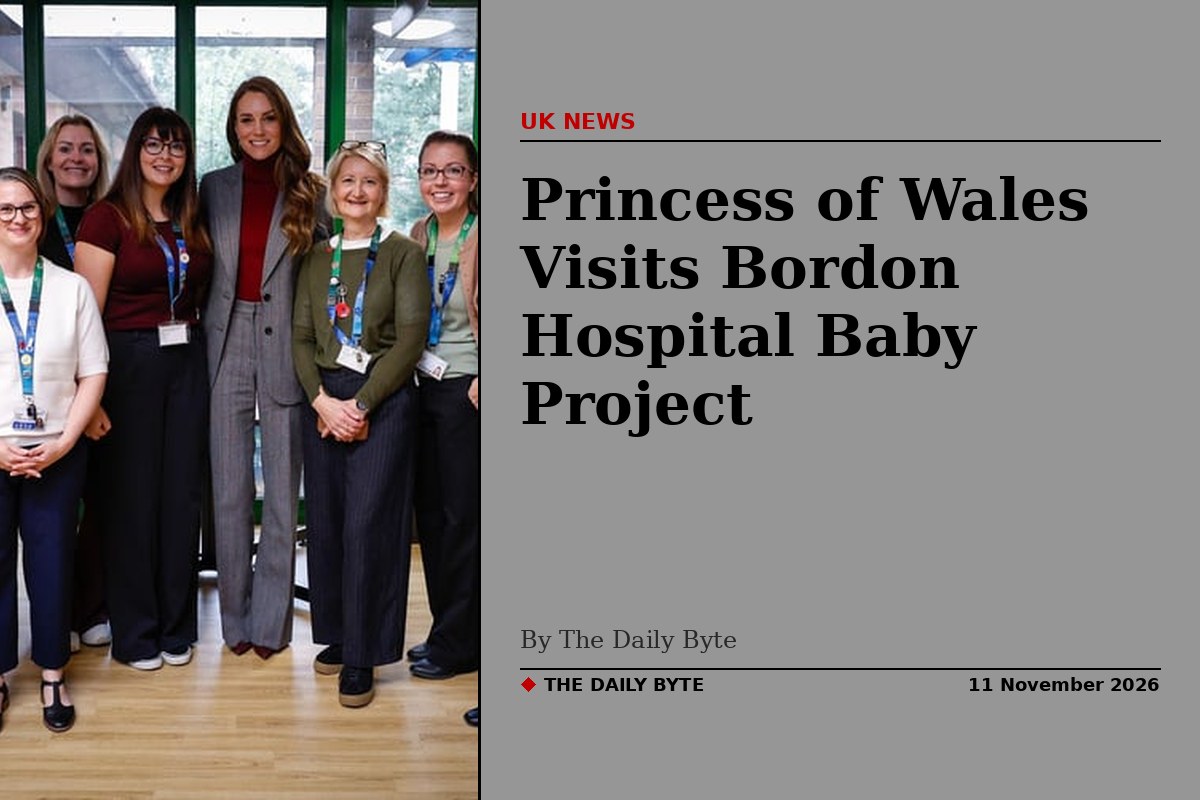
The Princess of Wales visited Chase Community Hospital in Bordon, Hampshire, on Tuesday 11 November to see how a pioneering project backed by her Royal Foundation Centre for Early Childhood is being expanded to help identify more babies and families in need of support.
During the solo visit, the Princess met health visitors using the Alarm Distress Baby Scale, known as ADBB, an observational tool that helps professionals spot early signs of social and relational withdrawal in babies aged from birth to 24 months. She also met families who have received extra support following assessments, including six-month-old Enid and her mother Amy Raynsford.
How the baby scale works
The ADBB helps health visitors and childcare professionals focus on a baby's eye contact, facial expressions, vocalisation and activity levels during routine health checks. By observing these cues, practitioners can better understand a baby's social behaviour and identify where further assessment or support may be needed.
The approach is designed to help professionals understand babies' behaviour, support parents, and identify children who may benefit from further assessment or intervention at the earliest possible stage. The Princess first observed the evidence-based tool in action during a visit to Denmark in February 2022, and then asked her Centre for Early Childhood to explore how it could be used in Britain.
The Chase Community Hospital is home to one of three health visiting teams from Hampshire and Isle of Wight Healthcare NHS Foundation Trust trained during the project's pilot phase. The trust has since trained additional specialist health visitors and staff from its Growing Little Minds team, and plans to extend the training to its remaining health visiting teams across the county.
Two pilots and £250,000 more funding
The programme has already undergone two pilot phases involving ten NHS sites. Over the summer, the Centre for Early Childhood announced a further £250,000 of investment over three years to support wider adoption of the approach, including funding for the Institute of Health Visiting to develop commissioning guidance and training resources, alongside a national network offering professional support.
Alison Morton, chief executive of the Institute of Health Visiting, said it was wonderful to welcome the Princess of Wales to Hampshire and share how health visitors are using the ADBB tool to strengthen their assessment of infant social and emotional wellbeing. She added that evaluations had shown the approach could be incorporated into routine visits, with growing interest from health services across the country.
Christian Guy, executive director of The Royal Foundation Centre for Early Childhood, said that by giving health visitors the tools and confidence to recognise when a baby may need extra support, parents and carers can be helped to better understand their baby's cues and nurture the early relationships that have such a positive impact on lifelong wellbeing.
A personal cause for the Princess
The Princess founded the Centre for Early Childhood in 2021 as part of her Royal Foundation to raise awareness of the vital impact of the years between pregnancy and age five. She arrived at the hospital wearing a grey pinstriped suit with a burgundy turtleneck and a poppy, and was greeted by the Lord-Lieutenant of Hampshire, Nigel Atkinson.
During the visit she sat on a play mat with six-month-old Enid, joined a baby health and development review, and spoke with NHS representatives from elsewhere in the UK who are considering introducing the training. Sources: Alton Herald and Hello! Magazine.
Frequently asked questions
What is the Alarm Distress Baby Scale? It is an observational tool that helps health visitors identify early social and relational withdrawal in babies aged 0 to 24 months by watching eye contact, facial expressions, vocalisation and activity levels.
Where did the Princess visit? The Chase Community Hospital in Bordon, Hampshire, on Tuesday 11 November 2026.
How is the project expanding? After two pilot phases across ten NHS sites, the Centre for Early Childhood has committed a further £250,000 over three years to support wider adoption across the UK.