Rip Out Clutter to Revive UK High Streets, Report Says
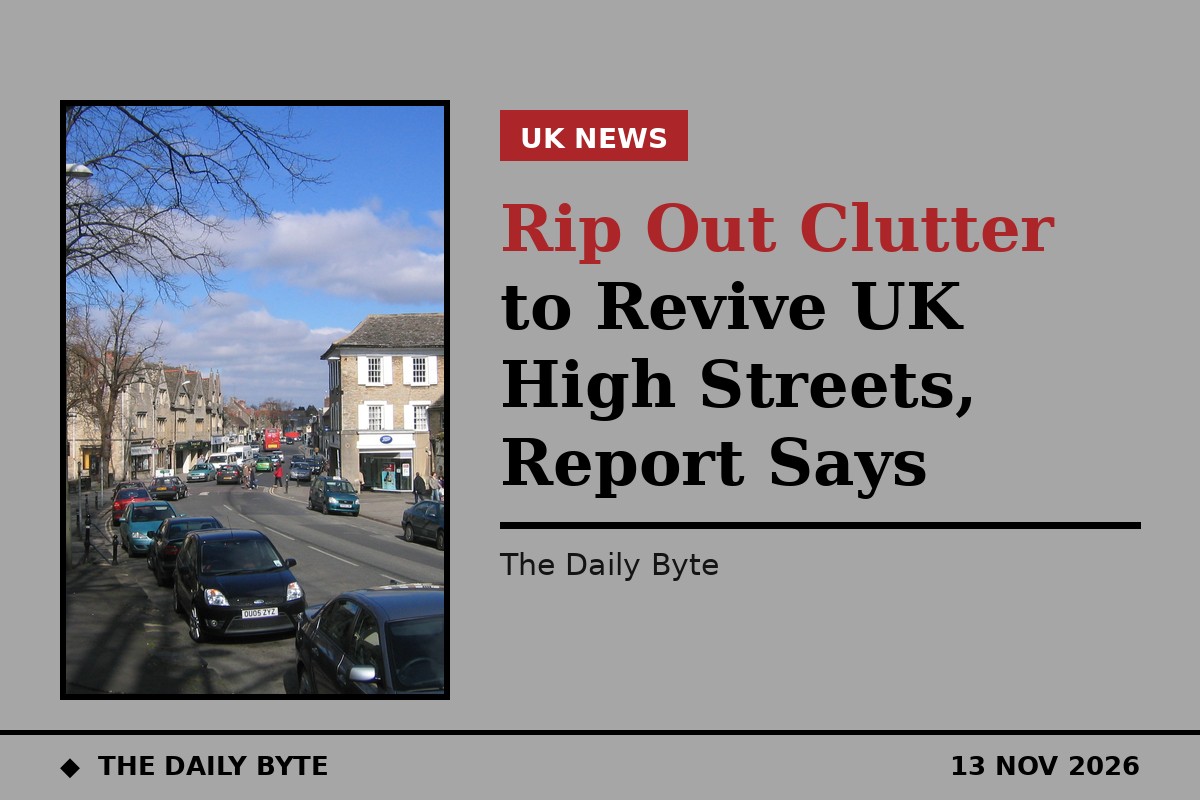
Removing ugly street clutter, taming motor traffic and making better use of kerbs could revive Britain's high streets more cheaply than multimillion-pound revamps, according to a new report.
The report, led by the urban thinktank Create Streets and produced with Cyclehoop, argues that small, low-cost changes aimed at making town and city centres more appealing would do more for struggling high streets than large redevelopment schemes.
Streets built for cars, not people
Central to the report is the argument that too many urban centres are places "designed to be driven through, not for time to be spent in". It blames planning regulations that favour conformity and clutter, and which too often treat speeding cars as a given to which everything else must adjust.
"The default high street is engineered for traffic and furnished from a catalogue: a tarmac pavement, guardrails penning people at the kerb, litter bins ordered from a procurement catalogue, a row of plastic planters – public investment that is joyless," the report says.
The report calls for a cultural rethink, with a "presumption of removal where an item cannot be justified" for street furniture that serves no clear purpose. It describes removing pedestrian guardrails next to roads as "the most cost-effective upgrade for the majority of high streets", calling them an eyesore with minimal safety benefits.
What a parking space is really worth
The report puts numbers on the trade-off. It found that one parking space in the high street of a market town is typically used by about 3.5 vehicles a day, bringing in just over £73,000 a year in spending to nearby shops.
The same 12 square metres, if used to hold nine shared e-bikes, generates an average of 13 trips a day and over £146,000 a year in spending, even taking into account the lower average spend per person. In a busier city, where shared bikes would be used more often, the estimated total annual spend rises to more than £300,000. Repurposing the space for outside dining brings less dramatic gains, but in a city centre it can still amount to about £120,000 in extra annual spending.
The report also uses what it calls "the wrist test" to judge whether a high street is working for families: whether it feels safe to let go of a young child's wrist so they can roam with some freedom. That, it argues, is best achieved by removing the threat of speeding motor vehicles, rather than by trying to mitigate their impact.
Cheap changes that worked
The report points to examples where low-cost changes had large effects. In Altrincham in Cheshire, the creation of a walkable, car-free urban area helped retail vacancies fall from over 30% to 7% in less than a decade. In Grimsby, an unused patch of land next to a church was turned into a park for less than £20,000.
"Streets that are ugly are not so because councils lack the desire to change them, but because the system is counting the maintenance liabilities, not the benefits," said David Milner of Create Streets. "What works is cheap: trees in the ground, benches people want to sit on, clutter taken away."
The report also criticises Secured by Design, the police-backed guidelines on designing out crime, saying they can lead to benches and plants being removed on police advice, supposedly to discourage antisocial behaviour.
The government's own high street plan
The prime minister, Andy Burnham, has pledged to try to reverse the decline of high streets, announcing in September a £210 million regeneration fund. However, the bulk of that money will go into buildings, turning old shops into shared workspaces or community cafes, or keeping pubs and clubs in business.
The report argues that renovating buildings is pointless if the street outside is unappealing. A spokesperson for the Ministry of Housing, Communities and Local Government said the government's Hope on the High Street strategy would help local people revive town centres by protecting community assets, bringing derelict buildings back into use and tackling the spread of vape and gambling shops, and that funding was available for local leaders to spend on their priorities, including pedestrianising high streets if they wished.
The Create Streets report is a set of recommendations, not government policy. But its message is that the cheapest high street revival may also be the simplest: fewer cars, less clutter, and streets designed for the people who use them.


