Royal Mail Set To Miss Delivery Targets Fourth Year
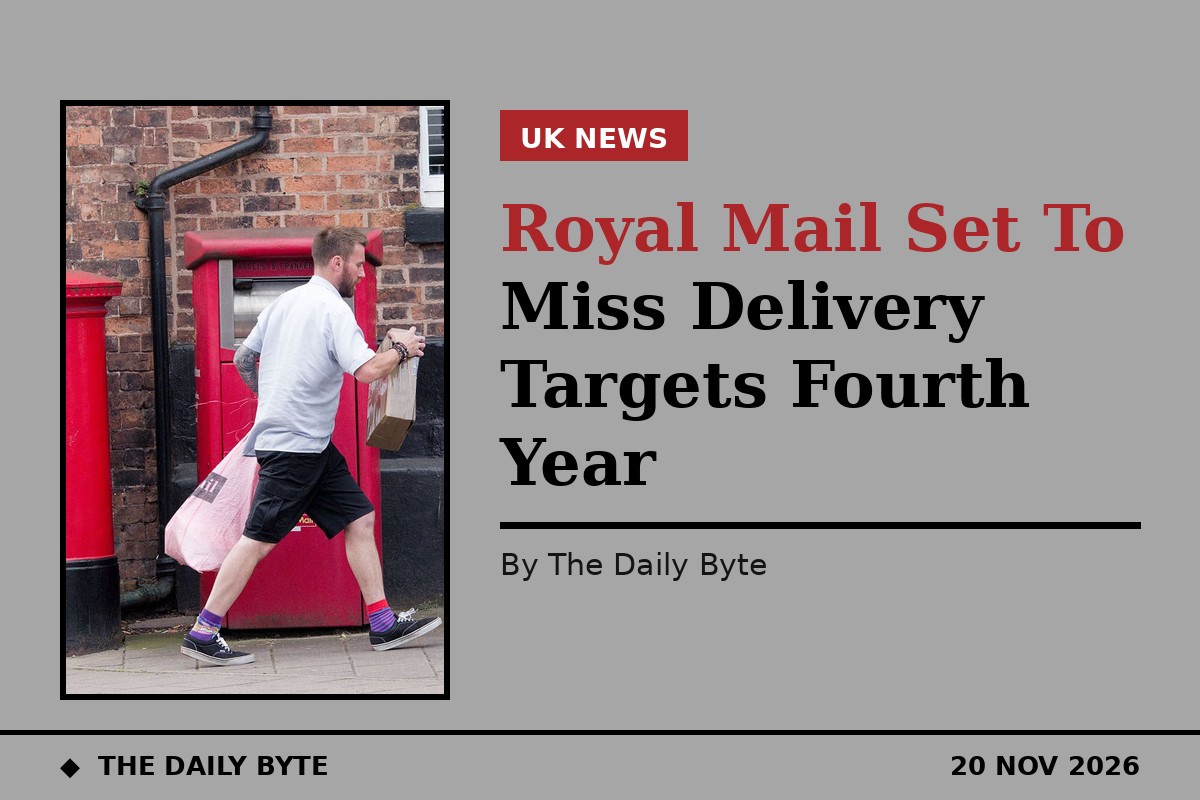
Royal Mail is on course to miss its first-class delivery target for a fourth consecutive year, after delivering only 82.5 per cent of first-class post on time in the second quarter. The figure, down from 85 per cent in the first quarter, sits well below the 90 per cent requirement set by the regulator, Ofcom, which says 90 per cent of first-class post must arrive by the next working day.
Second-class performance has slipped too. Just 87.2 per cent of second-class items arrived within three working days in the second quarter, compared with 91.4 per cent in the previous three months. The Ofcom target for second-class post is 95 per cent. Royal Mail said on Thursday that it did not expect to meet its targets until next April. It last met its first-class delivery target in 2017, before the requirements were temporarily suspended during the pandemic.
Citizens Advice has accused the postal service of offering customers a pot luck service, in which a letter may or may not arrive on time. Tom MacInnes, the charity's director of policy, said putting a letter in a postbox should not be like rolling a dice to see if it arrives on time. Citizens Advice counts the run of missed first-class targets differently from the company, saying Royal Mail is on track to miss its annual first-class target for a tenth consecutive year, and its second-class target for a seventh year. Royal Mail says that, taking into account the emergency exemption from regulatory targets during the pandemic, it has missed its regulatory targets for the last four years.
Fines and the Ofcom investigation
Royal Mail has been fined a total of 37 million pounds since 2023 for missing delivery targets. In June, Ofcom opened an investigation into the company's 2025-26 delivery performance, saying it would examine whether Royal Mail was prioritising parcel delivery over letters. Whistleblowers and unions have made that allegation, which the company denies.
The missed targets come despite Ofcom giving Royal Mail permission last year to downgrade its universal service obligation. The change cut second-class deliveries to alternate weekdays, with no second-class deliveries on Saturdays. Royal Mail also missed its first-class delivery target for the year to March, a result reported in June.
A Royal Mail spokesperson said the company was broadly on track against its quality of service improvement plan, with first-class next-working-day performance up 9.1 percentage points on last year and ahead of the trajectory set out in the plan. The company argues that the direction of travel is improving, even though the headline targets are still being missed.
Christmas peak and the wider business
The figures were published alongside results from International Distribution Services, Royal Mail's parent company, which reported a 6.3 per cent rise in group revenue to 6.85 billion pounds in the six months to 27 September. Royal Mail's revenue rose 3.9 per cent to 4.13 billion pounds over the same period. IDS was bought for 3.6 billion pounds by the Czech billionaire Daniel Kretinsky last year.
The company is now preparing for its busiest period of the year, running from the Black Friday shopping event through to Christmas. Royal Mail said it had hired an additional 22,000 seasonal workers and was ready for a very busy Christmas. Its chief executive's parent-company counterpart, Martin Seidenberg, said it was already quite busy in the network, but that the company was ready.
The wider picture for letters remains difficult. The number of letters sent through Royal Mail has fallen from about 20 billion to 6.7 billion over the past decade, while the number of addresses it serves has risen by four million. In April, Royal Mail raised the price of a first-class stamp by 10p, or 6 per cent, to 1.80 pounds, and a second-class stamp by 4p, or 5 per cent, to 91p. The business has also announced plans to cut up to 2,500 jobs as part of a restructuring, focused on head office and support roles.


