Senegal Parliament Denounces Faye Budget Decree
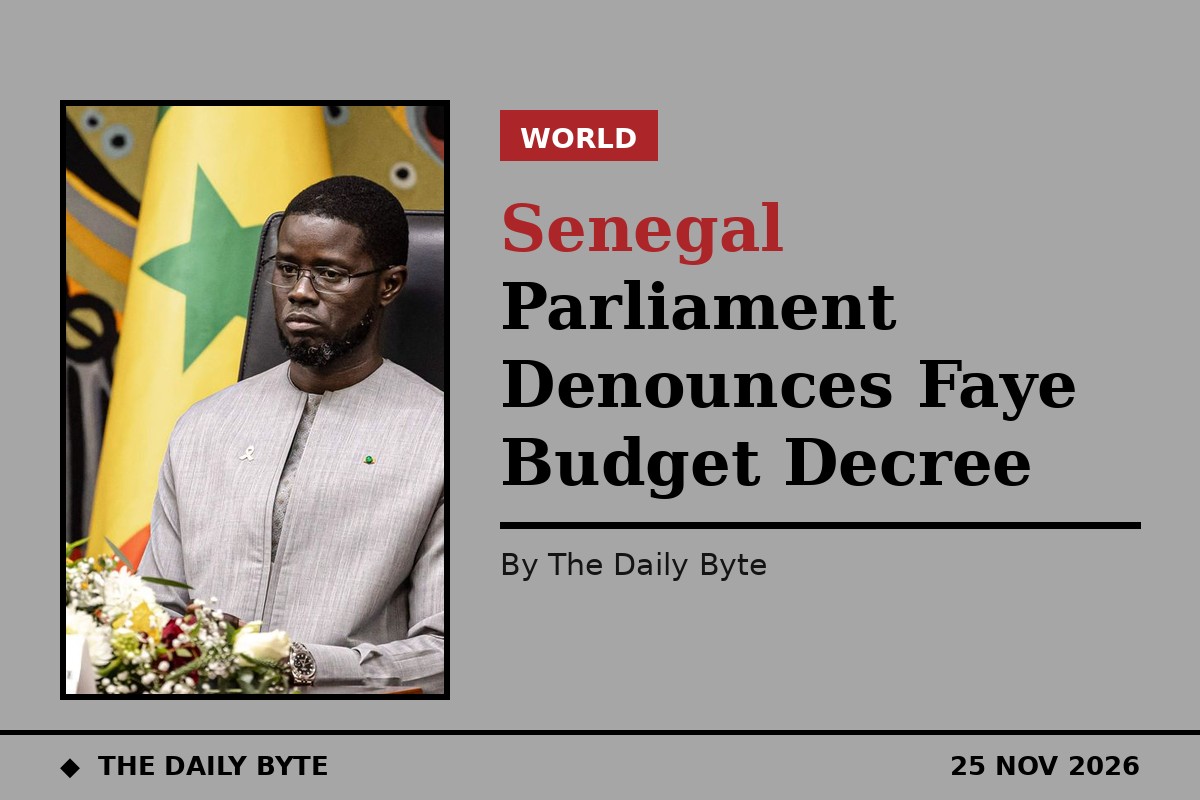
Senegal's National Assembly has adopted a resolution denouncing President Bassirou Diomaye Faye's decision to put a revised 2026 budget into force by decree, after lawmakers had already rejected it. Deputies voted 128 to 9 in favour of the resolution on Wednesday, 25 November 2026, deepening an institutional standoff that threatens a new 2.2-billion-dollar support programme from the International Monetary Fund.
The vote is the latest turn in a dispute between Faye and his former prime minister, Ousmane Sonko, who now heads the National Assembly. Sonko's Pastef party controls the chamber and opposes the amended 2026 budget and the 2027 budget in their current form, arguing that the government has not been transparent enough about the public finances and debt assumptions behind them.
What the resolution says
The resolution, which runs to six articles, concerns Decree No. 2026-2416, signed on 19 November, which put into force the draft revised finance law for 2026, known by its French initials LFR, even though the Assembly had rejected it. Through the text, lawmakers reaffirm the authority of the parliamentary vote, the separation of powers and the Assembly's constitutional prerogatives over the budget.
The Assembly describes the decree as an usurpation of legislative power and demands its withdrawal without delay. It also calls on the executive to refrain from carrying out the revised budget on the basis of the decree, and says the future 2026 settlement law should review in detail the revenue collected, the spending undertaken and the borrowing raised under it. A parliamentary resolution on its own does not have the power to annul a presidential decree, so the text's force is political rather than legal, but it puts the Assembly formally on record against the president's move.
During the plenary session, deputies first rejected a preliminary question from opposition MP Abdou Mbow asking for the examination of the resolution to be suspended. The government was not represented at the sitting.
How the standoff built up
The crisis began on 3 November, when the Assembly, dominated by Pastef, ended its examination of the revised budget by adopting a preliminary question by 109 votes to 20, with three abstentions. Lawmakers then rejected the first part of the proposed 2027 budget on 18 November by 128 votes to 18, also with three abstentions, blocking examination of the rest of that bill.
The political rupture widened on 17 November, when Pastef struck Faye and 31 others off its membership rolls. Two days later Faye signed the decree bringing the rejected 2026 revision into force. The presidency argued that the president, as guarantor of the regular functioning of the state, was entitled to act under Article 68 of the Constitution, which gives the Assembly a maximum of 60 days to vote on a finance bill and allows a bill not definitively voted within that period to be enacted by decree. The revised budget was tabled on 18 September, and the presidency said the deadline had passed.
The IMF stakes
Both budgets are central to advancing the IMF programme, which underpins Senegal's strategy for reworking its large debt burden but has not yet been signed off by the fund's executive board. Morgan Stanley strategist Neville Mandimika said on Tuesday that the budget standoff posed a significant risk to Senegal's medium-term fiscal plans, adding that completing the country's debt restructuring in 2026 would be challenging.
The 2026 revision targets a deficit of 7.6 per cent of GDP. The 2027 budget remains blocked, and its own 60-day period under Article 68 expires in mid-December, setting up a further confrontation if no compromise is reached.
What happens next
Attention now turns to the presidency's response to the resolution, and to the calendar: the current Assembly was installed on 2 December 2024, which means Faye acquires the power to dissolve it from 2 December 2026, less than a fortnight away. Whether the president answers the resolution or moves towards dissolution will determine whether Senegal heads for de-escalation or a durable institutional crisis.
Frequently asked questions
What is the LFR 2026? It is the revised finance law for 2026, a supplementary budget adjusting the year's revenue, spending and borrowing. The Assembly rejected it on 3 November, and President Faye put it into force by decree on 19 November.
Does the resolution cancel the decree? No. A parliamentary resolution cannot by itself annul a presidential decree. Its effect is political: it formally records the Assembly's position that the decree was unlawful and demands its withdrawal.
Why does the IMF programme matter? The 2.2-billion-dollar programme underpins Senegal's plan to rework its debt burden, but it needs the budgets to advance and has not yet been approved by the IMF's executive board.