Shabana Mahmood tells police to 'leave politics to politicians' in two-tier policing speech
By The Daily Byte
·20 Nov 2026
·6 min read
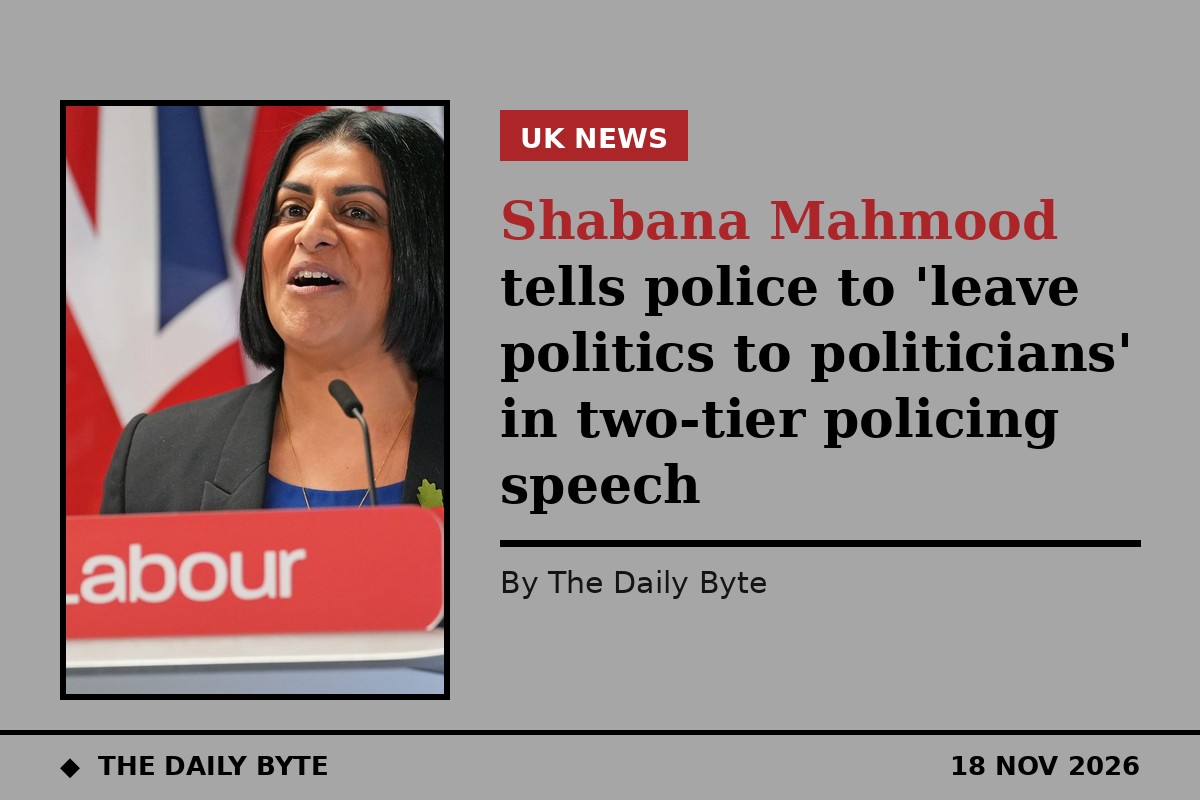
Home Secretary Shabana Mahmood has told police officers to "leave the politics to the politicians" and announced a new impartiality standard for policing, as she confronted the "corrosive and growing perception" of two-tier policing in a speech to police chiefs in London on Wednesday 18 November.
Ms Mahmood said the vast majority of officers policed impartially, but accepted there had been examples of different groups being treated differently, and said those examples had damaged public confidence. The new standard, to be developed by the College of Policing and put out for consultation early next year, will bring the key principles of impartial policing into one place.
## What the new impartiality standard will cover
The standard is intended to give officers more confidence in how they handle cases, whatever a person's race, faith or other characteristics, and to give the public confidence that they will be treated fairly. It will give officers guidance on practical questions such as wearing symbols on badges and lanyards, and on how to behave at community-led events.
Ms Mahmood also backed a ban on police officers marching in Pride events while in uniform. The Guardian reported that she pointed to a Pride event in Northumbria, where officers took part in the march in 2024. The High Court later found that their involvement had breached a duty of impartiality. Ms Mahmood said the judgment had found that the officers "got the balance wrong" and that marching in uniform "was not acceptable and not impartial".
Nik Adams, deputy commissioner of the City of London Police and the police chiefs' national lead on LGBTQ+ issues, said describing LGBTQ+ questions as contested made LGBTQ+ people in policing and in wider society feel less safe and less valued.
## Mahmood attacks the old police anti-racism commitment
Ms Mahmood was sharply critical of the former police anti-racism commitment, which has since been withdrawn. She said it was "patently absurd to tell police officers that fair policing 'does not mean treating everyone the same'", and that its guidance that officers should not be "colourblind" was "clearly wrong".
"I understand what the guidance was trying to achieve," she said. "But the result was a misguided and distortive document that put fire under the idea that this country pursues two-tier policing and so achieved precisely the opposite effect it intended."
Speaking to journalists after the speech, she rejected the claim that two-tier policing was routine. "What Reform and others will have you believe is every single day officers go out and they practice a thing called two-tier policing," she said. "That is utter complete ridiculous rubbish. That is not what's happening in our police forces. But there have been examples of differential treatment, and those have had an impact on confidence in policing, and they've allowed that false perception of two-tier policing to take hold."
Her intervention follows the killing of Henry Nowak, which prompted fresh accusations of two-tier policing and far-right protests. A More in Common poll earlier this year found that a third of Britons believe police treat people from ethnic minority backgrounds more favourably than white people, a figure that has doubled in the last two years.
On community engagement, Ms Mahmood told officers: "When it comes to political groups, leave the politics to the politicians, and we will leave the policing to you." She said community engagement should mean attending a residents' association meeting and discussing local issues. "It can be over tea and biscuits or tea and samosas. But it doesn't mean engaging with activist groups and campaigners who are pushing their own political agenda."
## Fast-track leadership scheme and 200 local commands
The Home Secretary also set out plans to address what she described as sometimes "inadequate" police leadership. Around 200 recruits a year, drawn from inside and outside policing, will be fast-tracked to the rank of superintendent within five to 10 years, in her response to the Police Leadership Commission.
Sweeping reforms of policing in England and Wales will also create around 200 local commands, each around the size of a unitary authority and led by a named commander.
Ms Mahmood said it was "shameful" that, 33 years after the murder of black teenager Stephen Lawrence, the proportion of black officers in police forces remained virtually unchanged. Sky News reported that she has also commissioned Lord MacDonald to review public order and hate crime laws, with the report and the government's response to be published soon.
Gavin Stephens, chairman of the National Police Chiefs' Council, said officers needed tolerance for the difficult judgments they make on emergency calls. He told the Press Association: "There's a 999 call every two seconds, often with limited information, lots of different factors to weigh up, and that's why we have discretion. And discretion means that two situations will be dealt [with] differently that on the face of it might be the same."
## Reaction to the speech
Shadow home secretary Chris Philp said: "We have been calling out unequal treatment for years. It is fundamentally wrong for the police to treat people differently because of the colour of their skin."
Reform UK leader Nigel Farage said: "We said there was two-tier policing. We were called racist. The Labour Home Secretary has now admitted it: 'There have been examples of differential treatment'."
## Frequently asked questions
**What is two-tier policing?**
It is the claim, disputed by the Home Secretary and police leaders, that police in the UK treat some groups of people more favourably, or more harshly, than others. Ms Mahmood said there was no systematic or routine two-tier policing, but accepted there had been examples of differential treatment.
**When will the new impartiality standard come into force?**
The standard is being developed by the College of Policing and is due to go out for consultation early next year. Force chiefs had already been working on new guidance before the speech, and Ms Mahmood said she had been in discussions with them.
**What did the Home Secretary say about Pride marches?**
She backed a ban on officers marching in Pride events in uniform, while officers would still police such events. She cited a High Court ruling that uniformed officers marching at a Pride event in Northumbria had breached their duty of impartiality.
Sources: The Oldham Times (Press Association), [Home Secretary tells police to 'leave the politics to the politicians'](https://www.theoldhamtimes.co.uk/news/national/26741702.home-secretary-tells-police-leave-politics-politicians/); BritBrief, [Home Secretary: Police Should Not Join Pride Marches](https://britbrief.co.uk/politics/policymaking/home-secretary-police-should-not-join-pride-marches.html).
Source
The Oldham Times (Press Association) — https://www.theoldhamtimes.co.uk/news/national/26741702.home-secretary-tells-police-leave-politics-politicians/ 

