South Korea Eases Margin Rules to Steady KOSPI Rout
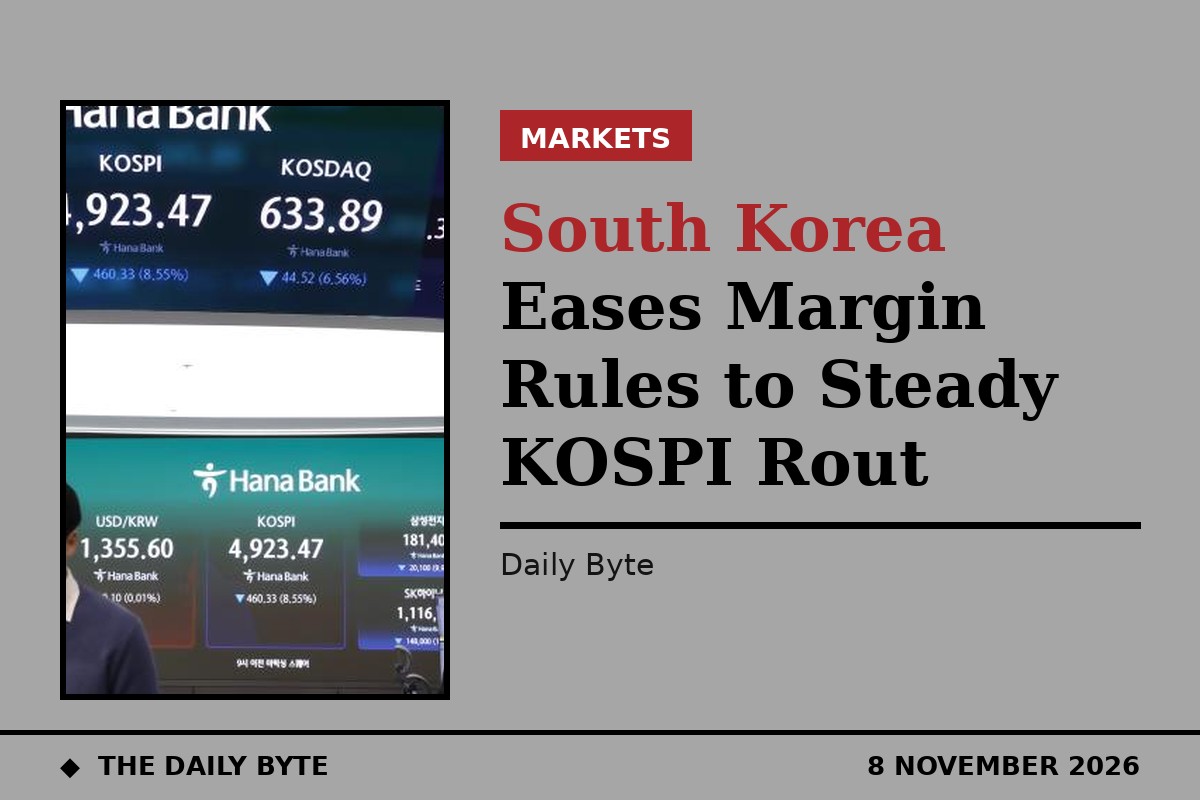
South Korea will relax margin-lending rules for three months from Monday in an emergency attempt to stop forced selling from deepening the KOSPI's rout, after the benchmark plunged more than 8% on Friday and triggered a trading halt. The measure was agreed at an emergency meeting chaired by Deputy Prime Minister and Finance Minister Lee Hyoung-il, with the heads of the Financial Services Commission, the Financial Supervisory Service and the Bank of Korea, as reported by Dow Jones via Morningstar.
Under the relief, brokerages will be exempt for three months from the rule requiring them to hold collateral worth at least 140% of the money they lend investors to buy shares. When prices fall and the ratio slips below that level, borrowers must top up with cash or shares or see their holdings sold. The exemption lets brokerages lower the threshold or delay forced sales, though it does not stop them automatically, and how much relief borrowers get will depend on each brokerage.
The KOSPI fell below 5,000 for the first time in about nine months shortly after Friday's opening bell, triggering a 20-minute halt, and recovered about a third of its losses after the announcement, closing down 6.02% at 5,059.65. Institutions did most of the buying, while foreign investors kept selling, according to Aju Press.
The pressure has been building all year. Forced sales of margin-bought shares at Korea's 10 largest securities firms totalled 919.34 billion won ($678.4 million) in the first half of 2026. Outstanding margin loans stood at 28.64 trillion won on 4 November, down 25.9% from their 24 June peak. Morningstar reported the market has lost roughly $2.4 trillion in value since its June peak. Seoul used the same tool in 2022, when the KOSPI still ended the year down 24.9% — a reminder that the relief buys time rather than a recovery.