St Cuthbert's Rochdale Put in Special Measures
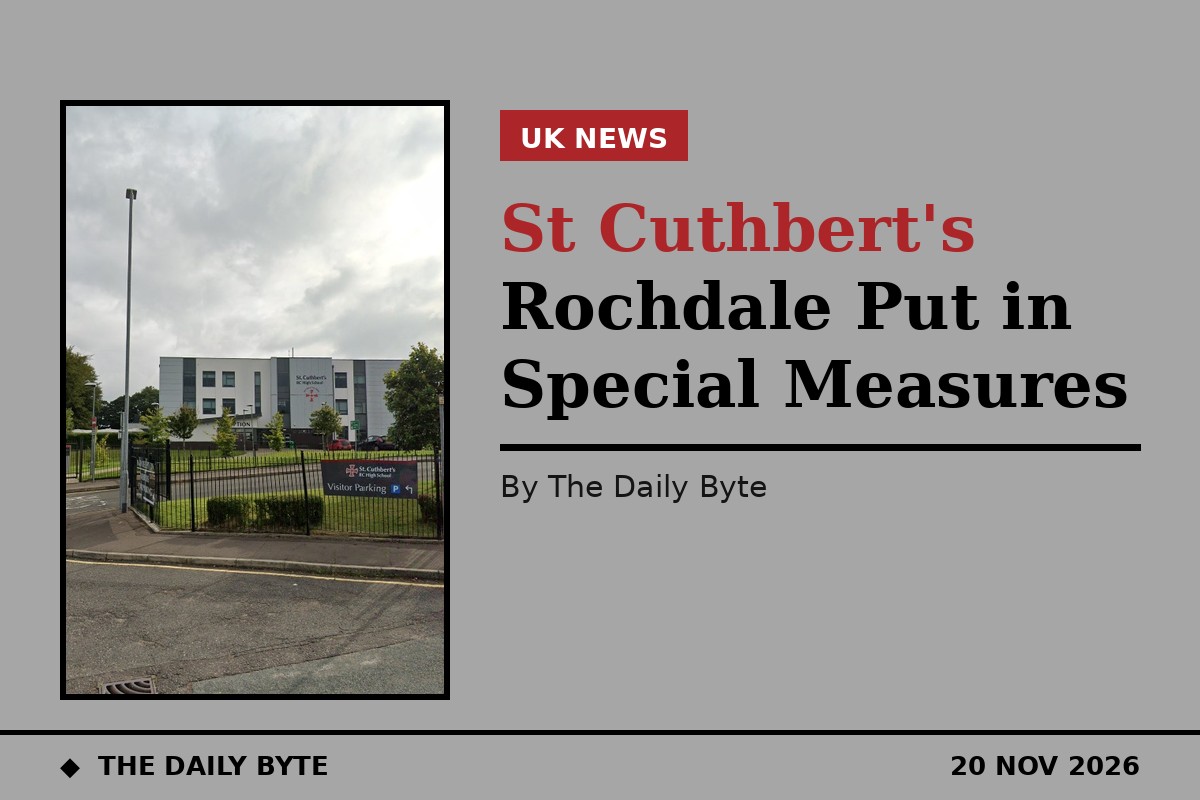
St Cuthbert's Roman Catholic High School in Rochdale has been placed in special measures after an Ofsted report found that pupils did not feel safe and that the school was failing to give them an acceptable standard of education.
The report, published on 19 November following an inspection on 6 October, judged that "urgent improvement" was required, the lowest grade under Ofsted's new framework. His Majesty's Chief Inspector concluded that the school, which has more than 1,000 pupils on roll, was failing to provide an acceptable standard of education and that those responsible for leading it were not demonstrating the capacity to secure the improvements needed.
The school is part of the St Teresa of Calcutta Catholic Academy Trust, which is headquartered in Bury and runs nine schools in Bury, eight in Rochdale, five in Bolton, one in Salford and two in Heywood.
What inspectors found
Inspectors found that safeguarding standards had not been met. Leaders had not ensured "an open and positive culture around safeguarding that adequately protects pupils from harm", the report said.
One of the most serious findings concerned discrimination. Ofsted said leaders had failed to create a culture in which staff consistently challenge racism, sexism and homophobia, and as a result those behaviours had become normalised among pupils. "Pupils experience discriminatory language in daily interactions, and this goes unaddressed by staff," the report states.
Pupils told inspectors they felt unsafe because prejudicial language and conduct were not routinely challenged, and they lacked confidence that staff would protect them. Child-on-child incidents occurred too often, and staff, parents and carers raised concerns about how regularly, and how visibly, such behaviour happened.
Behaviour across the school was a major concern. Inspectors found bullying was not dealt with effectively, many pupils routinely ignored school rules, and a significant minority arrived late to lessons or wandered the corridors when they should have been in class. "Pupils do not feel safe in school. They are not proud to attend," the report said, adding that over time pupils had "become accustomed to low standards, poor-quality education and a culture that fails to promote respect or high expectations".
Results and attendance
Attainment remained significantly below national averages. In 2024/25, just 29 per cent of pupils achieved grade five or above in English and maths at GCSE, compared with a national average of 45.4 per cent.
Inspectors found many pupils joined the school with gaps in literacy and numeracy, but leaders had not put effective systems in place to help them catch up. Teachers were found not to have high enough expectations of pupils, and in some subjects lacked sufficient expertise to deliver lessons effectively. Many pupils struggled to remember what they had previously learned and could not build successfully on earlier knowledge.
Attendance was also highlighted as a long-standing weakness. Overall absence stood at 10.6 per cent in 2024/25, well above the national average of 8.4 per cent, while almost one in three pupils was classed as persistently absent. Inspectors said many pupils did not feel a sense of belonging in the school community and did not value attending regularly.
Provision for pupils with special educational needs and disabilities was equally criticised. Inspectors said some pupils' needs were not properly identified or met, and staff were not making sufficient use of information about barriers to learning when planning lessons. Urgent improvement was also required in achievement, attendance and behaviour, curriculum and teaching, inclusion, leadership and governance, and personal development and wellbeing.
Leadership and the trust's response
Leadership was another area judged to require urgent improvement. The school has had four headteachers since its previous inspection, with an interim executive headteacher in post since November 2025. The governing body has been disbanded and replaced by a trust intervention committee. Staff at the school took industrial action between February and June in a dispute with the trust, and the report described the school as characterised by "disharmony and a lack of unity".
The trust said it fully accepted Ofsted's findings. Its chief executive, Chris Foley, apologised to parents, saying: "While we'd already identified several of the issues raised by Ofsted, we must acknowledge that the pace of improvement has not been sufficient. Ultimately, we're accountable for ensuring that standards improve."
The trust said its improvement programme would focus on stronger leadership capacity and oversight, external school improvement support, better behaviour, attendance and safeguarding, higher expectations for teaching and learning, and clear milestones against which progress could be measured and reported. The school will now receive regular monitoring inspections by Ofsted.


