Supreme Court Wins ISO 9001 Quality Certification
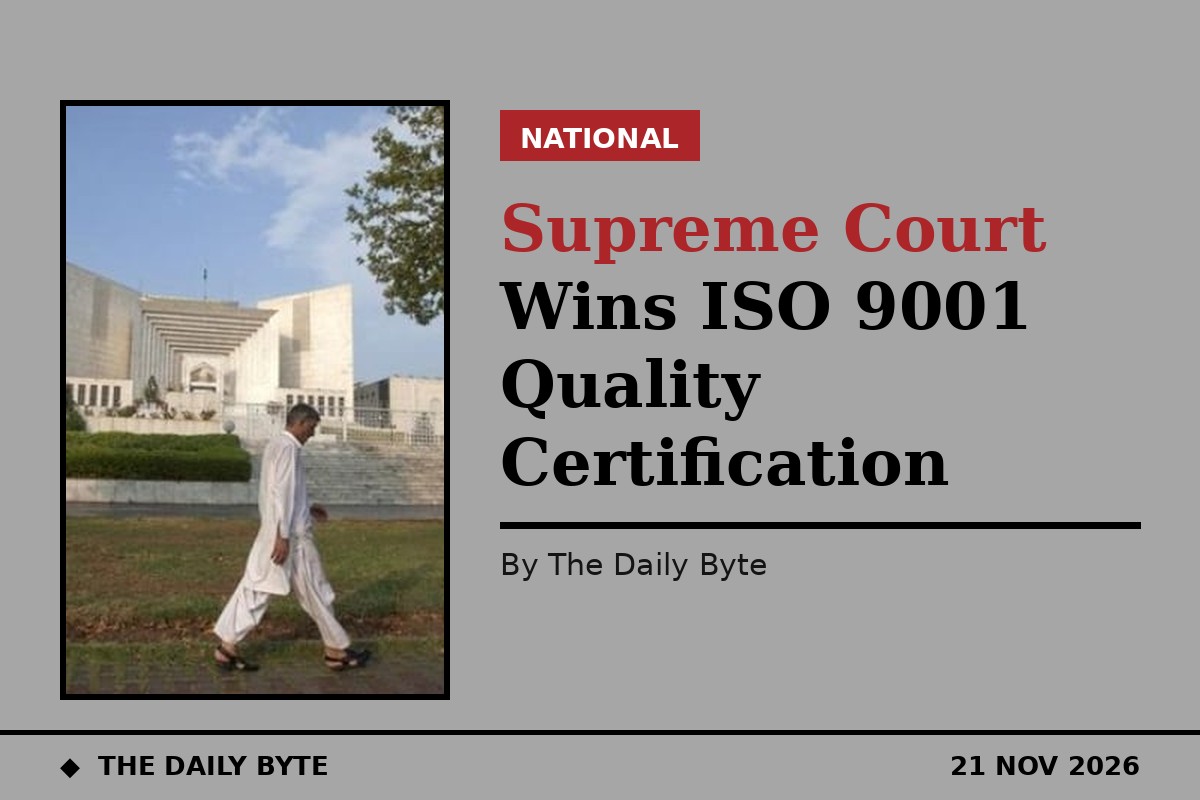
The Supreme Court of Pakistan has obtained ISO 9001:2015 certification for its Quality Management System, after an assessment found that the court's administration meets internationally recognised quality management standards.
The certification was issued by INTERCERT on 19 November 2026, according to a press release issued by the court on Friday, 20 November. The court described the certification as a significant milestone in its continuing institutional reforms, aimed at improving judicial administration, transparency, accountability and public service delivery.
ISO 9001:2015 is the international standard for quality management systems. It requires an organisation to document its procedures, measure how well they work, audit them regularly and keep improving them, rather than relying on informal or ad hoc working practices.
What the certification covers
The certification covers the provision of judicial services, including final appellate adjudication of civil and criminal matters, rent and family appeals, review of judgments and orders, the exercise of contempt jurisdiction, and the issuance and enforcement of judicial orders and decrees.
It also covers the administration behind those services, including registry work, case management and archiving. According to the court's press release, numbered 176 of 2026, the certification followed the establishment of standardised procedures, operating procedures, audits and monitoring across those areas.
The certificate of registration, numbered IC-QM-2611208, records 19 November 2026 as both the initial certification date and the date of issue. Surveillance validity runs until 18 November 2027, with recertification due by 18 November 2029.
Part of wider court reforms
The court has linked the certification to broader reforms, including digitisation and e-filing, which it says are intended to make cases easier to track and to improve the experience of litigants and advocates who use the court.
The Supreme Court had already pointed to the certification work when it opened the new judicial year 2026-27, saying that compliance with ISO certification reflected its commitment to standardisation and quality management, alongside speedier justice and better case management.
Certification does not decide any case and does not change the law. What it certifies is the management system around the court's work: that procedures are written down, followed, checked and corrected when they fall short. For litigants, the practical test will be whether filing, listing and the handling of court records become more predictable in the months ahead.
Keeping the certification will require regular surveillance audits before the recertification date in 2029. If those audits find that procedures are no longer being followed, the certification can be suspended or withdrawn, so the court will need to show that the system it has documented is the system it actually uses day to day.
The court said the achievement reinforced its commitment to internationally recognised standards and to strengthening public confidence in the institution.