Tempest fighter jet could be last crewed RAF plane
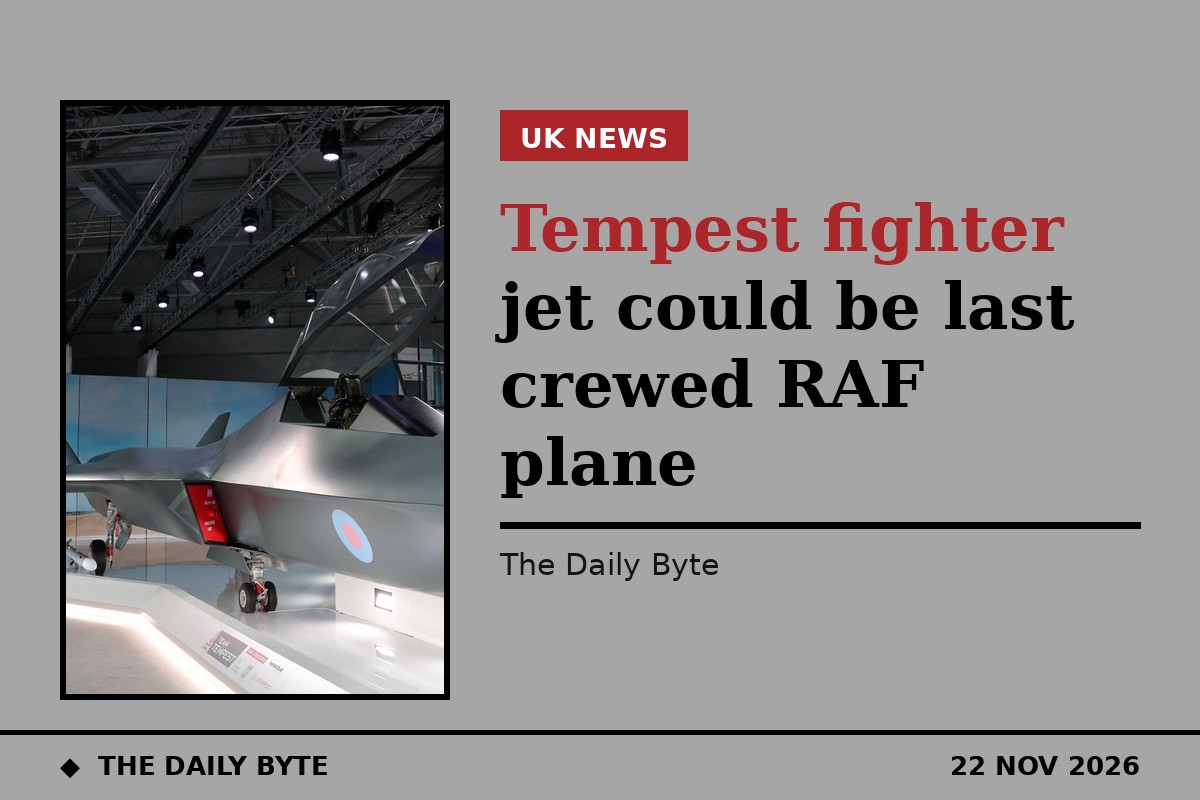
Britain's next fighter jet could be the last crewed combat aircraft the country ever builds, the head of the Royal Air Force has said. Air Chief Marshal Sir Harv Smyth said artificial intelligence and uncrewed aircraft would change military flying as profoundly as the move from propellers to jets, and confirmed that uncrewed fighter jets will start flying in British airspace next year.
Sir Harv, the Chief of the Air Staff, set out the warning in an article for The Telegraph published on Sunday 22 November. His comments centre on the Tempest, the sixth-generation stealth fighter being built under the Global Combat Air Programme, a partnership between the United Kingdom, Italy and Japan. The aircraft is expected to enter service by 2035.
What the RAF chief said
Sir Harv wrote that the Tempest was "perhaps the last crewed fighter we will ever build", adding that this was "not because people will become less important, quite the opposite". He said the future RAF would combine its current Typhoon and F-35 jets with autonomous systems, and that AI-enabled, uncrewed aircraft would "transform military aviation as profoundly as the shift from propellers to jets".
He added: "Used properly, AI and machines will tackle the most dangerous tasks instead of humans, but technology must enhance human judgment, not replace accountability." He also confirmed: "Uncrewed fighter jets will start flying in UK airspace next year. This is exciting and necessary in equal measure."
Speaking at the Royal United Services Institute in October, Sir Harv said AI had gained the equivalent of 50 years of human air-combat training and experience in just 14 days during a simulation, underlining how fast the technology is developing.
What Tempest is
The Tempest is the informal name for the aircraft being developed under the Global Combat Air Programme, known as GCAP. The programme was announced in 2022 by the UK, Italy and Japan, which are jointly developing a sixth-generation fighter expected to provide speed, stealth, advanced sensors and AI to assist the human pilot when overwhelmed or under extreme stress.
Britain signed a 4.6 billion pound contract in July for the design of the aircraft, alongside Italy and Japan. The jet is being developed by Edgewing, a joint venture between the UK's BAE Systems, Italy's Leonardo and the Japan Aircraft Industrial Enhancement Company. Canada joined the programme as an observer nation in July.
The RAF's main fighter jets at present are the Eurofighter Typhoon FGR4 and the stealth Lightning F-35B, the latter also used by the Royal Navy because it can take off from an aircraft carrier. Britain already operates a remotely piloted aircraft, the 11-metre-long Protector drone, which is capable of surveillance as well as armed operations.
Drones already flying alongside pilots
A United States Air Force test last month gave a glimpse of the future Sir Harv described. Taking off from Edwards Air Force Base in California, a piloted F-22 Raptor acted as an airborne controller, issuing orders to a nearby YFQ-44A Fury drone. The drone, which looks similar to a traditional manned jet, interpreted the orders autonomously, selected its own manoeuvres and carried out simulated combat tasks.
Sir Harv's message is that this kind of teaming between crewed aircraft and autonomous drones is now close to reality, not a distant prospect. The Tempest itself will still require a crew, but the RAF chief's assessment is that future combat aircraft projects after it are likely to be uncrewed.
Why it matters
The statement is the clearest signal yet from the top of the RAF that the service expects a fundamental change in how Britain fights in the air within a generation. If the Tempest does prove to be the last crewed fighter, the pilots who fly it will be the final generation of RAF fast-jet aircrew, with machines taking on the most dangerous missions.
The programme also matters industrially. The 4.6 billion pound design contract supports high-skilled jobs at BAE Systems and its partners, and the UK, Italy and Japan have tied their future air defences together through the joint venture. How the programme is funded and delivered in the coming decade will shape both the RAF and Britain's defence industry.
For now, the immediate milestone is nearer: uncrewed fighter jets flying in UK airspace from next year, a step Sir Harv described as both exciting and necessary.