Tinubu asks parliament to end jail for suicide bids
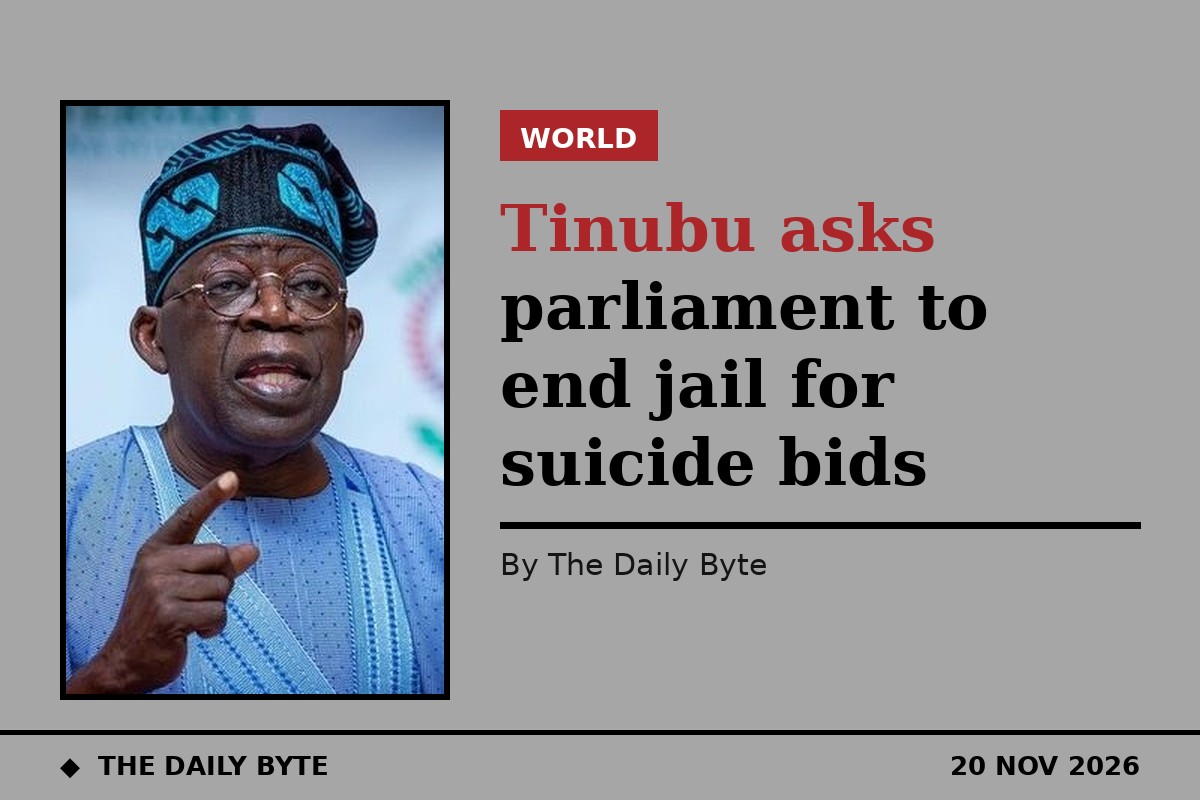
Nigerian President Bola Tinubu has asked parliament to decriminalise attempted suicide, proposing that people who survive a suicide attempt receive medical care and support instead of facing prosecution.
The National Mental Health (Amendment) Bill, 2026, was presented to the Senate on Tuesday and read in the House of Representatives on Wednesday. It would amend the National Mental Health Act of 2021, the law that governs mental health care in Nigeria, to remove the criminal penalties that still apply to attempted suicide.
Under the country's Criminal Code and Penal Code, attempted suicide remains a criminal offence. A person convicted can face a fine, up to a year in jail, or both, depending on which code applies where they live.
In the letter accompanying the bill, a copy of which was seen by Reuters, Mr Tinubu said the changes would "decriminalise attempted suicide and provide support" to people who attempt to take their own lives. The letter, addressed to the Speaker of the House, Tajudeen Abbas, was sent under Section 58(2) of the 1999 Constitution, which covers how the president transmits bills to the National Assembly.
Care instead of punishment
The bill would require the authorities to provide rehabilitation services for survivors of suicide attempts, and to promote wider access to mental health care. Its stated aim is to treat a suicide attempt as a mental health issue rather than a criminal offence.
Mental health advocates in Nigeria have campaigned for the change for years. They argue that criminal penalties deepen the stigma around suicide in a country where access to mental health care is limited and many people struggle to obtain treatment. Psychiatrists have made the same case, and a parallel proposal has also been before the Senate, following a motion by Senator Asuquo Ekpenyong calling for decriminalisation.
If the bill becomes law, Nigeria would join a growing number of countries that have removed criminal penalties for attempted suicide. Reuters reported that the measure would change the country's approach to mental health, replacing punitive measures with care and support for survivors.
What happens next
The bill is not yet law. It must complete the legislative process in both chambers of the National Assembly and then receive presidential assent before it can take effect.
The Senate has referred the proposal to its Committee on Rules and Business for further legislative consideration, and the committee has been directed to report back as soon as practicable. The House of Representatives is considering the bill in parallel, after the president's letter was read on the floor during plenary.
For now, the existing criminal provisions remain in force. But the president's intervention puts the weight of the presidency behind a reform that campaigners have sought for years, and it frames the issue plainly: a person in crisis needs help, not a prison cell.
Sources: Reuters; Nigeria News Update.