Tories Pledge to Halt On-Screen Exams and Cut Classroom Screen Time
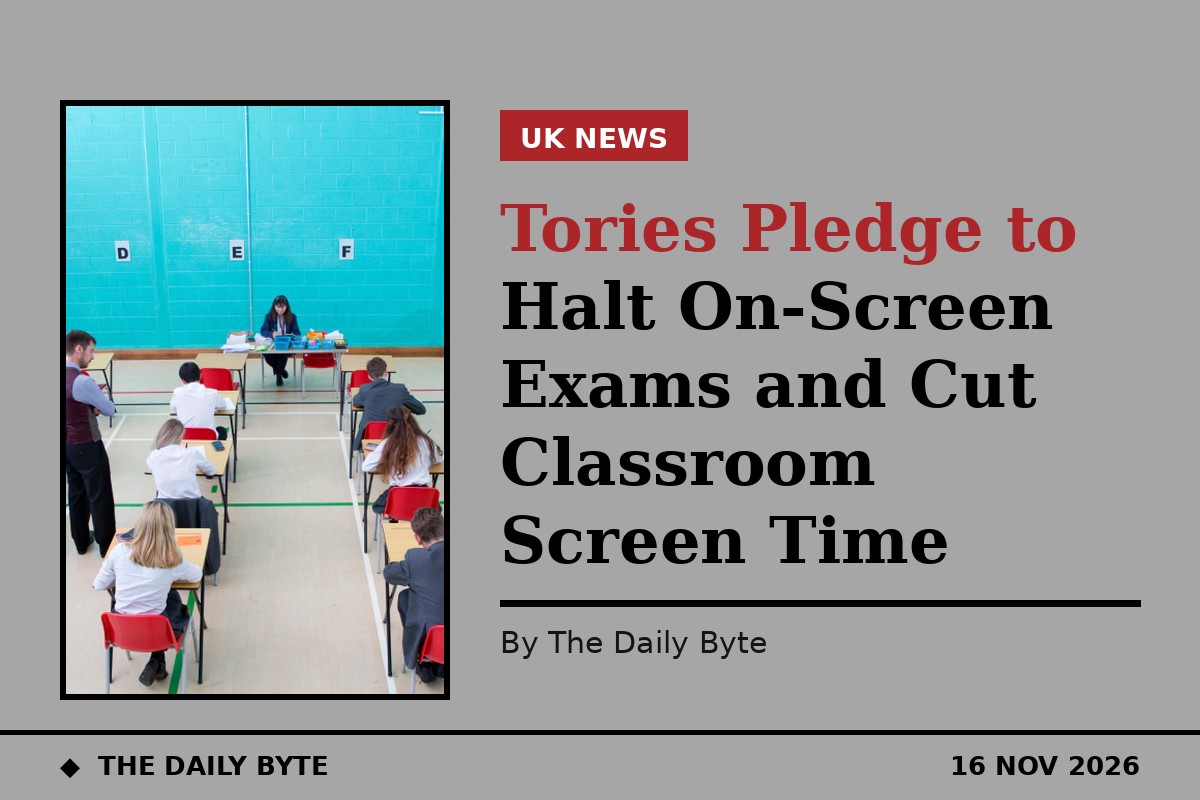
The Conservatives have pledged to halt the rollout of screen-based exams in England, cut coursework and sharply limit screen time in schools if the party returns to power, in a plan aimed at reducing children's reliance on artificial intelligence and digital devices.
The proposals were announced on Sunday, 15 November, and set out at a press conference in London on Monday, 16 November, by party leader Kemi Badenoch and shadow education secretary Laura Trott. They are opposition pledges, not current government policy, and nothing changes for pupils taking exams under the existing arrangements.
What the plan would do
Under the plan, the introduction of on-screen exams would be stopped, and reversed where it has already happened. The amount of coursework in school assessment would be minimised, with the party arguing that coursework is vulnerable to undisclosed use of AI tools.
Screen use would be banned in early years settings, including for the reception baseline assessment. In primary schools, screens would be kept to an absolute minimum and used only where relevant to the curriculum, such as for computing. Secondary pupils would be limited to a maximum of two hours of screen time a day, including homework.
New guidelines for teachers would seek to ensure that laptops and tablets are not the default in classrooms. The party also proposed a new £250 million textbook fund, aiming for three physical books per pupil, which it said could be funded by repurposing what it claimed was £900 million spent each year on education technology.
Why the party says it is needed
Ms Trott said Britain had "sleepwalked into a situation where nearly a million children spend almost every lesson" on a device, despite warnings from health professionals about excessive screen time. She said she wanted to "slash screen use in classrooms and set a new norm where screens are no longer the default".
The party later clarified that the figure about children spending almost every lesson on a screen was based on a survey of 2,000 parents carried out by Focaldata for the campaign group SafeScreens. The plan also drew on warnings from more than 150 clinicians in the Health Professionals for Safer Screens campaign, who have raised concerns about the effect of screens on children's health, development and learning.
Ms Badenoch questioned the exam board AQA, which has argued that the move towards on-screen assessment is going too slowly. "Who is AQA trying to help here?" she said, adding that companies would say things that were helpful to them, "not necessarily helpful for the children who have to go to school and take these exams". AQA declined to respond when contacted by Tes.
The current position on digital exams
At present, the vast majority of school exams in England are still taken with pen and paper. The exams regulator, Ofqual, consulted between December 2025 and March 2026 on how on-screen assessment should be regulated for GCSEs, A levels and AS levels, and has said pen and paper would remain central to most exams. Ofqual has said some on-screen exams could be introduced by 2030, for subjects with fewer than 100,000 entries a year.
Department for Education figures show how widespread devices already are: in 2025, 87 per cent of primary schools had tablets for pupils and 98 per cent of secondary schools had desktop computers.
Labour disputed the funding claim, calling it "just bad maths" and saying the education technology budget covers basic infrastructure and data protection in schools, not just screens. The Department for Education said it would publish guidance on screen use for children aged five to 18 in the new year, building on strengthened guidance on phone-free school days.
For now, the Conservative package remains a promise for a future government. It would only take effect if the party wins the next general election and then carries it out.
Sources: Tes and Schools Week.


