UK hosts Chinese defence chief in first visit in 26 years
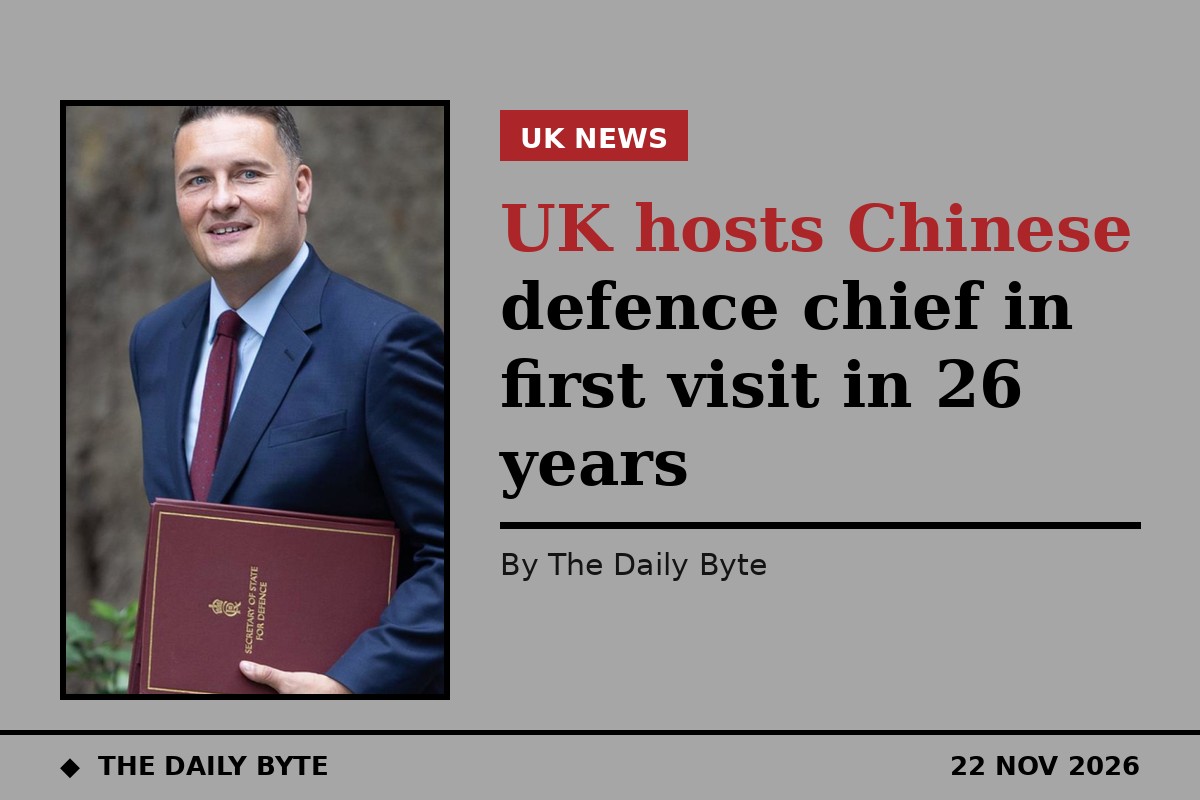
Defence Secretary Wes Streeting has hosted China's defence minister in London in the first visit of its kind to Britain in 26 years, as the government tries to rebuild military-to-military contact with Beijing without lowering its guard.
Admiral Dong Jun, China's minister of national defence, met Mr Streeting on Thursday 19 November. In a written statement to Parliament, Mr Streeting said it was the first visit of its kind for 26 years, when Labour was last in government.
Diplomacy without lowering the guard
Writing in The Times before the meeting, Mr Streeting said Labour should "extend the hand of diplomacy" to China without "lowering our guard". He said the government had "stepped up our interaction with China", but stressed this was based on "a clear-eyed assessment of both the opportunities and the risks involved".
He said Britain must forge better relations with Beijing despite the danger of cyberattacks, espionage and foreign interference. He added that the differences between the two countries were profound, and that he would speak plainly to Admiral Dong about human rights and coercion in the Indo-Pacific.
Mr Streeting, who described China as a "threat" in an interview last month, said engaging directly with Admiral Dong was the same approach his counterparts in the United States, France, Germany and Italy had taken in recent years. As defence secretary, he said, he had an additional responsibility: "to ensure that strategic rivalry does not become military confrontation through misunderstanding or miscalculation."
Ukraine and the wider picture
Mr Streeting also argued that co-operating with China could help Ukraine, because President Xi Jinping could be "a restraining influence on the worst instincts of President Putin's war machine".
The visit announced no defence pact and no change in Britain's alliances. According to Chinese state media, the two ministers exchanged views on relations between the two countries and their armed forces, and on international and regional issues, and said they would work to implement the consensus reached by the two countries' leaders.
Criticism at home
The visit has drawn criticism from some quarters. A report by the think tank Policy Exchange, titled The China Trap, warned that China accounts for 91 per cent of the UK's solar imports and 94 per cent of the permanent magnets used in wind power, and argued that Britain's transition to net zero faces security risks from that dependence.
Shadow foreign secretary Tom Tugendhat and Labour peer Maurice Glasman have both criticised the government's approach to China. The government's position, set out in its manifesto, is that Britain should "co-operate where we can, compete where we need to, and challenge where we must".
What happens next
No concrete agreements were announced from the talks, and Beijing confirmed the meeting without announcing any specific topics, mechanisms or verifiable results. The significance of the visit lies in the channel itself: after more than a quarter of a century without a Chinese defence minister visiting Britain, the two sides now have a direct line of communication between their defence chiefs. Whether that channel produces anything concrete, and whether the government can sustain its balancing act between engagement and vigilance, will be tested in the months ahead.