UK Spouse Visa £29,000 Income Rule Explained
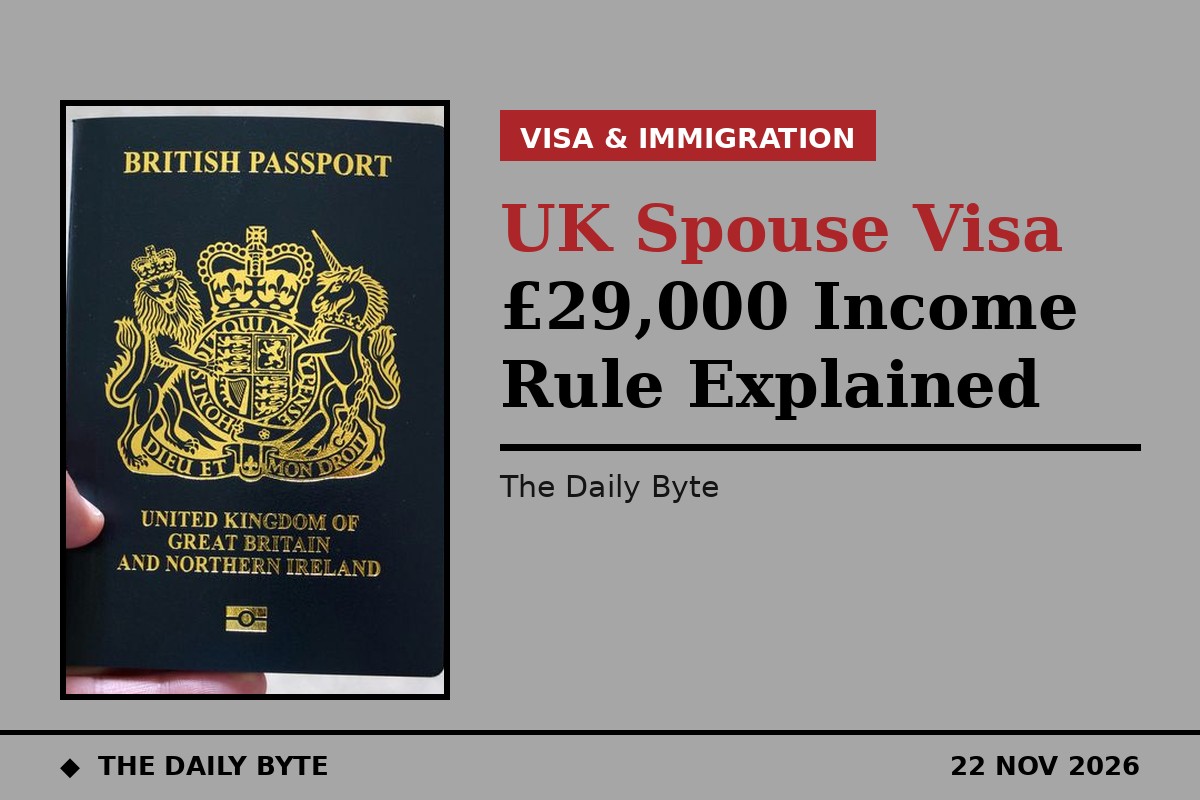
The UK spouse visa minimum income requirement is £29,000 a year for most new applications. You and your partner must usually prove a combined gross annual income of at least that amount, or show you can cover the gap with cash savings. The figure applies to first applications made on or after 11 April 2024, and it is set out in the Immigration Rules under Appendix FM.
This guide explains who the £29,000 rule applies to, who pays a lower figure, how savings can replace income, and which income counts. It is general information about the rules as they stand on 22 November 2026, not personal immigration advice. Immigration rules change, so always check the official GOV.UK page before you apply: GOV.UK — Family visas: prove your income.
How much income do you need for a spouse visa?
For most couples applying for the first time on the partner route on or after 11 April 2024, the answer is £29,000 a year in gross income — that is, income before tax and National Insurance. GOV.UK states it plainly: “you and your partner usually need to prove that your combined income is at least £29,000 a year. This is called a ‘minimum income requirement’.”
The income can be yours, your partner’s, or a combination of both, as long as each source is one the Immigration Rules allow and you can prove it with the evidence Appendix FM-SE requires. The Home Office does not simply take your word for the figure: the documents, the dates they cover and the format they are in all matter, and applications are refused on paperwork even when the couple earns comfortably above the line.
There is no separate extra amount for children under the current £29,000 rules. That is a change from the older framework, under which child supplements applied.
Who pays the lower £18,600 figure?
Not everyone is tested at £29,000. If you first applied as a partner before 11 April 2024 and you are now extending that visa with the same partner, the old threshold still applies: a combined income of at least £18,600 a year. GOV.UK confirms this, and adds that under the older framework you must prove extra money for children who are dependants on the visa — £3,800 for the first child and £2,400 for each further child, as set out in the Immigration Rules.
Partners of serving members of HM Armed Forces face a different threshold again: £23,496 for new applications made on or after 11 April 2024, under Appendix HM Armed Forces. If your partner is in the armed forces, check the armed-forces section of the GOV.UK financial-requirements guidance rather than the civilian figure.
How cash savings can replace income
If your income falls short of £29,000, cash savings can fill the gap — but only savings above £16,000 count, and the amount above that level is divided by 2.5. The formula is: (savings minus £16,000) divided by 2.5 equals the income the savings are worth.
Worked examples make the arithmetic clear. With no income at all, you would need £88,500 in savings: £16,000 plus 2.5 times £29,000. If your combined income is £24,000, the shortfall is £5,000, so you need £16,000 plus 2.5 times £5,000 — £28,500 in savings held for the required period. Under the older £18,600 framework, the savings-only figure is £62,500.
Savings must have been held for at least six months, and the source of the savings can be checked. Money borrowed from a bank or a loan does not count as savings for this purpose.
Which income counts — and which does not
The Rules allow income from specified sources only. Salaried employment, self-employment, pensions, rental income and some other specified sources can count. The Home Office groups permitted income into categories, and the evidence you need depends on the category.
For salaried employment with the same employer for six months or more — known as Category A — the lowest payslip in the six-month period sets the annualised figure. That surprises many applicants: one low month, for example because of unpaid leave, can pull the whole calculation down. Self-employed applicants face a different test, based on their tax year, and must produce the tax documents the Rules specify.
Some money does not count at all. Loans do not count, and most state benefits do not count as income towards the threshold — Universal Credit, Child Benefit and tax credits are among the sources that do not count, according to legal guidance on the Rules. What matters is not how much money passes through your household, but how much comes from sources the Rules recognise.
When there is no minimum income figure at all
There is an important exception. You do not need to meet a minimum income figure if your partner receives one of the disability or carer’s benefits GOV.UK lists. Those include Disability Living Allowance, Personal Independence Payment, Carer’s Allowance, Attendance Allowance, Severe Disablement Allowance, Industrial Injuries Disablement Benefit, Armed Forces Independence Payment and several others set out on the GOV.UK page.
In that case a different test applies, called “adequate maintenance”: you must show that you and your family have enough money to house and support yourselves without relying on additional public funds. The caseworker looks at your income after housing costs and compares it with what a family on income support would have.
Fees, health surcharge and waiting times
The money test is only one part of the application. The fee for a partner visa is £2,064 if you apply from outside the UK and £1,407 if you apply from inside the UK, according to GOV.UK. On top of that comes the immigration health surcharge: £2,587.50 for a stay of two years and six months, or £3,105 for two years and nine months, for each adult.
Decisions usually take up to 12 weeks for applications made outside the UK. Applications made inside the UK usually take up to eight weeks if you meet the financial and English-language requirements — but GOV.UK warns that if you do not meet them, it currently takes about 12 months. A faster decision may be available for an extra fee in some cases.
You must also meet the other partner-visa tests: both of you must be 18 or over, your partner must be British or Irish, settled in the UK, or in another qualifying category, you must show a genuine and subsisting relationship, you must have adequate accommodation, and you must show English at level A1 or above for a first application.
Is the £29,000 threshold going up?
Not currently. The staged rises announced in 2023 — first to £34,500 and ultimately to £38,700 — were shelved, and the Migration Advisory Committee’s family visa financial requirements review, published in June 2025, recommended against raising the threshold to £38,700. No change has been implemented since, and any future move would arrive through the Immigration Rules with notice. Applications are decided under the rules in force on the day you apply, so the figure that matters is the one in force when your application is submitted — another reason to check the official GOV.UK guidance before you apply.
A second source, the legal guide published by KQ Solicitors and checked against GOV.UK in October 2026, confirms the same figures: £29,000 for most new applications, £18,600 for pre-April 2024 extensions, £23,496 for armed-forces partners, and the £16,000-plus-2.5-times formula for savings. You can read it at KQ Solicitors — UK Spouse Visa Financial Requirement 2026.
FAQ
What is the UK spouse visa minimum income requirement in 2026?
Usually £29,000 a year in combined gross income for first applications made on or after 11 April 2024. Savings can cover a shortfall under the formula in this guide.
Can savings replace income for a spouse visa?
Yes. Only savings above £16,000 count, divided by 2.5. With no income at all you need £88,500 in savings under the current £29,000 rules.
Do I still need £29,000 if my partner gets PIP or Carer’s Allowance?
No. If your partner receives one of the listed disability or carer’s benefits, the minimum income figure does not apply. Instead you must show adequate maintenance.
What if I first applied as a partner before 11 April 2024?
When you extend with the same partner, the old £18,600 threshold applies, plus £3,800 for the first child and £2,400 for each further child who is a dependant.
How long does a spouse visa decision take?
Usually within 12 weeks from outside the UK, and within eight weeks from inside the UK if you meet the financial and English-language requirements.
This article is general information about the spouse visa financial requirement on 22 November 2026. It is not immigration advice for your own circumstances. Check the official GOV.UK page — rules change — and consider regulated immigration advice before you apply.