UK Student Visa Explained: Fees, Rules and How to Apply
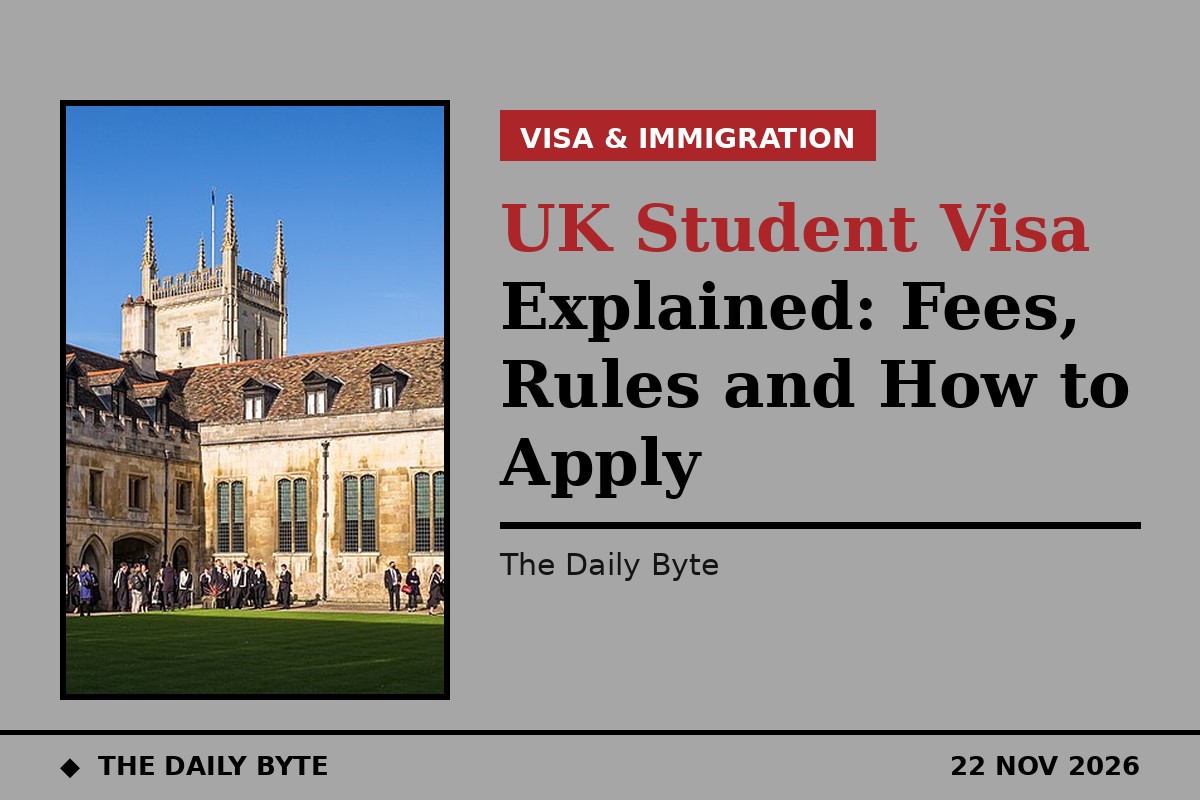
A UK Student visa lets you come to the United Kingdom to study a course at a licensed education provider. You must be 16 or over, have an unconditional offer of a place on a course from a licensed student sponsor, be able to speak, read, write and understand English, and have enough money to pay for your course and support yourself. Your sponsor gives you a Confirmation of Acceptance for Studies, known as a CAS, and you apply online through GOV.UK. This guide explains the requirements, the fees, the money you must show, how long the visa lasts, and what you can and cannot do once you hold it. Immigration rules change, so always check the official GOV.UK page before you apply, and this guide is general information, not personal immigration advice.
Who can apply for a UK Student visa?
You can apply for a Student visa if you are 16 or over and you have been offered a place on a course by a licensed student sponsor, you have enough money to support yourself and pay for your course, and you can speak, read, write and understand English. If you are 16 or 17, you will also need evidence of consent from your parents. If you are 16 or 17 and want to study at an independent school, you may be eligible for a Child Student visa instead. The Student visa replaced the old Tier 4 (General) student visa, so older guides that mention Tier 4 are describing the same route under its former name.
The course itself must be eligible. In practice that means a full-time course at degree level or above, or another course offered by a licensed sponsor that meets the Immigration Rules, such as some courses below degree level, pre-sessional courses, and recognised foundation programmes. Your education provider will tell you whether your course qualifies, and it will only issue a CAS for a course that meets the rules. Do not pay a deposit or book travel until you have the CAS, because you cannot apply without its reference number.
What is a CAS and why do you need one?
A CAS is a Confirmation of Acceptance for Studies. It is an electronic record, not a paper certificate, that your sponsor creates once it has offered you an unconditional place. The CAS contains a unique reference number, details of your course, its start and end dates, its fees, and the qualifications your sponsor relied on when it offered you the place. You enter the CAS number in your online application, and UK Visas and Immigration checks it against its own systems. A CAS is normally valid for six months, and you can only use it once, so apply promptly after you receive it. If your course details change after the CAS is issued, ask your sponsor to correct it before you apply, because a mismatch between the CAS and your application can delay or damage your case.
The English language requirement
You must show you can read, write, speak and understand English to the level your course requires. For courses at degree level or above, that is normally CEFR level B2, which is roughly upper-intermediate. For courses below degree level, it is normally CEFR level B1, which is intermediate. You usually prove this with a Secure English Language Test from an approved provider, or with a qualification your sponsor accepts, such as a previous degree taught in English. Some applicants do not need to prove their English, for example nationals of majority English-speaking countries, but the GOV.UK guidance lists exactly who is exempt. Your sponsor may also assess your English itself and record the result on your CAS. Take the test early, because a failed or delayed test is one of the most common reasons applications are submitted late.
How much does a UK Student visa cost?
It costs £558 to apply for a Student visa, whether you apply from outside the UK or extend or switch to a Student visa from inside the UK. That fee has applied since 8 April 2026, when it rose from £524. You must pay the fee for each person who applies, including any dependants. The application fee is not refunded if your visa is refused, so it is worth checking every requirement before you pay.
On top of the application fee, most applicants also pay the Immigration Health Surcharge, which gives access to the National Health Service on broadly the same basis as UK residents. For students the surcharge is £776 per year of visa permission, with periods of less than six months charged at half the annual rate, £388. The surcharge is calculated on the length of your visa, which includes extra time before and after your course, so a three-year degree can carry a surcharge of £2,716. Unlike the application fee, the surcharge is refunded in full if your application is refused. If you apply from inside the UK, you pay the surcharge whatever the length of your visa; if you apply from outside the UK, it applies to visas of more than six months.
How much money must you show?
You must show you can pay your course fees for the first year and your living costs for up to nine months. For living costs, the Home Office expects £1,529 a month if you are studying in London, or £1,171 a month if you are studying outside London, for applications made before 30 November 2026. From 30 November 2026, published guidance raises those figures to £1,570 a month in London and £1,203 a month elsewhere. For a course of nine months or more, that means £10,539 outside London, or £10,827 from 30 November 2026, plus the first year of course fees. For shorter courses, you show £1,171 for each month of the course, or £1,203 from 30 November 2026.
The money must have been held for 28 days, and you must be able to evidence it with documents the Home Office accepts, such as bank statements, or show that you have an official financial sponsor. Some applicants do not need to provide financial documents with the application because they are applying from a country on the Home Office's differential-evidence list, but the Home Office can still ask for the evidence, so keep it ready. If your sponsor has already received part of your course fees, the amount is recorded on your CAS and reduces the sum you must show. Check the GOV.UK guidance for the exact rules that apply to your circumstances, because the financial requirement is one of the most common grounds for refusal.
When to apply and how long a decision takes
If you are applying from outside the UK, the earliest you can apply is six months before your course starts. If you are applying from inside the UK, the earliest is three months before your course starts, and you must apply before your current visa expires. Your new course must begin within 28 days of your current visa expiring. You will usually get a decision within three weeks if you apply from outside the UK, or within eight weeks if you apply from inside the UK. You may be able to pay for a faster decision, and you will be told whether that is available when you apply.
Successful applicants receive an eVisa, a digital record of their immigration status, rather than a physical visa sticker in most cases. You must not travel to the UK before the start date given on your visa, even if your course starts earlier. The visa normally allows you to arrive up to one month before your course begins for courses of six months or more, or up to one week before for shorter courses, but the exact dates on your grant are the ones that count.
How long can you stay?
How long you can stay depends on the length of your course and what study you have already completed in the UK. If you are 18 or over and your course is at degree level, you can usually stay in the UK for up to five years. If your course is below degree level, you can usually stay for up to two years. Extra time is added at the end of your course, normally two months for courses of between six and twelve months, and four months for courses longer than twelve months. You may be able to extend your visa to continue your studies, or switch to another visa route, if you meet the requirements of that route at the time.
Working while you study
Most degree-level students at a higher education provider can work up to 20 hours a week during term time, and full time during holidays, but the exact conditions depend on your course level and your sponsor, and they are printed on your eVisa. Students on courses below degree level usually have a lower limit, often 10 hours a week in term time. You cannot be self-employed, work as a professional sportsperson or sports coach, or claim public funds. You can do a work placement if it is an assessed part of your course. Always check the work conditions on your own grant before taking a job, because working more hours than your visa allows can affect future applications.
Can you bring your partner or children?
You may be able to bring your partner and children as dependants, but the rules are now narrow. In most cases, only students on postgraduate research courses, or courses funded by a government scholarship, can bring dependants. Your dependants must each pay the £558 application fee and the Immigration Health Surcharge at the student rate, and you must show extra money to support them. Each dependant needs their own application and their own CAS-linked evidence. Because the dependant rules changed in January 2024 and further changes have been announced since, check the current GOV.UK guidance for your course type before making plans for your family.
After your course: the Graduate visa
After successfully completing your course, you may be able to stay in the UK under the Graduate visa, which lets you work, or look for work, without needing a sponsor. GOV.UK currently states that a Graduate visa allows you to stay for two years if you apply on or before 31 December 2026, or for 18 months if you apply on or after 1 January 2027. That change is one reason to check the official page close to the time you apply rather than relying on older guides. You must apply for the Graduate visa from inside the UK, and you must have successfully completed your course. The Graduate visa cannot be extended, but you can switch to another route, such as the Skilled Worker visa, if you meet its requirements.
Common mistakes to avoid
The most common problems are avoidable. Do not apply without a CAS, or with a CAS that has already been used. Do not let your money fall below the required amount during the 28-day holding period, even for a day, because the Home Office checks the lowest balance in that window. Do not submit bank statements that are out of date or in a format the Home Office does not accept. Do not book non-refundable travel before your visa is granted. And do not use an agent who asks you to pay for a job or a guaranteed visa, because no one can guarantee a decision, and the Home Office decides every application on its own merits.
Frequently asked questions
How much is a UK Student visa in 2026? The application fee is £558, whether you apply from outside the UK or extend or switch from inside the UK. You will also usually pay the Immigration Health Surcharge of £776 per year of visa permission, and you must show money for your course fees and living costs.
How long does a Student visa take? You will usually get a decision within three weeks if you apply from outside the UK, or within eight weeks if you apply from inside the UK. Faster services may be available for an extra fee.
What is a CAS? A Confirmation of Acceptance for Studies is an electronic record your licensed sponsor creates when it offers you an unconditional place. It carries a unique reference number you need for your application, and it records your course, its dates and its fees.
Can Student visa holders work in the UK? Most degree-level students can work up to 20 hours a week during term time and full time in holidays, but the exact limit depends on your course and sponsor, and it is stated on your eVisa. You cannot be self-employed or claim public funds.
Can I stay in the UK after my studies? You may be able to apply for a Graduate visa after successfully completing your course. It currently allows a stay of two years for applications made on or before 31 December 2026, or 18 months for applications made on or after 1 January 2027. Check the GOV.UK page for the rules in force when you apply.
Immigration rules and fees change, and the figures in this guide are those published as of 22 November 2026. Before you apply, read the official Student visa guidance on GOV.UK, which is the authoritative source. Guidance from universities, including the Nottingham Trent University student visa guide, also explains the process step by step. If your case is complicated, consider regulated immigration advice rather than relying on a general guide.