UN warns UK on security laws as Palestine Action ban weighed
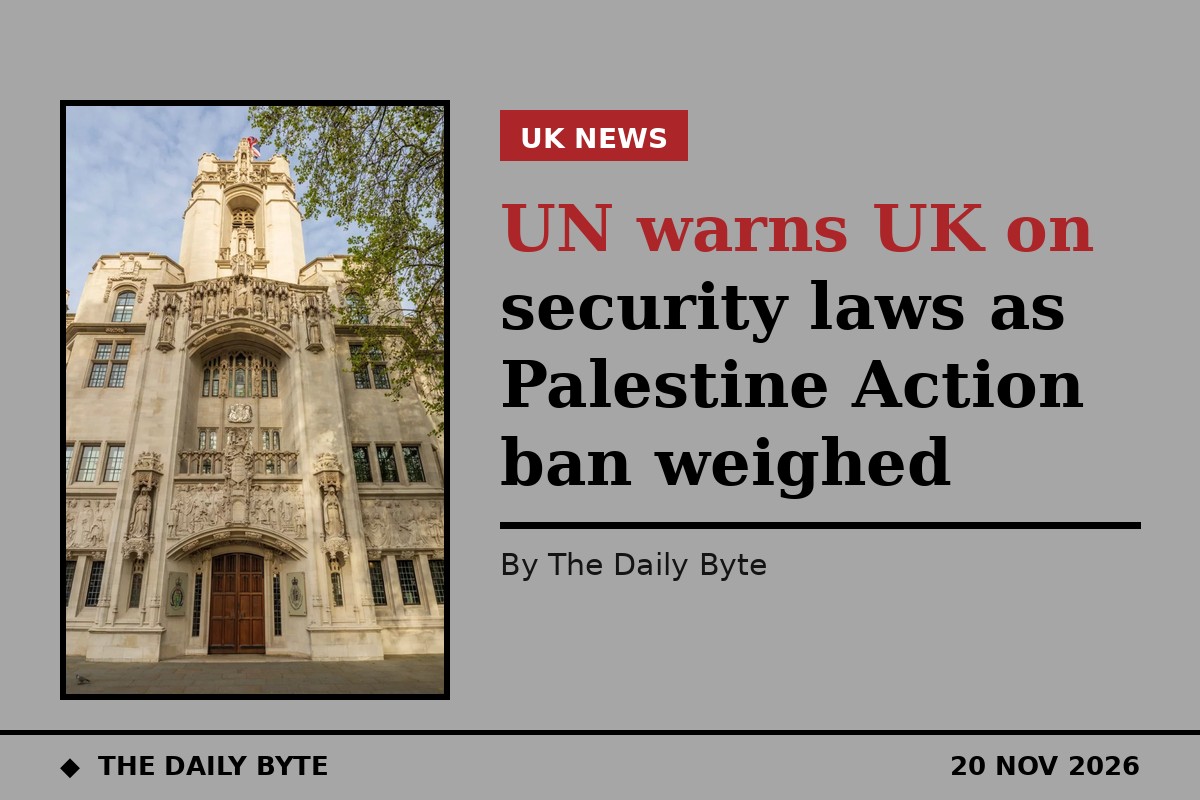
The United Nations Human Rights Committee has warned against the misuse of counter-terrorism and national security legislation, as the UK's highest court considers whether the ban on Palestine Action was lawful.
The committee published its first comprehensive guidance on freedom of association on Thursday 19 November. The document criticises vaguely worded laws that target "extremism" or "undesirable" organisations, and says the right to defend human rights, report violations or advocate for accountability "cannot as such be labelled as a threat or breach of public order".
While the guidance does not explicitly refer to Palestine Action, its vice-chair, Helene Tigroudja, said the decision to issue it had been spurred by events in countries including the UK, North Korea, Russia, China and Israel.
Supreme Court judgment awaited
The warning lands while the UK Supreme Court considers a challenge to the proscription of Palestine Action. The case, R (on the application of Ammori) v Secretary of State for the Home Department (UKSC/2026/0099), was heard on 4 and 5 November 2026, and judgment is awaited.
Palestine Action was proscribed by the then Home Secretary in June 2025, with the implementing order coming into effect on 5 July 2025. It was the first direct action group to be banned under the Terrorism Act 2000, placing it on the same proscribed list as groups including al-Qaida and Boko Haram.
Huda Ammori, one of the group's two co-founders, challenged the decision. The Divisional Court found in her favour on two grounds, holding that the decision was unlawful because the Home Secretary's reasoning was inconsistent with her own policy and because proscription was incompatible with Articles 10 and 11 of the European Convention on Human Rights, which protect freedom of expression and freedom of association.
The Court of Appeal disagreed and allowed the Home Secretary's appeal, concluding that the policy had been correctly applied and that proscription was a proportionate interference with those rights. Ms Ammori now appeals to the Supreme Court, with permission granted on the question of whether the proscription is compatible with Articles 10 and 11.
What each side says
Ms Ammori said the UN committee's report "goes to the heart of the Palestine Action case" and urged the Supreme Court to heed its warning and overturn what she called "this unjust, dangerous and disproportionate ban".
In the Supreme Court case, her lawyer described the group's aims as the "disruption of the supply of weapons from the United Kingdom to Israel at a time when the international court of justice had found a real and imminent risk of irreparable prejudice to the rights of Palestinians in Gaza".
A Home Office spokesperson said: "As the court of appeal found, Palestine Action is not a civil disobedience protest group but one that carried out acts of terrorism, celebrated those who took part in them and promoted the use of violence."
The Supreme Court's case record lists Amnesty International UK, the National Council for Civil Liberties, English PEN and PEN International among the interveners, alongside Professor Ben Saul, the UN Special Rapporteur on the promotion and protection of human rights while countering terrorism.
Sources: The Guardian; UK Supreme Court.


