US firms seek deep-sea mining near Pacific islands
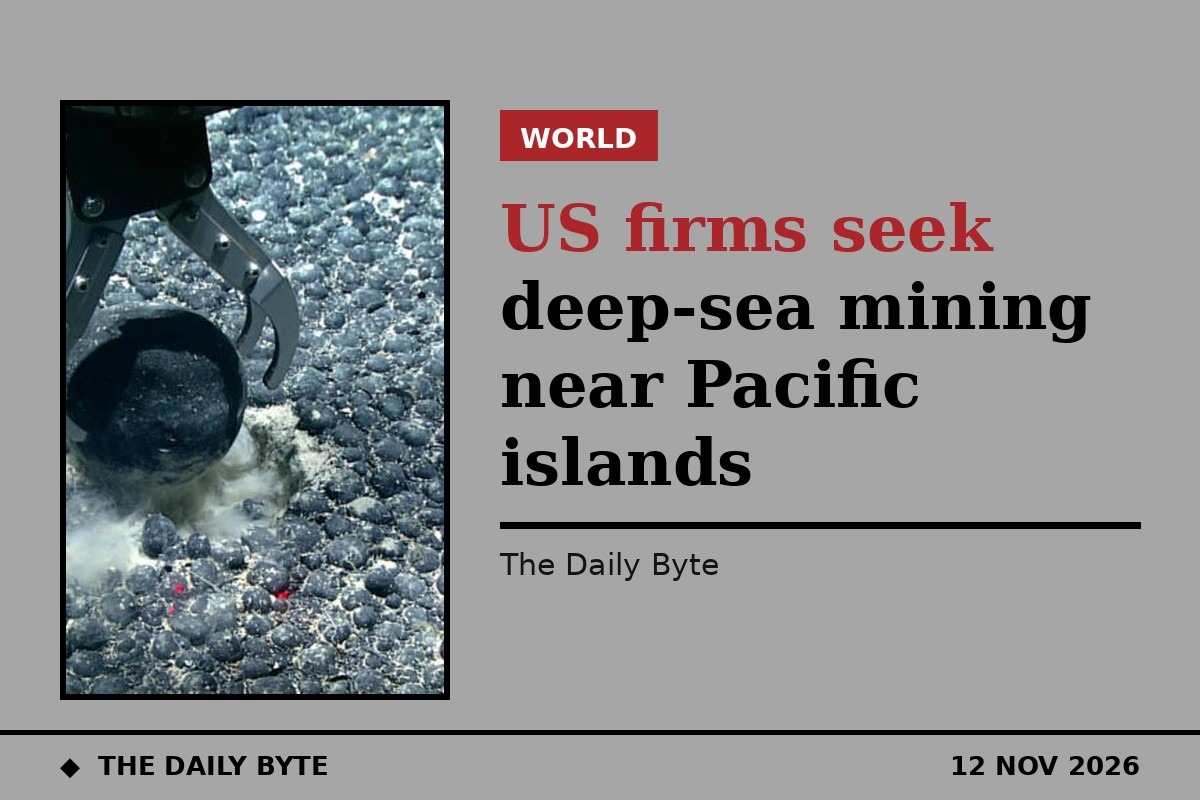
Two US companies have applied to the United States government for licences to explore the deep seabed in two large areas of international waters near the Cook Islands, Kiribati and French Polynesia in the South Pacific, drawing pushback from Pacific governments and environmental groups. The applications are part of a wider move by American firms to stake claims to the international seabed through a US permitting process that bypasses the United Nations-linked body set up to regulate deep-sea mining.
The two applicants are Delaware-incorporated American Deep Sea Minerals, Inc. (ADSM) and Florida-based American Ocean Minerals Corporation (AOM). They want to explore the seabed for its mining potential, with a view to eventually extracting and selling seabed minerals. Their plans focus on two areas: a 101,064-square-kilometre pocket of international waters bounded by the exclusive economic zones of the Cook Islands, Kiribati and French Polynesia, and an 89,645-square-kilometre area south of the Cook Islands' exclusive economic zone. Both areas hold polymetallic nodules, potato-sized rocks that contain nickel, manganese, copper, cobalt and other minerals.
A permitting route outside the UN system
The applications go to the National Oceanic and Atmospheric Administration (NOAA), the US scientific and regulatory agency in charge of issuing deep-sea mining licences to US companies in international waters. They rely on the Deep Seabed Hard Mineral Resources Act, a 1980 US law that lets American entities seek permits to explore and recover minerals beyond national jurisdiction. The process bypasses the International Seabed Authority (ISA), the UN-linked body tasked with regulating mining on the high seas and protecting the marine environment. The United States signed the United Nations Convention on the Law of the Sea but never ratified it, so it is not a party to the treaty behind the ISA system.
An application is not an authorisation. NOAA has determined that one filing meets the information requirements to move through its assessment process, but the agency has not approved an exploration licence or a commercial mining permit. Aside from publishing ADSM's application in the US Federal Register and holding a virtual public hearing on it in July, NOAA has made no further announcements about the application. It has yet to publicly acknowledge AOM's applications or publish them in the Federal Register, and it did not respond to further questions about the pending applications.
ADSM, a company established in 2025 and run by financial analyst Graham Goulet, is seeking exploration rights over the entire pocket, known as Eastern High Seas Pocket 3. It has proposed a four-year technical work programme that would culminate in a mining equipment trial. Previous reporting suggests the company does not appear to possess mining equipment or other technology needed to conduct deep-sea mining, nor does it appear to maintain an online presence.
AOM, which is led by former Rio Tinto chief executive Tom Albanese, has also filed an application with NOAA to mine in a 56,509-square-kilometre enclave within the pocket, according to a company filing with the US Securities and Exchange Commission. The company acknowledges in the filing that an earlier-filed application, apparently ADSM's, would have "priority of right" to the area, but says it elected to continue its application. AOM has also applied to NOAA for rights to a patch of seabed just south of the Cook Islands' exclusive economic zone, as well as blocks in the Clarion-Clipperton Zone, a vast area between Hawaii and Mexico. Separately, AOM is set to acquire a substantial stake in two active deep-sea mining exploration licences within the Cook Islands' exclusive economic zone after its planned one-billion-dollar merger with Florida-based deep-sea mining company Odyssey Marine Exploration.
Why Pacific islanders are pushing back
French Polynesia, which has banned deep-sea mining in its territorial waters, has vocally opposed ADSM's plans. In a letter to NOAA lodged in July during the public comment period for the application, the French Polynesian government requested that NOAA deny the application or suspend the review process, require more information, conduct a thorough environmental review, and formally consult France, French Polynesia, the Cook Islands, Kiribati and relevant regional organisations. It also questioned NOAA's authority to permit mining in international waters, arguing that any mineral resource activity "must be addressed through the multilateral framework established under international law, including the International Seabed Authority". France, French Polynesia's administering power, is an ISA member and called for an outright ban on the industry in 2022.
The proposed mining area borders French Polynesia's Tainui Atea marine protected area network, which spans nearly the entirety of French Polynesia's exclusive economic zone and is the world's largest marine protected area, and sits directly beside the Societe Ouest reserve, a strictly protected area that allows no industrial activities such as fishing. The pocket is a crucial marine corridor for a range of species, including the critically endangered oceanic whitetip shark, and has been designated a special management area by the Western and Central Pacific Fisheries Commission since 2010. The high seas treaty, the agreement on marine biodiversity beyond national jurisdiction, took effect in January and will enable marine protected areas to be established in international waters.
Pacific organisations have also objected. The Cook Islands groups Korero o te 'Orau, Te Ipukarea Society and Ocean Toa, along with French Polynesian organisation Te Pu 'Atiti'a, which are part of the Ocean Ancestors collective, wrote to NOAA during the public comment period asking it to deny the application, arguing the region is a critical migration corridor for tuna stocks that sustain food security and livelihoods, as well as whales, turtles and other species. Louisa Castledine, a spokesperson for the collective, said the companies' plans create a "dangerous pathway of opening up the Pacific region to increased exploitation and vulnerability". The governments of the Cook Islands and Kiribati have not publicly voiced their stances on either company's plans. The Cook Islands has signed a critical minerals framework with Washington, but says the agreement is not a mining licence, and no commercial mining decision is expected there before 2032.
What the companies and regulators say
Goulet told Mongabay his company had "proposed an exploration program focused on scientific and environmental study", intended to survey the seabed, characterise the surrounding environment and build a much stronger scientific understanding of the area than exists today. "We believe that better information is valuable to everyone with an interest in these waters, and we are committed to conducting the work carefully and responsibly," he said. AOM did not respond to a request for comment.
NOAA communications director Kim Doster previously told Mongabay that the agency's "permitting and review process includes a robust and comprehensive environmental review" and that its "gold standard science will provide the benchmark for sustainable deep ocean mining practices for this emerging industry and for our international partners". Beyond the two South Pacific sites, US companies are also seeking rights through the same process to large seabed blocks in international waters near Guam and in the Clarion-Clipperton Zone. For now, no exploration licence has been granted and no mining has begun, but Pacific island governments and conservation groups say the applications are a test of whether the high seas will be opened to mining outside the multilateral system built to govern them.