£10m Wellcome Study to Test Whether Under-16s Social Media Ban Helps Children's Mental Health
By The Daily Byte
·18 Nov 2026
·5 min read
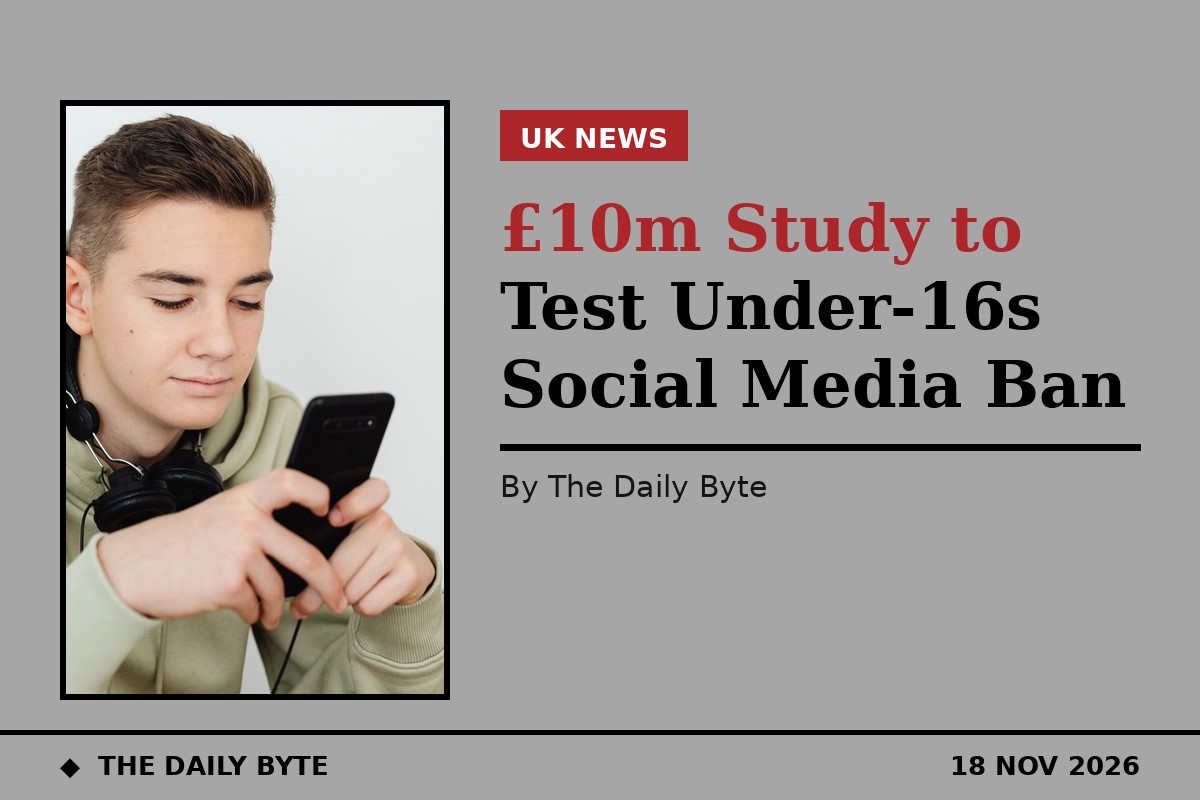
A major scientific study led by the health charity Wellcome will test whether the UK's planned social media ban for under-16s actually improves children's mental health. Backed by £9.3 million of funding from Wellcome, ten research projects will follow more than 300,000 young people across Britain, comparing their mental health, sleep and physical activity before and after the ban comes into force.
The ban for under-16s is expected in spring 2027, barring children from platforms such as Instagram, YouTube, TikTok, Snapchat, Facebook and X. There will also be restrictions around live-streaming and contact from strangers on gaming platforms. The study is described as the first of its kind, and some early results are expected before the ban takes effect.
## A question with very little evidence behind it
Countries around the world are considering social media bans for children, but whether they work in practice has been hotly debated. Dr Camilla Iannone, research lead at Wellcome, said there had been a heated debate about the ban in Britain and around the world, but very limited scientific evidence about how social media and its restrictions actually affect young people's mental health.
"We really don't think that this is a simple binary question of whether social media is good or bad, or whether restrictions work or don't work," she said. "Instead, the teams will study whether changing young people's digital environment leads to meaningful changes in their mental health and wellbeing." She called the ban a once-in-a-generation opportunity to study the question at scale.
Australia brought in a social media ban for under-16s last year, and other countries, including Canada, Greece and Denmark, are also taking action. The UK ban is expected to follow a similar model.
## What the ten projects will look at
The ten projects are based at universities across England, Wales and Scotland, including Cardiff University, the University of Oxford, the University of Birmingham, King's College London, the University of Edinburgh, the University of Manchester, the London School of Hygiene and Tropical Medicine and University College London.
One project, called Smart Schools Plus and co-led by Professor Victoria Goodyear of the University of Birmingham, will span 16 schools and 800 pupils in England. It will look not only at mental health and wellbeing, but also at physical activity, sleep, social networks, disruptive school behaviour, attainment and attendance, using surveys, apps, interviews, digital diaries and research-grade activity trackers.
"We're going to look at whether sleep, physical activity, social networks, and these other educational outcomes influence the mental health outcomes," Professor Goodyear said. "So it's answering, why are there any changes or why are there not any changes?" Her team will also explore whether risky content — such as material relating to self-harm, suicide and eating disorders — has moved from one online platform to another as a result of the ban.
Another project, co-led by Dr Gemma Knowles of King's College London, will explore whether the ban's impacts differ for young people of different genders, social class and sexual orientations. A third strand, led by Dr Alex Kwong from the University of Edinburgh, will work with families across England, Wales and Scotland to understand how the restrictions affect children and families together, including whether they lead to conflict at home and how families navigate it.
## Workarounds and what children do instead
The researchers will also examine the habits of children and teenagers in detail, including whether they spend less time on their phones and what they replace scrolling with. Dr Kwong's team will look at whether young people find workarounds for the restrictions. "If children and adolescents still use social media after the ban, that's the difference between understanding policy on paper and policy in practice," he said.
BBC News, reporting the launch, noted that the studies will use wearable technology, smartphones, digital diaries and surveys to collect data on how young people respond to the ban, both physically and mentally. The work is intended to inform future online safety policy in the UK and internationally.
Opinions on the ban remain split. Some raise concerns about the impact on young people who rely on social media for friendships, while others point out that children could find ways around the restrictions. The Wellcome study is designed to replace argument with evidence — measuring, before and after the ban, whether young people's lives actually change, and why.
## Frequently asked questions
**When does the UK social media ban for under-16s start?**
The ban is expected in spring 2027.
**How many young people will the Wellcome study follow?**
More than 300,000 young people across Britain, through ten separate research projects.
**What will the study measure?**
Children's mental health and wellbeing, sleep, physical activity, social networks, school behaviour, attainment and attendance, before and after the ban.
*Sources: The Guardian, via Finwire, "£10m 'once-in-a-generation' study to explore effects of children's social media ban" (https://finwire.io/news/world-news/10m-once-in-a-generation-study-to-explore-effects-of-childrens-social-media-ban); BBC News reporting by Annabel Rackham, "Largest British study to check social media ban's effect on youth mental health".*
Source
The Guardian (via Finwire) — https://finwire.io/news/world-news/10m-once-in-a-generation-study-to-explore-effects-of-childrens-social-media-ban 

