What does the UK face-to-face banking review mean for Monzo and Revolut customers?
On Monday 16 November 2026, the government accepted the central recommendation of an independent review into access to banking and said it will legislate to protect face-to-face banking in the UK. For Monzo and Revolut customers, the short answer is that nothing changes immediately — and the biggest question, whether digital-only banks will have to help pay for branches and banking hubs, has not yet been decided.
The review, chaired by former Which? director Richard Lloyd OBE and commissioned by HM Treasury in May 2026, drew on more than 18,000 public responses as well as evidence from businesses, charities, consumer groups and the banking industry. It concluded that declining access to in-person banking has caused widespread, material and recurring harm, and recommended new legal protections so people can keep getting the essential face-to-face services they need.
What did the face-to-face banking review find?
More than three million people in the UK currently rely on banking in person on a regular basis, according to evidence given to the review, rising to more than four million when less frequent users are included. Face-to-face banking matters most for older people, disabled people, people on low incomes, those facing difficult life events and those who find digital services harder to use.
The review found that people need in-person access for two kinds of essential service: day-to-day banking, centred on opening and managing a personal current account, and more complex services linked to unplanned life events or circumstances that need tailored support. When people cannot reach those services, the review found, the harm includes financial costs or gains missed, stress, disempowerment, risk-taking, lost confidence and lost time.
The scale of the change is stark. According to Financial Conduct Authority data cited by the government, 79.6% of the UK population lived within three miles of a physical bank branch run by one of the larger banks and building societies in 2025, down from 87% in 2022 At the same time, mobile banking has grown sharply: in the 12 months to 2024, 75% of day-to-day account holders used a mobile banking app, according to the FCA's Financial Lives Survey 2024.
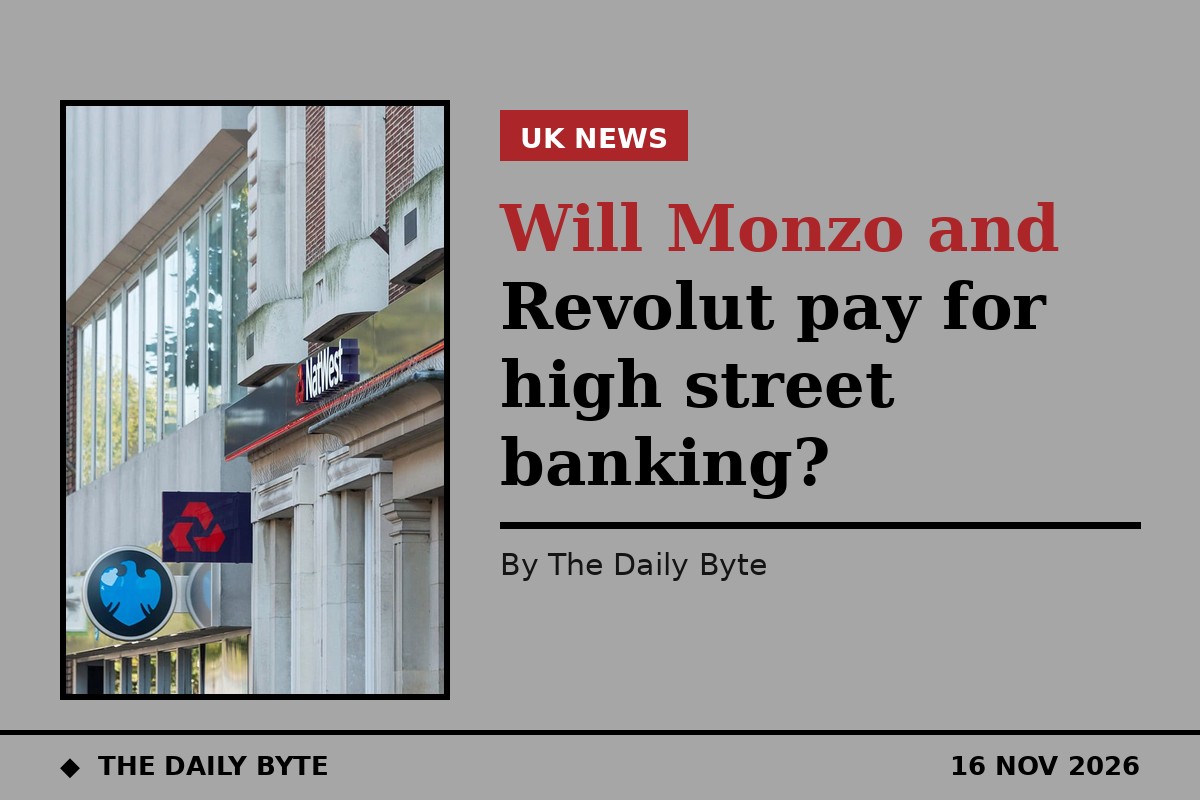
Will Monzo and Revolut have to pay for high street banking?
This is the question the review leaves open, and it is the most contested part of the announcement. The review found that large numbers of customers of digital-only banks frequently rely on physical cash services — in practice, leaning on the branches of traditional lenders such as NatWest, Barclays and Lloyds. Monzo, Revolut and Innovate Finance, which represents digital banks and fintech firms, were approached for comment when the review was published.
What has been decided is the principle: larger current account providers will face a legal duty to ensure reasonable access to essential in-person banking services, under a new statutory framework developed with the FCA, industry and consumer groups. What has not been decided is which lenders count as larger providers, how the duty will be defined, and whether digital-only banks that have never run branches will be asked to contribute to the cost of the services their customers use.
That matters because the cost of keeping physical banking going currently falls mainly on the high street banks that still run branches. High street lenders have already set up 250 shared banking hubs, operated by the Post Office, where customers of major banks and building societies can carry out cash transactions.
What are banking hubs, and will they replace branches?
A banking hub is a shared space where several banks provide services from one location, usually operated by the Post Office. The review does not require every branch to stay open: banks could meet the new legal duty through their own branches, through shared hubs, or through a mix of the two.
Who still needs face-to-face banking?
The government said face-to-face banking is particularly important for older people, disabled people, people on low incomes, those facing negative life events and those who find digital services harder to use. The FCA's Financial Lives Survey 2024 found that 17% of all UK adults found it difficult to get to a bank, building society or credit union using their normal forms of transport.
What happens next?
The government will now work with the FCA, industry, consumer groups and other stakeholders to design the detailed statutory framework, including what counts as reasonable access for different types of essential banking service. The review recommended that legislation be introduced as soon as possible. No date for a bill has been announced, and no decision has yet been taken on which lenders will be covered or how the costs will be shared.
Frequently asked questions
Will Monzo and Revolut customers have to pay extra? Not as a result of this announcement. The government has not decided whether digital-only banks will be asked to contribute to the cost of branches and banking hubs, and no charge on customers has been announced.
Will closed bank branches reopen? No. The review does not require every branch to stay open, and nothing in the announcement reopens branches that have already closed. The duty can be met through branches, shared banking hubs or a combination.
Does this affect my Monzo or Revolut account? No. Your account, card and app are unchanged. The announcement is about the legal framework for access to in-person services, which is still being designed.
Source: GOV.UK — Government commits to safeguard face-to-face banking