What Is a Green Card? US Permanent Residence Explained
By The Daily Byte
·26 Nov 2026
·9 min read
## What is a green card?
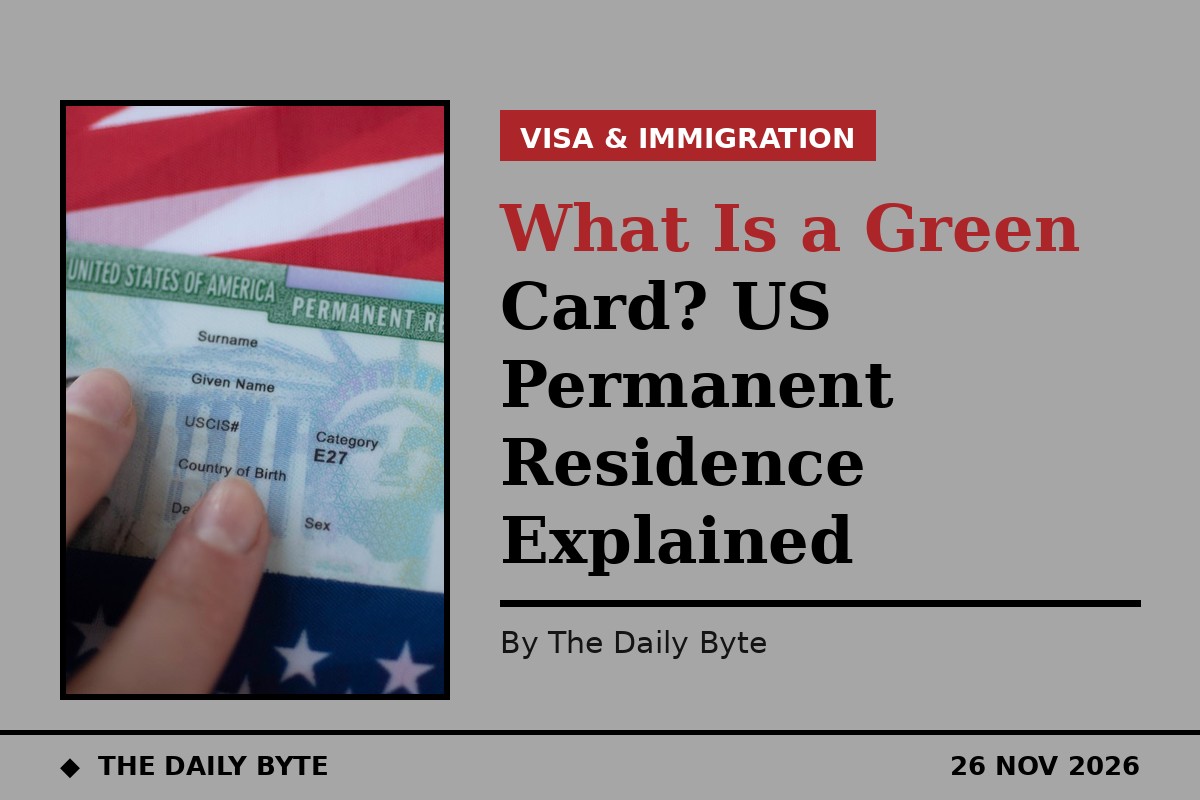
A green card is the common name for the United States Permanent Resident Card, officially known as Form I-551. It is the wallet-sized photo identity card issued by US Citizenship and Immigration Services (USCIS) that proves its holder is a lawful permanent resident (LPR) of the United States.
The distinction matters. Lawful permanent residence is the legal status; the green card is the physical proof of it. The status is what gives a person the right to live and work in the United States indefinitely. The card is the document they show to employers, at the border and to government agencies to prove that status. Estimates put the number of lawful permanent residents at about 12.8 million as of 2024, of whom almost 9 million were eligible to apply for US citizenship.
A green card is not a visa. A visa is permission to travel to the United States and seek entry for a specific purpose and a limited time. A green card has no departure deadline. It is also not citizenship. Citizens can vote, hold a US passport and cannot be deported. Green card holders can do most of what citizens do in daily life, but they cannot vote in federal elections, they can be removed from the country for certain crimes or fraud, and some federal jobs are open only to citizens.
This article is general information only. It is not legal or immigration advice, and US immigration rules change — anyone applying should check the current position with USCIS or a qualified immigration lawyer.
## What does a green card allow?
Lawful permanent residence carries broad rights. A green card holder may live permanently in the United States, in any state or territory, and may work for any employer without needing a separate work visa or permit. The card itself is a List A document for employment checks, meaning it alone proves both identity and the right to work.
Holders may own property, sign contracts, start a business, attend public schools and universities, and apply for federal student aid as eligible noncitizens. They may travel in and out of the United States, and the card serves as the re-entry document, replacing the need for a visa stamp at a US consulate. They may also sponsor certain family members — a spouse and unmarried children — for green cards of their own, although those family categories are capped each year and carry long waiting lists, unlike the categories open to US citizens.
Green card holders can obtain a Social Security number if they do not already have one, pay into the Social Security system and, after enough years of work, draw retirement, disability and Medicare benefits. They qualify for health insurance through the Affordable Care Act marketplace, although for Medicaid and the Children's Health Insurance Program there is generally a five-year waiting period for people who became permanent residents on or after 22 August 1996.
## What are the limits?
The limits are the reason the status is described as permanent residence rather than citizenship. The most important are:
- **No vote.** Green card holders cannot vote in federal elections, and in most places they cannot vote in state or local elections either. Voting in a federal election as a non-citizen is a federal offence and can lead to removal.
- **Removal is still possible.** A permanent resident can be placed in removal proceedings for certain criminal convictions, fraud in obtaining the green card, or other immigration violations.
- **Residence must be maintained.** The status can be lost by abandoning US residence. Long absences abroad raise questions: a trip of more than a year can be treated as abandonment unless the holder applied for a re-entry permit before leaving, which is generally valid for up to two years. Holders who move address must also notify USCIS, usually on Form AR-11.
- **Some jobs are closed.** Federal roles and posts requiring a security clearance generally require citizenship.
- **The card expires.** A standard green card is valid for 10 years and must be renewed. The status itself does not expire with the card, but an expired card cannot be used as proof of it, so renewal matters.
## Conditional green cards: the two-year card
Not every green card lasts 10 years. Two groups receive a conditional card valid for two years. The first is a person who becomes a permanent resident through a marriage that is less than two years old when residence is granted. The second is an investor admitted under the EB-5 programme. In both cases the conditions must be removed before the two years run out — a spouse files Form I-751, an investor files Form I-829 — or the status can be terminated.
## How do people get a green card?
There is no single application. USCIS lists several broad eligibility categories, and every applicant must fit one of them, show that an immigrant visa number is available in that category, and be admissible to the United States. The main routes are set out below.
### Family
The most common route is family sponsorship. Spouses, unmarried children under 21 and parents of a US citizen aged 21 or over are "immediate relatives" and face no annual cap on numbers, which is why this is usually the fastest family route. Other relatives fall into four preference categories, F1 to F4: unmarried adult children of citizens, spouses and unmarried children of permanent residents, married children of citizens, and siblings of adult citizens. Family-preference visas are capped at 226,000 a year across all four categories, and demand exceeds supply, so applicants wait for their "priority date" to become current in the monthly Visa Bulletin — in some categories, for many years.
### Employment
Employment-based green cards are divided into five preference tiers, EB-1 to EB-5, with about 140,000 visas a year under the Immigration and Nationality Act. EB-1 covers people of extraordinary ability, outstanding professors and researchers, and multinational managers and executives, many of whom can self-petition. EB-2 covers professionals with advanced degrees or exceptional ability, including the National Interest Waiver route. EB-3 covers skilled workers with at least two years of training or experience, professionals with a bachelor's degree, and other workers. EB-4 covers special immigrants, including certain religious workers. EB-5 is the investor route, requiring investment of at least $1,050,000 — or $800,000 in a targeted employment area — in a business that creates at least 10 full-time jobs. Most employment routes start with the employer filing Form I-140, often after a labour certification showing no qualified US worker is available.
### The Diversity Visa lottery
The Diversity Immigrant Visa Program makes up to 55,000 immigrant visas available each year to people from countries with historically low rates of immigration to the United States. Winners are selected at random, but selection alone does not guarantee a green card: winners must also have at least a high school education or two years of qualifying work experience in the last five years, and must complete the visa process before the fiscal year ends. Entry is free, through the US State Department's website, during a registration window that usually opens for about a month each autumn — and any website charging a fee to enter is a scam.
### Humanitarian and other routes
Refugees can usually apply one year after being admitted, and people granted asylum one year after the grant. Victims of trafficking and certain crimes who hold T or U status, abused spouses, children and parents who self-petition under the Violence Against Women Act, and special immigrant juveniles also have routes. A small number of other categories exist, including registry for people who have lived continuously in the United States since before 1 January 1972.
## The application process in outline
For most family and employment cases the process has two stages. First, a petition is filed to establish the qualifying relationship or job offer — Form I-130 for family cases, Form I-140 for employment cases. Second, once an immigrant visa number is available, the applicant either adjusts status inside the United States on Form I-485 or completes consular processing at a US embassy or consulate abroad. Immediate relatives of US citizens can usually file both stages together, because no visa-number wait applies to them. Fees apply at each stage and change over time, so the current amounts should be checked with USCIS before filing.
Waiting times are the hardest part of the system for most applicants. The Visa Bulletin, published monthly by the State Department, shows which priority dates are being processed in each capped category. Backlogs for applicants from countries with very high demand, notably India, China, Mexico and the Philippines, can run to years or decades in some categories.
## From green card to citizenship
Most permanent residents can apply for naturalisation after five years of continuous residence in the United States. The period is three years for people married to, and living with, the same US citizen. Applicants may file up to 90 days before meeting the residence requirement. They must also show good moral character, pass an English test and a civics test, and demonstrate attachment to the US Constitution. Children under 18 automatically become citizens in most cases when a parent naturalises. Citizenship removes the limits described above: citizens can vote, hold a US passport, sponsor a wider range of relatives without annual caps, and cannot be deported.
## Green card versus citizenship at a glance
A green card gives the right to live and work in the United States permanently, to travel freely, to own property and to sponsor a spouse and unmarried children. Citizenship adds the vote, a US passport, the right to sponsor parents, siblings and married children without the caps that apply to residents, and protection from removal. For many holders the green card is the destination; for others it is the five-year stepping stone to naturalisation. Either way, it is worth remembering what the card is and is not: proof of a durable but conditional status, not a passport, and the most secure form of residence the United States offers short of citizenship itself.
Source
USCIS — Green Card Eligibility Categories — https://www.uscis.gov/green-card/green-card-eligibility-categories