What Is a Ground Stop? FAA Orders Explained
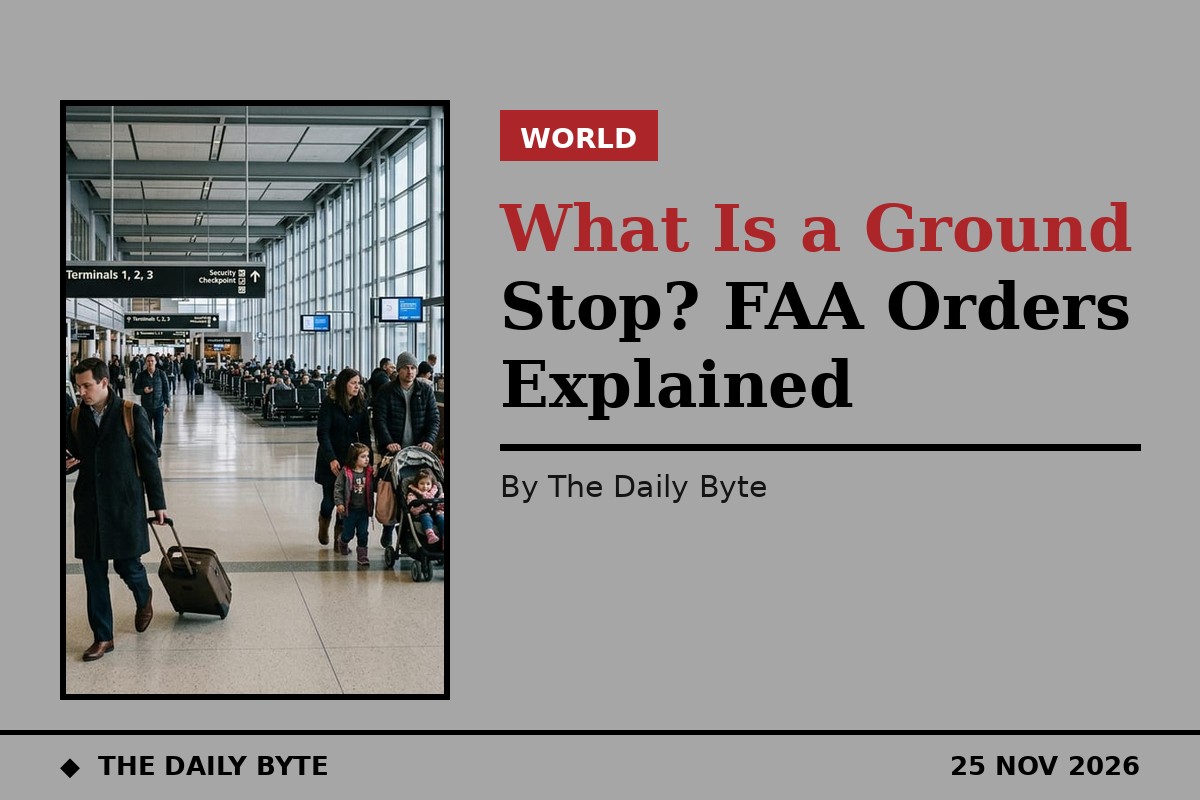
A ground stop is an order from the US Federal Aviation Administration (FAA) that holds flights bound for a particular airport on the ground at their departure airports until the order is lifted. Nothing bound for that airport takes off while the stop is in force, but flights already in the air keep flying to their destination. It is the FAA's most restrictive traffic-management tool, used when a sudden problem means an airport cannot safely accept the aircraft already heading towards it.
The question is being asked widely this week because Chicago O'Hare, one of the world's busiest airports, was hit by two ground stops in two days at the start of the Thanksgiving travel rush: one on Monday 23 November 2026 blamed on air-traffic-controller staffing, and a second on Tuesday 24 November after an equipment outage knocked out part of the airport's ground radar. A nationwide ground stop on 13 November 2026, which lasted nearly five hours, had already put the term in front of millions of travellers. This explainer sets out what a ground stop is, how it differs from a ground delay programme, and what it means if your flight is caught in one.
What is a ground stop, exactly?
The FAA's own definition, in its Pilot/Controller Glossary, is that a ground stop is a process that requires aircraft meeting specific criteria to remain on the ground. The criteria may be tied to an airport, to a piece of airspace, or to a type of equipment, and ground stops normally occur with little or no warning. In plain terms: the FAA tells airports not to let certain flights depart, because the destination cannot take them yet.
A ground stop is issued by the FAA's Air Traffic Control System Command Center, working with the local air-traffic facility. It is a traffic-flow decision, not a safety finding about any particular aircraft. The aircraft themselves are fine; the problem is on the ground at the destination, or in the system that manages arrivals there. Common triggers include a storm cell sitting over the airfield, a runway closed by a disabled aircraft, an equipment failure, a security incident, or a shortage of controllers at the facility guiding aircraft into the area.
At O'Hare on 24 November, the trigger was an outage in the Airport Surface Detection Equipment, Model X (ASDE-X) system, the ground surveillance radar that controllers use to track aircraft and vehicles moving on runways and taxiways and to prevent collisions on the ground. With that picture degraded, the FAA cut the airport's arrival capacity from its usual 100 flights an hour to 72, and held O'Hare-bound departures at their origin airports. The stop ran from 3.06pm to 4.02pm Central Time, according to FAA advisories, and was then replaced by a ground delay programme that ran until 4.47pm. Delays at O'Hare averaged 47 minutes and reached up to 99 minutes, and flight-tracking service FlightAware recorded 373 delayed flights there by Tuesday evening, about 13 per cent of the airport's schedule.
Does a ground stop close the airport?
No, and this is the misunderstanding that causes most confusion. A ground stop at O'Hare does not close O'Hare. It is an order to other airports: flights scheduled to depart for O'Hare stay where they are until the stop ends. Departures out of O'Hare itself are a separate question, and flights already airborne when the stop is issued are not turned back; they continue to their destination, though they may face arrival delays or be held in the air for a time.
A ground stop can also be narrow in scope. The O'Hare stop on 24 November applied at first only to flights leaving a handful of Midwestern airports, including Minneapolis, Milwaukee, Green Bay and Des Moines, because those were the flights that would have arrived while the problem lasted. A stop can likewise be limited to a particular type of aircraft or to flights from a particular region. What matters is the criteria written into the order, not the name of the airport alone. And a ground stop overrides every other traffic-management initiative in force at the time: an aircraft covered by one must not be released without the approval of whoever issued it.
How is a ground stop different from a ground delay programme?
The two tools answer the same problem, more aircraft heading for an airport than it can land, in different ways. The measure behind both is the airport acceptance rate: how many arrivals the airport can take in one hour, given its runways, the weather and the navigation aids working at the time.
In a ground delay programme, flights still leave, but each one is given an assigned departure time, called an expect departure clearance time (EDCT), so that arrivals are spread out to match the rate the airport can accept. The pilot is expected to take off within five minutes either side of that time. A ground delay programme is the tool for a problem the FAA can see coming and expects to last for hours, such as low cloud cutting the number of aircraft that can land each hour.
A ground stop has no EDCT. It has an update time, when the FAA will look at the situation again, and a published rating of low, medium or high for the chance it is extended. It is the tool for a sudden problem. If the crew gives you a departure time, you are in a ground delay programme and you will leave at roughly that time. If the crew gives you only an update time, you are in a ground stop, and nobody yet knows when you will leave. The two often run in sequence: when a ground stop looks likely to last a long time, the FAA usually replaces it with a ground delay programme, turning an open-ended wait into assigned departure times. That is exactly what happened at O'Hare on 24 November.
- Ground stop: no flights bound for the airport depart at all until it ends; used for sudden, severe problems; usually issued in steps of 30 to 90 minutes.
- Ground delay programme: flights depart at assigned times (EDCTs) so arrivals match what the airport can land; used for predictable capacity loss lasting hours.
- Airborne holding: flights already in the air may be held in holding patterns; holding in the air burns fuel, which is one reason the FAA prefers to hold aircraft on the ground.
Why hold aircraft on the ground instead of in the air?
An aircraft waiting on the ground burns far less fuel than one circling in a holding pattern, and a queue on the ground is easier and safer to manage than a queue in the sky. Airborne holding is limited by fuel: every aircraft in a hold has a point, its minimum fuel state, after which it must land somewhere, whether or not its planned destination is ready. Holding on the ground avoids that pressure altogether. It also keeps the arrival stream orderly: when the destination reopens, aircraft can be released in a planned sequence rather than arriving in a bunch that the airport cannot absorb.
That is also why a ground stop at a hub airport ripples across the country. United Airlines and American Airlines both run major hubs at O'Hare, so an aircraft held on the ground in Chicago is an aircraft that is late for its next departure somewhere else, and a crew held in Chicago may time out of its legal duty limits. Delays at one hub become delays at the next, which is why a two-hour stop can still be disrupting schedules the following morning.
Why has this happened so often in November 2026?
The O'Hare stops came less than two weeks after a nationwide breakdown of the US air-traffic-control system. On 13 November 2026 the FAA ordered a ground stop covering every airport in the country for nearly five hours, the third nationwide ground stop in US history, after a technical failure cascaded through the system. Three days later, on 16 November, a computer outage at United Airlines disrupted departing flights for more than 90 minutes. On Sunday 23 November, an outage in Delta Air Lines' automated weight-and-balance system forced the FAA to briefly halt Atlanta-bound Delta flights, and Delta said more than 1,600 of its flights were delayed as staff calculated weight and balance figures by hand. The FAA stressed that the Delta outage was not related to air-traffic-control systems.
Monday 23 November brought a roughly 90-minute ground stop at O'Hare because of staffing constraints at Chicago Terminal Radar Approach Control, the facility that guides aircraft into and out of the Chicago area. Tuesday brought the radar outage. The FAA also warned of further controller shortages at the same facility on Tuesday evening. All of this is happening during what the FAA calls the busiest Thanksgiving flying period in 16 years, with more than 417,000 flights projected over nine days, and AAA projecting that 81.5 million Americans will travel at least 50 miles from home over the holiday, including 5.96 million on domestic flights. Chicago aviation officials expect about 1.6 million travellers to pass through O'Hare between 24 and 29 November.
What should you do if your flight is under a ground stop?
First, check the status rather than guessing. The FAA publishes live ground stops and delay programmes on its National Airspace System status page at fly.faa.gov, and your airline's app will usually show the same information in plainer language. A ground stop is normally issued in short steps and extended if the problem has not cleared, so the update time matters more than the first announcement: a stop due to be reviewed at 4.15pm may be lifted then, or extended by another hour.
Second, understand what the airline does and does not owe you. Because an FAA equipment outage or a controller shortage is beyond the airline's control, carriers are not generally obliged to provide free hotel or meal vouchers for the delay, as they would be for a problem of their own making. Under US Department of Transportation rules, however, if the airline cancels your flight, or makes a significant change to it, and you do not accept the alternative it offers, you are entitled to an automatic refund. Airlines also may not keep passengers on the tarmac for more than three hours on a domestic flight without giving them a chance to get off. Keep boarding passes and receipts, and rebook through the airline's app rather than joining the queue at the desk, where hundreds of other passengers will have the same idea at the same time.
Third, do not assume a ground stop means your whole trip is lost. Stops are usually measured in tens of minutes, not hours, and the switch to a ground delay programme, as at O'Hare on Tuesday, means departure times are being assigned again. The disruption that lasts longest is usually the knock-on effect: the aircraft and crew for your later flight may be stuck somewhere else. If you have a connection, ask the airline early whether it can be protected, and consider whether a later direct flight is a better bet than a tight connection through the affected hub.
Frequently asked questions
How long does a ground stop last?
Most are issued in steps of 30 to 90 minutes and extended if the problem has not cleared. The O'Hare stop on 24 November 2026 lasted just under an hour; the nationwide stop on 13 November lasted nearly five hours, which is exceptional.
Does a ground stop affect flights already in the air?
No. Flights already airborne continue to their destination, though they may face arrival delays or be held in the air. A ground stop holds flights that have not yet departed.
What is an EDCT?
An expect departure clearance time is the departure time assigned to a flight under a ground delay programme. The aircraft is expected to take off within five minutes either side of it.
Who decides to issue a ground stop?
The FAA's Air Traffic Control System Command Center, working with the local air-traffic facility. It is an air-traffic-management decision, not a decision by the airline.
Can I get compensation for a ground-stop delay?
In the US there is no general right to compensation for delays caused by air-traffic control or equipment failures beyond the airline's control. You are entitled to a refund if your flight is cancelled or significantly changed and you do not accept the rebooking offered.