What Is a Hoax Bomb Threat? UK Law Explained
By The Daily Byte
·12 Nov 2026
·11 min read
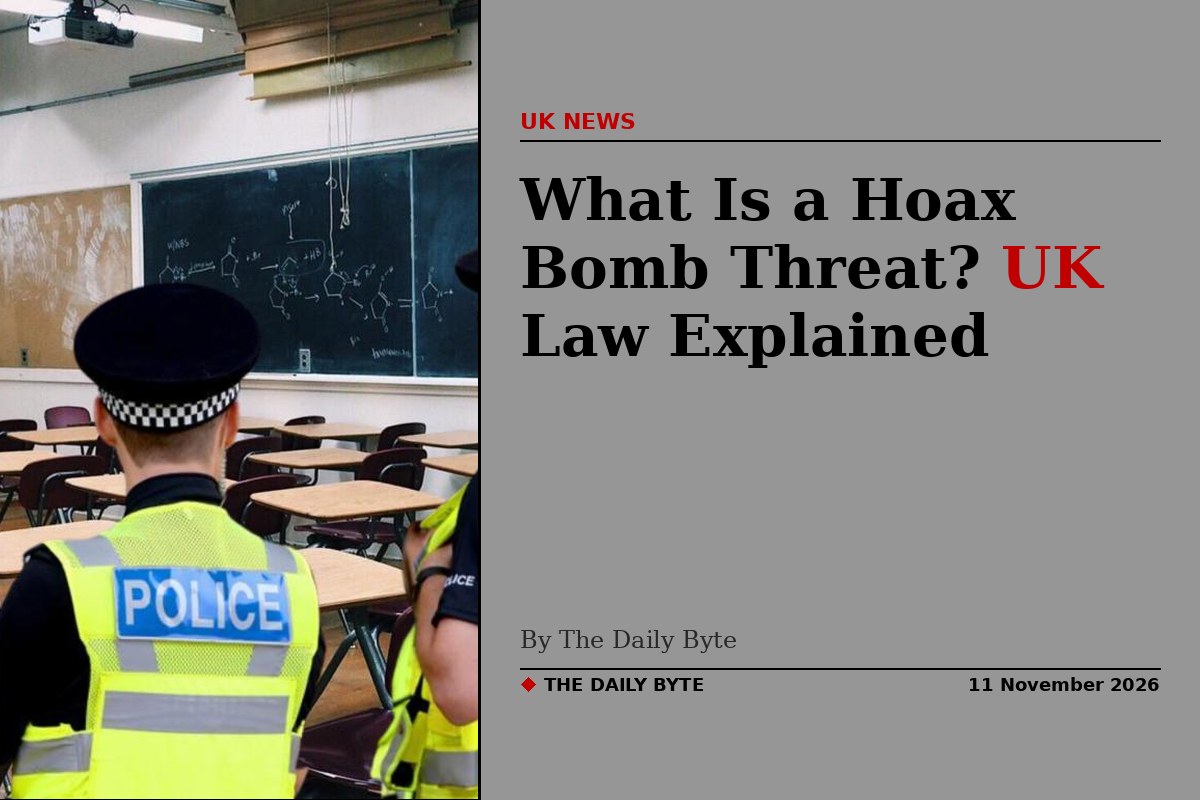
A hoax bomb threat is a false claim that a bomb or other explosive device is present in a place, made with the intention of making people believe the danger is real. No bomb exists, and the person sending the threat knows it. The aim is usually to cause fear, force an evacuation, disrupt a school or workplace, and waste police time. In the UK it is a criminal offence, and on conviction on indictment it can carry up to seven years in prison. On Wednesday 11 November 2026, threatening emails of this kind were sent to around 470 schools in Scotland and around 300 schools in Northern Ireland. Police assessed them immediately and said they were hoaxes, with nothing to suggest a credible threat.
## What happened on 11 November 2026?
On the morning of Wednesday 11 November 2026, schools across Scotland received threatening emails referring to a 'device' in schools. Police Scotland said the messages had been sent to a number of schools in Scotland and across the UK, and that they were 'immediately assessed and are being treated as hoaxes'. The force said its inquiries had 'established that there is nothing to suggest that they represent a credible threat or that there is any wider threat to the public'.
Police Scotland confirmed that 470 schools in Scotland were affected. Around 300 schools in Northern Ireland received a similar message, according to reports of the Police Service of Northern Ireland. Some schools evacuated as a precaution before the police assessment was confirmed. In Edinburgh, Queensferry High School was evacuated and pupils were sent home. Some schools in Dumfries and Galloway were also evacuated, and Highland Council said a number of its schools had activated their emergency procedures. Most schools, however, stayed open.
The emails were sent using the name Mikhail Andropov, who claimed to be the leader of the 'Red Owl' project. The subject line read 'DEATH IS NEAR', and the message threatened to 'carry out a genocide against your people'. The same alias had also appeared in bomb threats targeting European broadcasters, including Ireland's RTE and Sky, on the previous Friday, according to reporting of the incident. The Police Service of Northern Ireland said the email originated outside the UK. Police Scotland's Cyber and Fraud Unit is carrying out extensive inquiries to establish the source of the messages, working with law enforcement partners across the UK and internationally.
This was the second nationwide wave of hoax school bomb threats in Scotland in recent weeks. A similar hoax last month led to a number of schools in Northern Ireland and Scotland closing. The repetition is part of what helped police assess the new messages quickly: the format, the mass distribution and the alias all matched a known pattern.
## What is a hoax bomb threat?
A hoax bomb threat is a threat that is not real. It can take several forms. The most common is a message, usually an email, a phone call or a social media post, claiming that a bomb has been planted in a building. It can also involve leaving a suspicious object somewhere to make people think it is a bomb, or sending an object through the post for the same purpose.
What makes it a hoax is not that it is vague or badly written. It is that the person making the claim knows or believes it to be false, and makes it intending that someone else will believe a bomb is present. That intention is the heart of the offence. A genuine warning about a real device is not a hoax. A joke that no reasonable person would take seriously is unlikely to be treated as one either, although even jokes about bombs in schools or airports can lead to serious consequences.
Hoax threats are usually sent to many targets at once. The 11 November emails were distributed through mailing lists used by schools across the UK, which is how a single message reached hundreds of schools in a morning. The sender does not need to know anything about any individual school. The disruption comes from the scale: hundreds of headteachers, police officers and council staff all have to assess the same message at the same time, and parents and pupils are frightened even when the threat turns out to be empty.
## How do police decide a threat is a hoax?
Police assess every bomb threat on its own facts, and they do not declare a threat a hoax lightly. In the 11 November case, Police Scotland said the messages were 'immediately assessed' before the force concluded they were hoaxes. Officers look at a combination of factors: whether the message is specific about a place, a time or a device, or whether it is generic; whether it has been sent to many unrelated targets at once; whether the language and the sender match a known pattern or alias; and whether there is any corroborating information, such as a suspicious object or a credible source.
A mass-mailed email with a dramatic subject line, a pseudonym and no detail about a specific device in a specific building is a classic hoax pattern. A message naming a particular room, a particular time and a particular type of device, sent to one target, would be treated very differently. Police also work with the organisation that received the threat. In this case, Glasgow City Council told schools that police had confirmed the emails were a hoax and that schools should not be evacuated, and the City of Edinburgh Council said schools had been evacuated briefly as a precaution before police confirmed the threats were not credible.
It is important to understand what 'treated as a hoax' does and does not mean. It means police have assessed the message and found no evidence of a credible threat. It does not mean the investigation is over. Police Scotland said its Cyber and Fraud Unit was still working to establish who sent the messages. It also does not mean schools must ignore their own procedures. A school that evacuates as a precaution before the police assessment is confirmed is following its emergency plan, and that is a reasonable response in the first minutes after a threatening message arrives.
## What does the law say in the UK?
The specific offence of a bomb hoax is set out in section 51 of the Criminal Law Act 1977, which applies in England, Wales and Scotland. It covers two kinds of conduct. First, placing or dispatching an article with the intention of inducing someone to believe it is likely to explode or ignite and cause personal injury or damage to property. Second, communicating information that the person knows or believes to be false, with the intention of inducing someone to believe falsely that a bomb or other thing liable to explode or ignite is present in any place.
The penalties are serious. On summary conviction, the maximum is six months in prison, a fine of up to 1,000 pounds, or both. On conviction on indictment, the maximum is seven years in prison, a fine, or both. Northern Ireland has an equivalent provision, article 3 of the Criminal Law (Amendment) (Northern Ireland) Order 1977, with the same maximum of seven years on indictment.
| Where | Law | Maximum on indictment |
|---|---|---|
| England, Wales and Scotland | Criminal Law Act 1977, section 51 | 7 years in prison |
| Northern Ireland | Criminal Law (Amendment) (Northern Ireland) Order 1977, article 3 | 7 years in prison |
The fact that no bomb exists is not a defence. The offence is about the false belief the sender intended to create. Prosecutors may also consider other charges depending on the facts, for example where a threat is part of a campaign of harassment or is sent to cause public alarm. Where the sender is outside the UK, as police said was the case with the 11 November emails, prosecution is harder in practice, and investigators rely on cooperation with law enforcement in other countries.
## What should schools and parents do?
Police Scotland's advice in the 11 November case was clear: 'there is no requirement to evacuate schools or keep children away from education based solely on the content of the emails.' That advice applies once police have assessed a specific message and found it is not credible. It is not a general instruction to ignore bomb threats. If a school receives a threatening message, it should contact the police immediately, follow its own emergency procedures, and follow the advice police give for that specific incident.
Parents should follow the advice of the school and the police, not rumours on social media. Police Scotland said it understood 'how distressing messages of this nature can be for pupils, parents, carers and school staff, and the concern they can understandably cause'. Sharing the full text of a threatening email, or screenshots of it, can spread fear and can also interfere with an investigation. Anyone who receives a threatening message should report it to the police, preserve the message rather than deleting it, and not forward it to others.
Schools are advised to have a plan for this situation before it happens: a single point of contact for police, a way to contact all parents quickly, and a clear decision process for whether to evacuate, lock down or carry on as normal. The 11 November incident showed why that matters. Schools that had a plan and a direct line to police were able to confirm the hoax quickly and keep children in lessons, while schools without that information evacuated first and asked questions afterwards.
## Why do people send hoax bomb threats?
There is no single motive, and police have not given a motive for the 11 November messages. The investigation is continuing. In general, hoax threats are sent to cause disruption and fear, to force closures, to attract attention, or to test how organisations and police respond. Some are sent by individuals. Others are part of a wider campaign by a group using a shared alias, as the 'Red Owl' name in this case suggests. The use of the same alias against schools and against broadcasters in different countries points to a coordinated campaign rather than a single local prank, but that is a matter for the investigation to establish.
Whatever the motive, the impact is real even when the threat is false. Pupils lose lessons, parents have to leave work to collect children, police and council staff spend hours assessing messages, and children are frightened. That is why the law treats a hoax bomb threat as a serious offence even though no device exists, and why police investigate the source even after they have concluded there is no credible danger.
## Frequently asked questions
**What is a hoax bomb threat?**
It is a false claim that a bomb is present in a place, made by someone who knows or believes it is false, intending others to believe the danger is real.
**Were the 11 November school threats real?**
No. Police Scotland said the messages sent to schools in Scotland and across the UK on 11 November 2026 were immediately assessed and are being treated as hoaxes, with nothing to suggest a credible threat.
**How many schools were affected?**
Police confirmed 470 schools in Scotland received the email, and around 300 schools in Northern Ireland received a similar message.
**Should schools evacuate when they get a bomb threat email?**
Schools should contact police immediately and follow police advice for that specific incident. In the 11 November case, police advised there was no requirement to evacuate or keep children away based solely on the emails, once they had been assessed as hoaxes.
**What is the punishment for a hoax bomb threat in the UK?**
Under section 51 of the Criminal Law Act 1977, the maximum on conviction on indictment is seven years in prison. Northern Ireland has an equivalent provision with the same maximum.
**Who sent the 11 November emails?**
That is not yet known. The emails used the name Mikhail Andropov and claimed to be from the 'Red Owl' project. Police Scotland's Cyber and Fraud Unit is investigating the source, and the Police Service of Northern Ireland said the email originated outside the UK.
*Sources: [Glasgow Times, reporting the Police Scotland statement](https://www.glasgowtimes.co.uk/news/national/26719707.police-treating-threatening-messages-sent-schools-uk-hoaxes/); [Criminal Law Act 1977, section 51, legislation.gov.uk](https://www.legislation.gov.uk/ukpga/1977/45/section/51?timeline=false); details of the emails from [Internewscast](https://internewscast.com/news/schools-evacuated-in-scotland-and-northern-ireland-after-bomb-threats/) and [The Scottish Sun](https://www.thescottishsun.co.uk/news/17054766/scottish-schools-evacuated-bomb-threats/).*