What Is a Lame-Duck Session? Congress Explained
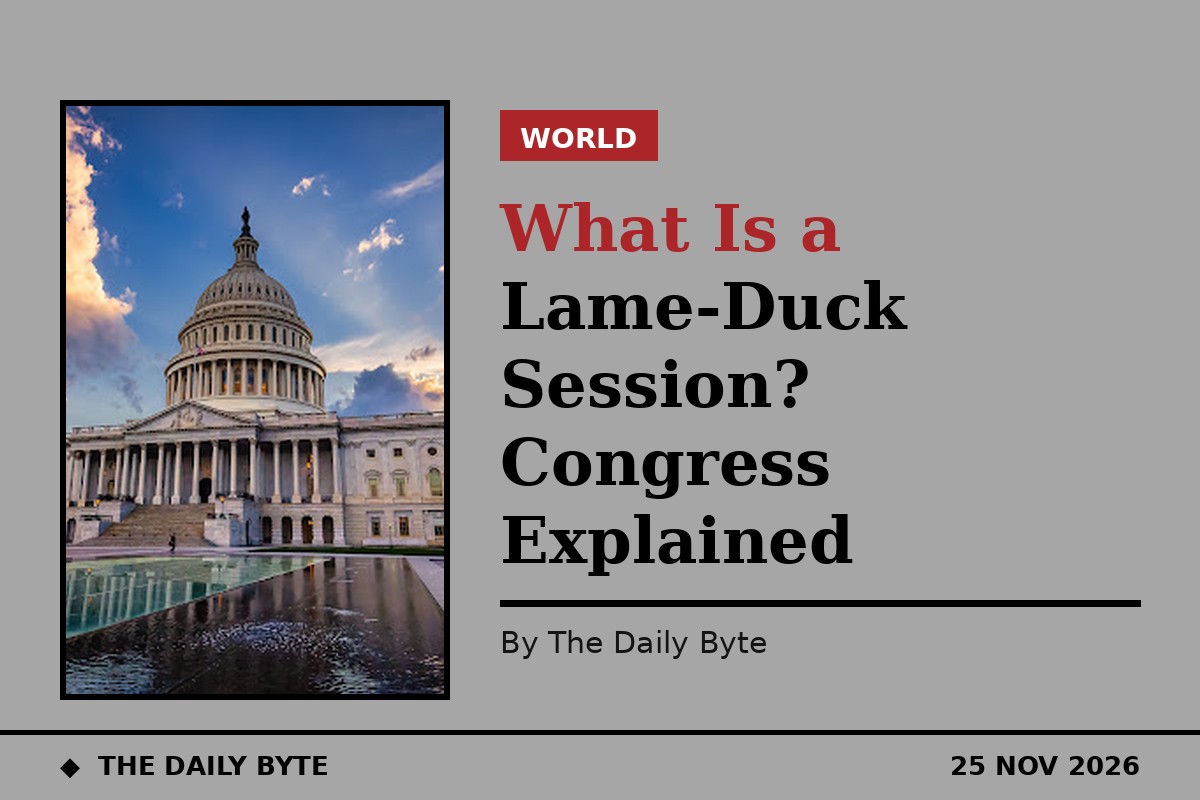
A lame-duck session of Congress is a session that takes place after the election for the next Congress has been held but before the current Congress has reached the end of its constitutional term. The people sitting in it are the members of the existing Congress, including those who have just lost their seats or are retiring, not the members-elect of the new Congress. Since 1935, the constitutional term of a Congress has begun on 3 January of each odd-numbered year and ended on 3 January of the next odd-numbered year, so any meeting of Congress between the congressional election in November of an even-numbered year and the following 3 January is a lame-duck session.
The term is in heavy use right now because the United States is in one. Voters chose the next Congress on 3 November 2026, the Democrats won control of the House, and the sitting 119th Congress is still in office until the new Congress convenes on 3 January 2027. Lawmakers left Washington for the Thanksgiving recess on Saturday 21 November with five House races still uncalled, a funding fight unfinished and a round of votes derailed by absences on their own side. This explainer sets out what a lame-duck session is, where the phrase comes from, what such a Congress can still do, and why these sessions are often controversial.
Where does the phrase 'lame duck' come from?
The expression was originally applied in 18th-century Britain to bankrupt businessmen, who were considered lame in the way a game bird injured by shot is lame: unable to keep up with the flock. By the 1830s the usage had been extended to officeholders whose service already had a known termination date. In current American usage, a president is considered a lame duck after his successor has been elected, and also whenever he is known not to be a candidate for re-election. Members of Congress in similar circumstances, those who have been defeated or who are retiring, are also called lame ducks. When the previously sitting Congress, which includes those members, meets after the election, that session is called a lame-duck session. The Congressional Research Service, the research arm of Congress itself, gives this history in its report on lame-duck sessions from 1935 to 2022.
How did the Twentieth Amendment change things?
Before the Twentieth Amendment, ratified in 1933, the last session of every Congress was always a lame-duck session. Terms ran long past the election: a Congress elected in November would not take its seats until March, so the outgoing Congress sat for four months after the voters had chosen its replacement. One purpose of the amendment was to change exactly that timing. Under it, the terms of members begin and end on 3 January of odd-numbered years, and Congress convenes in regular session on 3 January each year unless it passes a law changing the date. The 74th Congress, which sat from 1935 to 1937, was the first to begin on the new date.
The amendment did not abolish lame-duck sessions; it shortened them. They can still occur, but only when Congress chooses to meet after an election, either as the tail end of a regular session that continues after polling day, or as a separate session called after the regular session has adjourned. The first lame-duck session under the new rules took place after the 1940 elections. Through 2022 there have been 24 of them. A lame-duck session ends on the day of final adjournment, known as sine die adjournment, Latin for without a day, meaning no further meeting day has been set.
What can a lame-duck Congress actually do?
Everything a normal Congress can do. A lame-duck session is not a caretaker arrangement, and its members lose none of their powers when they lose their seats. They can pass laws, approve spending, confirm presidential appointments, ratify treaties and override vetoes, just as they could before the election. The Congressional Research Service says their primary purpose has been to complete action on legislation: finishing appropriations bills, dealing with matters left over from the regular session, and confirming nominees before the new Congress arrives.
That is why the weeks after an election are often some of the busiest of the year. Government funding is the usual centrepiece, because the federal government's money often runs out around the end of the calendar year and a new Congress cannot be relied on to finish the job in its first days. In 2026 the funding fight is the main item on the lame-duck agenda, alongside confirmations and the bills that were moving when the House left for the Thanksgiving recess. The session also has to cope with its own arithmetic: five House races from the 3 November elections were still uncalled when Congress left Washington on 21 November, with recounts under way in North Carolina and Minnesota and two Louisiana districts heading for runoffs on 12 December, so the exact size of the incoming Democratic majority is still not settled.
Why are lame-duck sessions controversial?
The objection is about accountability. Members who have just been voted out, or who are retiring and will never face the voters again, are still casting votes that bind the country, and they may vote differently from how they would have voted before the election. Critics call this legislating without a mandate. Supporters reply that the voters knew the rules: the outgoing Congress was elected for a full two-year term, and its term does not end on election day but on 3 January. Until then, its members are the lawful representatives, and leaving the government unfunded or senior posts unfilled for two months would be worse than letting them finish the work.
History has examples on both sides. Lame-duck sessions have passed significant and broadly supported legislation, including, in 2010, the repeal of the military's 'don't ask, don't tell' policy and the ratification of the New START nuclear arms treaty with Russia. They have also been used to push through measures that would have struggled before an election, which is why the sessions attract suspicion. The tension is built into the calendar: the period between an election and the seating of the new Congress is short by design, precisely so that the outgoing Congress has limited time to act, but it is long enough to matter.
Is a lame-duck president the same thing?
The phrase is used for presidents too, but the situation is different. A president is called a lame duck after a successor has been elected, or whenever it is known that he will not be a candidate for re-election, for example in the second term of a two-term president. Unlike a lame-duck Congress, a lame-duck president's powers do not expire early, and the final weeks of a presidency have often been active ones: pardons, executive orders, regulations and last-minute appointments. What the two cases share is the underlying idea, that an officeholder who will not have to answer to the voters again behaves differently, and is watched differently, from one who will.
Does the UK have lame-duck sessions?
Not in the same sense, because the British system works differently. When a general election is called in the UK, Parliament is dissolved: there are no Members of Parliament at all between dissolution and polling day, and the new Parliament meets only after the election. The outgoing government remains in office as a caretaker, but it cannot pass laws, because there is no Parliament to pass them. The American arrangement, in which the old Congress keeps sitting and voting after the election, has no direct British equivalent. The closest parallel is the period between an election and the formation of a new government, when ministers stay in post while the result is settled, but that is a matter of days, not the two months of an American lame-duck session.
What happens when the lame-duck session ends?
The session ends when Congress adjourns sine die, and the new Congress convenes on 3 January 2027. At that point the members-elect take their seats, the House elects its Speaker, and the unfinished business of the old Congress mostly dies with it: bills that were not passed have to be introduced again from scratch. That deadline is what gives the lame-duck session its urgency. Anything the outgoing Congress wants to finish, funding, confirmations, or any other legislation, must be done before the new Congress arrives, or it starts again. In 2026 that means the funding fight, the confirmations and the loose ends of the 119th Congress all have to be settled in the few sitting weeks between the Thanksgiving recess and the first days of January.
Frequently asked questions
When does the 2026 lame-duck session end?
When the 119th Congress adjourns sine die, and the new Congress convenes on 3 January 2027. Any meeting of Congress between the 3 November 2026 election and that date counts as a lame-duck session.
Can a lame-duck Congress pass laws?
Yes. It keeps its full legislative powers until its term ends, including passing laws, approving spending and confirming appointments.
Who sits in a lame-duck session?
The sitting members of the existing Congress, including those who lost their seats or are retiring. The newly elected members do not take part until the new Congress convenes.
Why is it called lame duck?
The phrase comes from 18th-century Britain, where bankrupt businessmen were called lame ducks, like game birds injured by shot. By the 1830s it was applied to officeholders whose service had a known end date.
How long do lame-duck sessions last?
At most about two months, from the November election to 3 January. Before the Twentieth Amendment in 1933 they lasted about four months, until March.
Does the UK have lame-duck sessions?
No. Parliament is dissolved before a general election, so there is no sitting Parliament after polling day. The US system, in which the old Congress keeps meeting, has no direct British equivalent.