What Is a Share Buyback? Rolls-Royce £1.5bn Explained
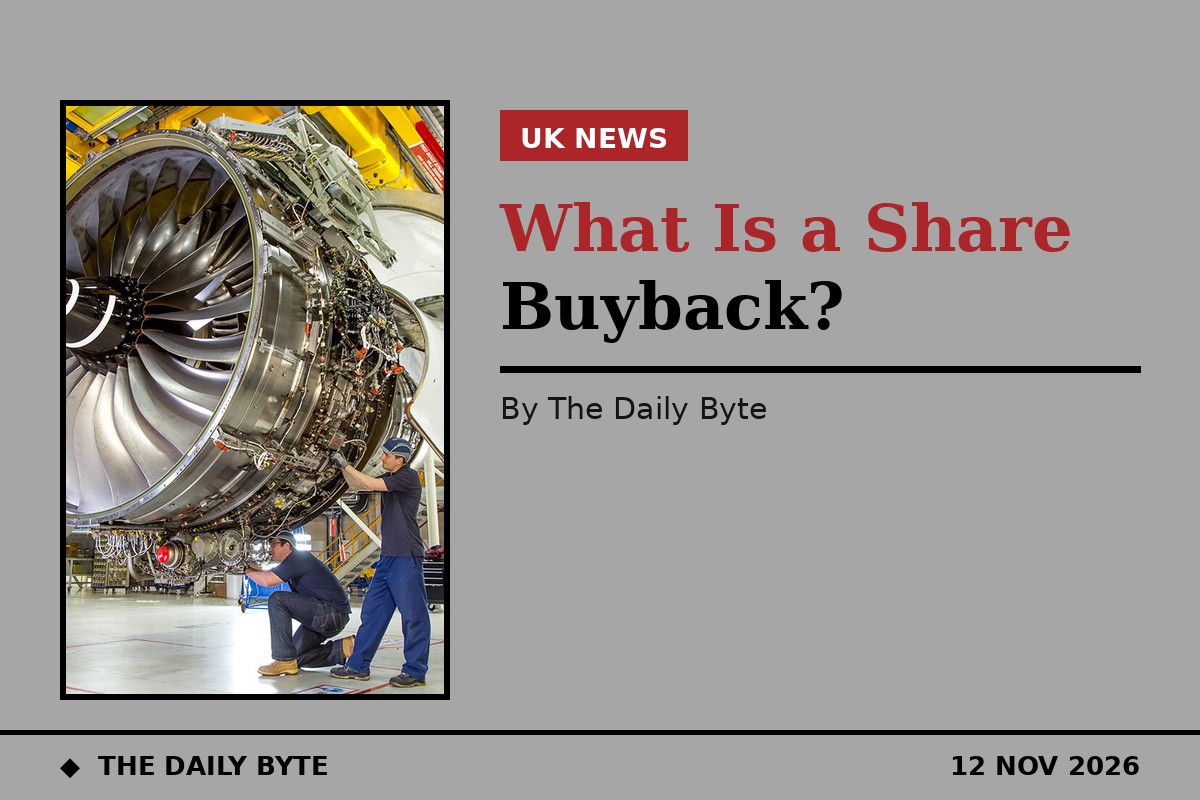
A share buyback is when a company uses its own cash to buy its shares back from investors on the stock market, and then cancels them. The shares disappear, so the investors who keep holding their shares own a bigger slice of the same company. Rolls-Royce put the term in the headlines on 12 November 2026, when it announced an interim share buyback worth £1.5 billion, to be completed by the time it reports full-year results on 25 February 2027.
Buybacks are one of the main ways big listed companies return money to shareholders, alongside dividends. They are also one of the most argued-over subjects in business: supporters say they are an efficient way to hand surplus cash back, while critics say companies should invest the money instead. This explainer sets out what a buyback is, how it works, what the Rolls-Royce deal involves, and what it does — and does not — mean for shareholders.
What is a share buyback?
When a company lists on the stock market, it sells shares to investors. Each share is a small slice of ownership in the business. A buyback reverses that process: the company spends its own money buying some of those shares back, usually through a broker on the stock exchange, and then cancels them. Once cancelled, the shares no longer exist, so the total number of shares in issue falls.
Imagine a company with 100 shares and £100 of annual profit. Each share represents £1 of profit. If the company buys back 10 shares and cancels them, the same £100 of profit is now spread across 90 shares, so each remaining share represents about £1.11 of profit. The company itself has not become more profitable — but the profit per share, known as earnings per share, has gone up. That arithmetic is at the heart of why buybacks matter to investors.
Buybacks are normally paid for out of surplus cash — money the company has earned but does not need for running the business, paying down debt or investing in new projects. A company that is short of cash, or that needs to fund a major investment, would not usually launch a large buyback.
How does a buyback work, step by step?
First, the board of directors decides how much the company can afford to spend and asks shareholders for permission. In the UK, shareholders vote at the annual general meeting to give the board authority to buy back shares, usually up to a set percentage of the shares in issue and for a limited period. The authority is typically renewed each year.
Second, the company appoints a broker — usually an investment bank — to buy the shares on its behalf. In Rolls-Royce's case, UBS is buying the shares on the London Stock Exchange, or another recognised exchange, on the company's behalf. The programme is described as irrevocable and non-discretionary, which means the broker follows a set of pre-agreed instructions and the company cannot change its mind part-way through to try to time the market.
Third, the broker buys shares gradually over weeks or months rather than all at once, to avoid pushing the share price up against itself. There are limits on how many shares can be bought each day and on the price that can be paid, under UK market rules.
Fourth, the shares bought are sold on to the company and cancelled, which reduces the company's share capital. The company must also disclose what it has bought: Rolls-Royce said it will announce each repurchase no later than the end of the seventh daily market session after the day it takes place.
Finally, the effect shows up in the company's accounts. With fewer shares in issue, earnings per share rise, and measures such as the dividend per share can rise too if the total dividend payout stays the same, because it is shared between fewer shares.
The Rolls-Royce buyback in numbers
Rolls-Royce announced the £1.5 billion interim buyback in a trading update on 12 November 2026, alongside strong trading figures. Chief executive Tufan Erginbilgic said the company had continued to deliver strong operational, strategic and financial progress in the second half of 2026, giving it further confidence in its full-year guidance of £4.7 billion to £4.9 billion of underlying operating profit and £3.8 billion to £4.0 billion of free cash flow.
| Rolls-Royce buyback | Detail |
|---|---|
| Interim buyback announced 12 November 2026 | £1.5 billion |
| Completion deadline | By full-year results on 25 February 2027 |
| Wider buyback programme | £7 billion to £9 billion across 2026 to 2028 |
| 2026 buyback programme already under way | £2.5 billion, of which £2.4 billion completed |
| Maximum shares that may be bought | 842,886,298 |
| Broker buying the shares | UBS, on the London Stock Exchange |
| 2026 guidance: underlying operating profit | £4.7 billion to £4.9 billion |
| 2026 guidance: free cash flow | £3.8 billion to £4.0 billion |
| Large engine order backlog | About 2,500 engines |
The company said it had substantially completed its previously announced £2.5 billion buyback programme for 2026, and that the new £1.5 billion programme is in addition to it. It also said large engine flying hours — a key measure of demand for its civil aerospace engines — grew 4 per cent year on year in the first 10 months of 2026, reaching 114 per cent of 2019 levels. Rolls-Royce also said it was finalising a significant multi-year contract to supply backup engines to a hyperscaler, alongside a framework agreement extending to 2031.
Why do companies buy back their own shares?
The most common reason is that the company has more cash than it can sensibly invest. A business that is generating strong cash flow may find it has money left over after funding its operations, paying its debts and investing in growth. Returning that surplus to shareholders is one way of putting it to use, and a buyback is one way of doing it.
A second reason is flexibility. A dividend creates an expectation: investors tend to treat it as a regular payment, and cutting it sends a bad signal. A buyback carries no such commitment. A company can run a large buyback in a good year and run none at all in a bad year, without the market reading it as a sign of trouble. That is why companies often prefer buybacks when their cash flow is strong but uncertain.
A third reason is the signal it sends. By spending its own money on its shares, a board is saying it believes the shares are worth at least what it is paying for them. Markets usually read a buyback announcement as a vote of confidence from management, which is why share prices often rise on the news. Rolls-Royce shares rose on the day of its 12 November announcement, with market reports putting the gain at about 3 per cent.
A fourth reason is tax and efficiency. In the UK, dividends are taxed as income for many shareholders, while a buyback can leave remaining shareholders better off through a higher share price, which may be taxed as a capital gain instead. The tax treatment depends on the individual shareholder's circumstances, and it is not the main reason most boards choose a buyback, but it is part of the calculation.
Buyback vs dividend: what is the difference?
Both are ways of returning cash to shareholders, but they work differently. A dividend pays cash directly to every shareholder, in proportion to the shares they hold. A buyback pays cash only to the shareholders who choose to sell their shares back; those who hold on receive nothing directly, but own a larger share of the company afterwards.
| Dividend | Share buyback | |
|---|---|---|
| Who gets the cash? | Every shareholder, pro rata | Only shareholders who sell their shares |
| Effect on shares in issue | No change | Number of shares falls |
| Effect on earnings per share | No direct effect | Rises if profits are unchanged |
| Commitment | Expected to be maintained or grown | One-off; can be stopped without alarm |
| Shareholder choice | Cash arrives automatically | Investors choose whether to sell |
Many large companies do both: they pay a regular dividend and run buybacks on top when cash is plentiful. Rolls-Royce's £7 billion to £9 billion programme for 2026 to 2028 is a shareholder returns programme of exactly that kind — a multi-year commitment to hand back surplus cash, with the pace adjusted as trading allows.
Does a buyback push the share price up?
Not necessarily, and not by itself. A buyback does not make a company more profitable, and it does not add a single pound to its revenues. What it does is concentrate the same profits across fewer shares, which can make each share more valuable — but only if the market values the company on its earnings per share, and only if the price paid for the shares was fair.
If a company overpays for its own shares, a buyback can destroy value: it has spent cash that was worth more than the shares it received. That is the main risk, and it is why the timing and price of buybacks matter. Buying back shares when they are cheap creates value for remaining shareholders; buying them back at a peak can waste money.
In practice, buyback announcements often lift the share price in the short term, partly because of the confidence signal and partly because the company's own buying adds demand for the shares. But the long-term effect depends on the underlying business. Rolls-Royce's shares have risen strongly during its turnaround under Tufan Erginbilgic, and the buyback is best understood as a consequence of that recovery — the company is generating enough cash to return billions to shareholders — rather than the cause of it.
What are the criticisms of buybacks?
Critics argue that money spent buying back shares could have been invested in the business instead — in new factories, research, higher wages or lower prices for customers. When a company chooses a buyback over investment, they say, it is choosing today's shareholders over the company's future.
A second criticism concerns executive pay. Many senior managers are paid partly in shares or in bonuses linked to earnings per share. Because a buyback mechanically raises earnings per share, it can make managers' targets easier to hit without any improvement in the underlying business. Supporters reply that well-designed pay schemes adjust for buybacks, but the concern is widely raised.
A third criticism is about timing. Companies tend to launch their biggest buybacks when times are good and cash is plentiful — which is often when their share price is already high. When a downturn arrives, the cash is gone. Critics say buybacks can leave companies with less of a cushion in a crisis.
None of these criticisms means buybacks are always wrong. For a mature company generating more cash than it can profitably reinvest, returning that cash is arguably the right thing to do — the alternative is to let it pile up unused, or to spend it on poor acquisitions. The question, as with any use of cash, is whether the buyback is the best available option at the time.
Frequently asked questions
What is a share buyback in simple terms? It is when a company buys its own shares back from investors and cancels them. Shareholders who keep their shares then own a bigger percentage of the company, and the profit per share goes up if profits stay the same.
Is a buyback good for shareholders? It can be, if the company has surplus cash and buys its shares at a fair price. Shareholders who sell receive cash; shareholders who hold own a larger slice of the business. But a buyback does not make the underlying business any better, and it can destroy value if the company overpays.
What is the difference between a buyback and a dividend? A dividend pays cash to all shareholders. A buyback pays cash only to those who sell their shares, while those who hold on end up owning more of the company. Dividends create an expectation of regular payment; buybacks are usually one-off and flexible.
Why is Rolls-Royce doing a £1.5 billion buyback now? The company says strong trading in the second half of 2026 has given it confidence in its full-year guidance, and it has already substantially completed its £2.5 billion buyback programme for 2026. The new £1.5 billion programme, announced on 12 November 2026, accelerates its wider £7 billion to £9 billion shareholder returns programme for 2026 to 2028.
Do I get anything from a buyback if I do not sell my shares? You receive no cash directly, but your ownership stake increases because there are fewer shares in issue. If the market values the company the same way, the price of each remaining share should reflect that.
This article is general information only and is not financial advice. Sources: Rolls-Royce Holdings plc trading update, 12 November 2026, via RNS; Reuters, 12 November 2026.