What Is a UK Health and Care Worker Visa? Explained
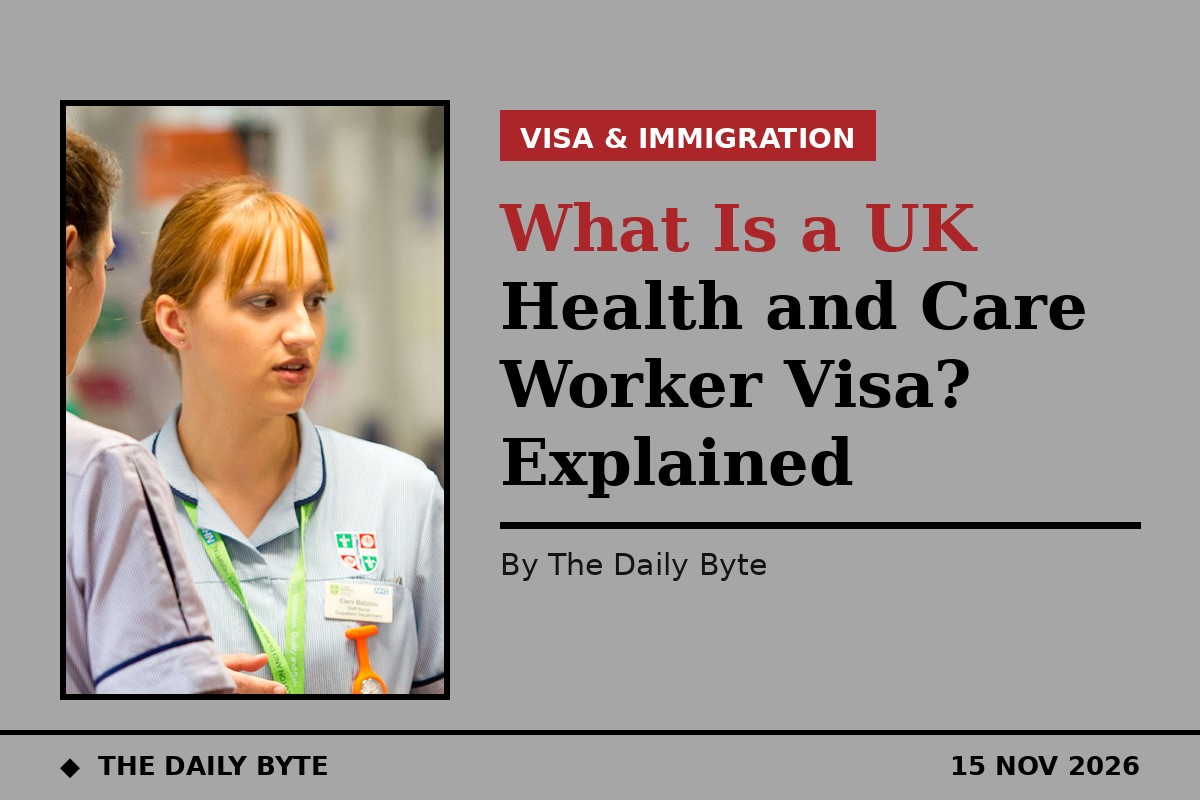
The UK Health and Care Worker visa is the work route for qualified doctors, nurses and other health professionals who have a job offer from the NHS, an organisation that provides medical services to the NHS, or an adult social care provider. It is a part of the Skilled Worker route, but it carries lower fees than a standard Skilled Worker visa and, unusually, no Immigration Health Surcharge. For many overseas health workers it is the first visa they will apply for, and the rules around it have changed several times in the past two years, so it is worth understanding exactly who it covers, what it costs and where its limits now sit.
This guide explains the route as it stands on 15 November 2026, using the official GOV.UK guidance. Immigration rules change, and a settlement reform announced in early November 2026 has not yet become law, so always check the official GOV.UK page linked at the end before you apply. This article is general information, not personal immigration advice.
What is a UK Health and Care Worker visa?
A Health and Care Worker visa allows a medical professional to come to, or stay in, the UK to do an eligible job with the NHS, an NHS supplier or in adult social care. The visa can last for up to five years before it needs to be extended, and it can be extended as many times as you like as long as you still meet the eligibility requirements. After five years, you may be able to apply to settle permanently in the UK, known as indefinite leave to remain, which gives you the right to live, work and study here for as long as you like and to apply for benefits if you are eligible.
The route is designed for people who already have a job. You must have a confirmed job offer before you apply, and your employer must be approved by the Home Office. Your employer, also known as your sponsor, gives you a certificate of sponsorship, an electronic record with a reference number that you need for your application. You must apply for your visa within three months of getting your certificate of sponsorship, and you can apply for the visa itself up to three months before the day you are due to start work, the date listed on the certificate.
Who can apply for a Health and Care Worker visa?
GOV.UK sets out five conditions, and you must meet all of them. You must be a qualified doctor, nurse, health professional or adult social care professional. You must work in an eligible health or social care job. You must work for a UK employer that has been approved by the Home Office. You must have a certificate of sponsorship from your employer with information about the role you have been offered. And you must be paid the minimum salary for the type of work you do. You must also be able to speak, read, write and understand English, and you will usually need to prove your knowledge of English when you apply.
The approved employers are the NHS, organisations providing medical services to the NHS, and organisations providing adult social care. If your employer is not currently approved, it can apply for a sponsor licence if it is eligible. The licence fee is £611 for small businesses and charities, or £1,682 for medium and large organisations, and it usually takes around eight weeks to process. If you are a care worker or senior care worker working in England, your employer must also be registered with the Care Quality Commission.
Which jobs qualify?
Eligibility is defined by occupation codes, the four-digit numbers the Home Office uses to classify jobs. GOV.UK lists the codes that qualify for a new Health and Care Worker visa application. They include generalist and specialist medical practitioners (2211 and 2212), physiotherapists, occupational therapists, speech and language therapists, clinical psychologists and other therapy professionals, midwifery nurses and registered nurses across community, specialist, mental health and children’s nursing (2231 to 2237), pharmacists, optometrists, dental practitioners, medical radiographers, paramedics, podiatrists, social workers (2461), laboratory technicians (3111), pharmaceutical technicians (3212) and nursing auxiliaries and assistants (6131). Health services and public health managers (1171) and residential, day and domiciliary care managers (1232) are also on the list, as are biochemists and biomedical scientists (2113) and physical scientists (2114).
If you do not know your occupation code, ask your employer, which should have it on the certificate of sponsorship. GOV.UK also points applicants to the CASCOT occupation coding tool. Make sure the job description matches what you will actually be doing, because some jobs in the same area of practice have different codes, for example dentists and dental hygiene therapists.
The care worker rule: who can no longer apply from abroad
The most important change to this route concerns care workers and senior care workers, occupation codes 6135 and 6136. These are now classed as medium-skilled codes that qualify only for extending, updating or switching to a Health and Care Worker visa from inside the UK. They are not on the list of codes for a new application from overseas. Overseas recruitment of care workers and senior care workers closed on 22 July 2025.
People already in the UK can still switch into those roles until 22 July 2028, under a transitional arrangement that the government has said is kept under review. If you are switching from a different visa into a care worker or senior care worker role, you must have been working legally in the job for your sponsor for at least three months. A further set of medium-skilled codes, including health care practice managers, dispensing opticians, medical and dental technicians and dental nurses, is available only to people who got their certificate of sponsorship before 22 July 2025 and have held a Health and Care Worker or Skilled Worker visa continuously since then.
How much do you need to be paid?
Salary is where applicants most often get caught out, because there are two different floors. For most eligible health and care jobs, you will usually need to be paid at least £25,000 a year, or the going rate for your job if that is higher. Each occupation code has its own annual going rate, and for many NHS clinical roles the relevant rate is the national pay scale for the job, band and part of the UK you will be working in. Your employer must also make sure your job pays at least the minimum wage and follows the UK rules on working hours. If it does not, GOV.UK says your application will be refused.
A listed set of occupation codes has a higher floor. If your job is in one of those codes, which include health services managers, care managers, biochemists, biomedical scientists, physical scientists, laboratory and pharmaceutical technicians and care workers, you will usually need at least £31,300 a year, or the lower going rate for your job, whichever is higher. There are discounts for some applicants in those codes: you can be paid between 70% and 90% of the lower going rate if your salary is at least £25,000 a year and you are under 26, studying or a recent graduate, in professional training, hold a relevant PhD-level qualification, or hold a postdoctoral position in a scientific role. The exact discount depends on the reason, and you cannot get a discounted salary rate if your job is on the immigration salary list.
English language: B2 for new applicants
You must be able to speak, read, write and understand English. New applicants usually need to prove their English to at least level B2 on the Common European Framework of Reference for Languages, in all four components, by passing a Secure English Language Test from an approved provider, or by holding a qualifying UK school qualification or a degree taught in English. If you had this visa before 8 January 2026 and you are applying to extend or update it, you need level B1 English, and you do not need to prove it again. If you are switching from a Skilled Worker visa, you also do not need to provide proof again.
Some people do not need to prove their knowledge of English at all, including nationals of a list of countries that includes Australia, Canada, Jamaica, Malta, New Zealand and the USA, and doctors, dentists, nurses or midwives who have already passed an English assessment accepted by their professional regulator.
How much does a Health and Care Worker visa cost?
The application fee depends on how long you will be in the UK: £324 per person for a visa of up to three years, or £628 per person for more than three years. The fee is the same whether you apply from inside or outside the UK, and each dependant pays the same fee. You will usually also need to show you have at least £1,270 in personal savings, held for at least 28 days in a row, with day 28 falling within 31 days of applying, unless you have been in the UK with a valid visa for at least 12 months or your employer certifies on the certificate of sponsorship that it will cover your costs for your first month.
The biggest saving on this route is the healthcare surcharge. You, and your partner or children, will not have to pay the Immigration Health Surcharge, and you can start using the NHS for free from the date your visa starts, although you will still need to pay for some services such as prescriptions, dental treatment and eye tests.
How to apply and how long it takes
You must apply online, and how you apply depends on whether you are outside the UK, extending your current visa, or switching from a different visa. As part of your application you will need to prove your identity, either through the UK Immigration: ID Check app or by having your fingerprints and photograph taken at a visa application centre, and provide your documents. You may need to allow extra time if you need an appointment.
Once you have applied online, proved your identity and provided your documents, you will usually get a decision within three weeks. You may be able to pay to get a faster decision. You will be contacted if your application will take longer, for example because your supporting documents need to be verified or you need to attend an interview because of your personal circumstances. If your application is successful, your decision email will tell you what you will get to prove your immigration status and what you need to do next.
What you can and cannot do
With a Health and Care Worker visa you can work in an eligible job, take on additional work in certain circumstances, study, bring your partner and children as dependants if they meet the eligibility criteria, travel abroad and return to the UK, do voluntary work for a registered charity or similar body, and apply to settle permanently after five years. You cannot apply for most benefits, known as public funds, or the State Pension, and you cannot change jobs or employer unless you update your visa. If you change your job to a different occupation code, or move to a different employer, you must apply to update your visa, and your partner or child’s visa will not automatically change if you update yours.
Extending your visa and settling in the UK
You can apply to extend your visa as many times as you like, as long as you still have the same job and occupation code, still work for the same employer, and still meet the salary requirements. You must apply online before your current visa expires, and you must not travel outside the UK, Ireland, the Channel Islands or the Isle of Man until you get a decision, or your application will be withdrawn. A decision on an extension usually takes three weeks.
After five years, you may be able to apply for indefinite leave to remain. That position is currently stated on the GOV.UK page, but it is the part of the route most likely to change. On 2 November 2026 the Home Secretary confirmed the government’s earned settlement policy, under which the standard qualifying period for settlement would rise from five years to ten for most migrants, with a five-year route kept for higher earners and for specified public-service roles including doctors and nurses, and transitional protection for care workers who joined the route before May 2025 and earn at least £25,000. That policy is announced government policy, not yet law: the Immigration Rules have not yet been changed, and the detailed rules are expected to follow. Until a Statement of Changes is laid and comes into force, applications are decided under the current rules, so check the official GOV.UK page on the day you apply.
Documents you will need
When you apply you will need your certificate of sponsorship reference number, proof of your knowledge of English, a valid passport or other document that shows your identity and nationality, your job title and annual salary, your job’s occupation code, and the name of your employer and its sponsor licence number. Depending on your circumstances you might also need evidence of your savings, proof of your relationship with your partner or children if they are applying with you, tuberculosis test results if you are from a listed country, and a criminal record certificate if you are applying from outside the UK and your job requires one. If your documents are not in English or Welsh, you will also need a certified translation.
Check before you apply
Three checks prevent most refusals. First, confirm that your employer is a licensed sponsor and that your job’s occupation code is eligible for a new application, not only for an extension or a switch. Second, check the salary against the going rate for your code, not just the £25,000 headline figure. Third, be wary of anyone who offers you a care worker job from abroad for a fee, or promises a certificate of sponsorship in exchange for payment: overseas recruitment into care worker roles is closed, and a genuine sponsor issues the certificate itself after offering you the job. The official source for every figure in this guide is the GOV.UK Health and Care Worker visa page, linked below. Rules and fees change, so confirm the current position there before you apply.