What Is a UK Spouse Visa? Explained
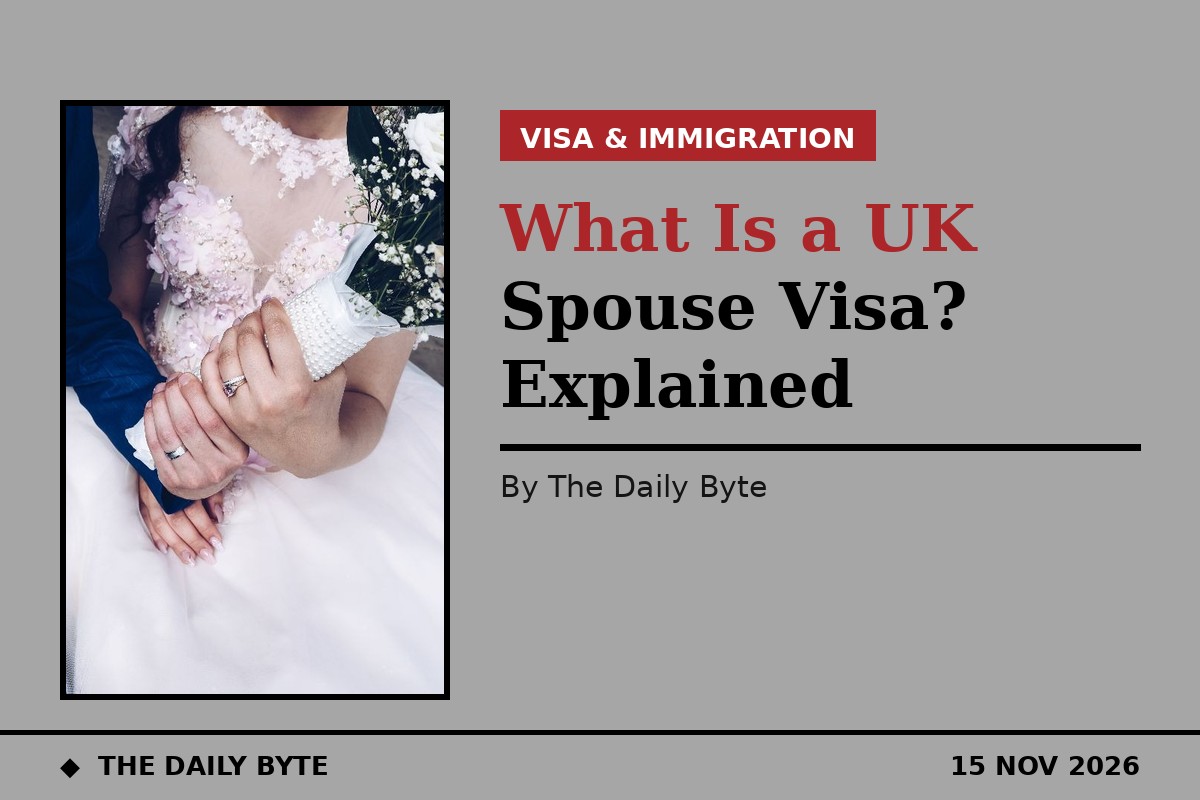
A UK spouse visa — officially the partner visa under the family visa route — lets the husband, wife, civil partner or long-term partner of a British citizen, Irish citizen or person settled in the UK live in the country, work without restriction, and apply for indefinite leave to remain after five years. To qualify you must both be 18 or over, prove a genuine relationship, show a combined income of usually at least £29,000 a year, meet an English language requirement and have suitable accommodation.
The spouse visa is one of the most searched UK immigration questions, and one of the most misunderstood. It is not the same as a fiancé visa, it is not a shortcut to settlement, and the income rule catches out more applicants than any other requirement. This guide explains what a UK spouse visa is, who can apply, what it costs in 2026, how long it takes and how it leads to settlement — using the official GOV.UK rules as they stand on 15 November 2026.
Who can apply for a UK spouse visa?
You can apply as a partner or spouse if your partner is a British or Irish citizen, has settled in the UK — for example with indefinite leave to remain or settled status — is from the EU, Switzerland, Norway, Iceland or Liechtenstein with pre-settled status and started living in the UK before 1 January 2021, holds a Turkish Businessperson or Turkish Worker visa, has protection status as a refugee or a person with humanitarian protection, or was granted permission to stay as a stateless person before you became their partner. Both of you must be 18 or over, and you must intend to live together permanently in the UK after you apply.
If your partner has settled or pre-settled status under the EU Settlement Scheme, you may be able to apply through that free scheme instead of the family visa route. It is worth checking, because the EU Settlement Scheme has no fee and no minimum income requirement.
What relationship do you need to prove?
GOV.UK requires you to prove one of four things: that you are in a marriage or civil partnership recognised in the UK; that you have been living together in a relationship for at least two years when you apply; that you are a fiancé, fiancée or proposed civil partner who will marry or enter a civil partnership in the UK within six months of arriving; or that you have been in a relationship for at least two years but cannot live together — for example because you work or study in different places, or because living together is not accepted in your culture.
The evidence must come from official or independent sources such as the government, a bank, a landlord, a utility provider or a medical professional, and it must be less than four years old. A marriage or civil partnership certificate is the starting point for married couples. For unmarried partners, the Home Office looks for tenancy agreements, utility or Council Tax bills showing the same address, joint bank statements, or letters from a doctor or dentist confirming you live together. If you do not live together, you will need to show an ongoing commitment — regular communication, financial support for each other, care for children you have together, and time spent together as a couple.
One-off bills such as vets’ fees or home repair costs, letters confirming you are both on the voting register at the same address, and student finance paperwork showing a shared address can also be used. The Home Office is testing whether the relationship is genuine and continuing, so thin or inconsistent evidence is the most common reason partner applications run into trouble.
How much income do you need for a UK spouse visa?
For most new applicants, the answer is a combined gross income of at least £29,000 a year. That figure has applied since 11 April 2024. There is no extra amount added for children on new applications. If you first applied as a partner before 11 April 2024 and you are extending your visa with the same partner, the older threshold still applies: £18,600 a year, plus £3,800 for a first child and £2,400 for each additional child, capped at £29,000 in total.
Cash savings can fill the gap or replace income entirely. Under the Appendix FM rules, only savings above £16,000 count, and the money must have been held for at least six months. The formula is £16,000 plus 2.5 times any shortfall in income, which means £88,500 in savings if you have no qualifying income at all. Income can come from your sponsor’s salary, self-employment, dividends, rental income or certain pensions, but each type of income has its own evidence rules, and the Home Office applies them strictly.
There is one important exemption. If your sponsoring partner receives certain disability or carer benefits — such as Personal Independence Payment, Disability Living Allowance, Carer’s Allowance or Attendance Allowance — the £29,000 figure does not apply, and you need to show only that you can maintain yourselves adequately without recourse to public funds.
What English level do you need?
You need to show knowledge of English at level A1 of the Common European Framework of Reference for speaking and listening for a first spouse visa. The bar rises as you progress: A2 when you extend your visa, and B1 when you apply for settlement. From 26 March 2027, the settlement requirement rises to B2. You prove it with an approved Secure English Language Test, a degree taught in English, or nationality of a majority English-speaking country. The rising English requirement is one of the reasons to plan the whole five-year route, not just the first application.
How much does a UK spouse visa cost in 2026?
Applying from outside the UK costs £2,064 under the Home Office fee table that took effect on 8 April 2026 and was left unchanged in the October 2026 update. Extending or switching inside the UK costs £1,407. On top of the application fee, most applicants pay the immigration health surcharge — £3,105 per adult for the first grant — which gives access to the NHS while the visa is valid. A faster decision service is available for an extra fee if you need a decision sooner, and a fee waiver exists for applicants who cannot pay because they have nowhere to live, cannot afford essential living costs, or have a very low income and paying would harm their child’s wellbeing.
Children can be added to the application as dependants if they are under 18 when you apply, or were under 18 when first granted leave, and do not live an independent life — for example, they have not left home, married and had children of their own.
How long does a UK spouse visa take?
GOV.UK says that if you apply from outside the UK, you will usually get a decision within 12 weeks. If you apply inside the UK and you meet the financial and English language requirements, the usual time is within 8 weeks. If you apply inside the UK and do not meet those requirements, it currently takes about 12 months. These are usual times, not guarantees, and complex cases or missing evidence can take longer.
Successful applicants no longer receive a physical biometric residence permit — those were phased out at the end of 2024 — and instead prove their immigration status online with an eVisa, which is also how employers and landlords check the right to work and rent.
How long can you stay, and when can you settle?
A first spouse visa lets you stay in the UK for up to two years and nine months. After that you apply to extend your stay, and an extension gives you a further two years and six months. You can extend more than once, but the goal for most people is settlement: the earliest you can apply for indefinite leave to remain is after you have lived in the UK for five years continuously on a family visa as a partner. Time spent in the UK on any other visa does not count, and neither does time spent as a fiancé, fiancée or proposed civil partner.
Settlement is not automatic at five years. You will need to meet the financial requirement again in its settlement form, show English at B1 — rising to B2 for applications from 26 March 2027 — and pass the Life in the UK test. Once you hold indefinite leave to remain, you can usually apply for British citizenship after a further 12 months, if you meet the residence and good character requirements.
Spouse visa vs fiancé visa: what is the difference?
The two visas are often confused because they sit on the same GOV.UK family visa page, but they do very different jobs. A fiancé visa is for someone who plans to marry or enter a civil partnership in the UK within six months of arriving. It lasts six months, and you cannot work or study in the UK during your engagement. After the wedding you must apply to extend your stay as a partner, and only then do you gain the right to work.
A spouse visa, by contrast, is for people who are already married, in a civil partnership, or in a qualifying unmarried relationship. It lasts two years and nine months, lets you work and study from day one, and counts towards the five-year route to settlement. If you are already married, the spouse visa is the right route; the fiancé visa exists for couples who want the wedding itself to happen in the UK.
Could the rules change?
Yes — and they have changed repeatedly. The £29,000 income threshold was itself a sharp rise from the old £18,600 figure in April 2024, and the previous government’s planned increases to £34,500 and then £38,700 were never implemented. The Migration Advisory Committee reviewed the financial requirement in 2025 and did not recommend a further rise. The Home Secretary told the Commons Home Affairs Committee on 15 September 2026 that a new family migration policy is expected in early 2027, with work under way to align family routes so the same rules apply regardless of the sponsor’s immigration status. No change is in force yet, but anyone planning an application should check the GOV.UK family visa pages on the day they apply, because the rules in force on that day are the ones that decide the outcome.
Frequently asked questions
Can I work on a UK spouse visa? Yes. A spouse visa gives you the right to work in the UK without restriction from the day it is granted, including self-employment. This is one of the main differences from a fiancé visa, which does not allow work.
How much do I need to earn for a UK spouse visa? Usually a combined gross income of at least £29,000 a year, in force since 11 April 2024. Cash savings can cover some or all of the shortfall, and the figure does not apply if your sponsor receives certain disability or carer benefits.
How long does a spouse visa take from outside the UK? GOV.UK says you will usually get a decision within 12 weeks. A priority service is available for a faster decision for an extra fee.
Can I apply for a spouse visa if we are not married? Yes, if you have lived together in a relationship for at least two years, or have been in a relationship for two years but cannot live together for work, study or cultural reasons. You will need evidence of the relationship.
Does a spouse visa lead to settlement? Yes. You can apply for indefinite leave to remain after five years living continuously in the UK on a family visa as a partner, provided you still meet the financial and English requirements at that stage.
Immigration rules and fees change. This guide is general information based on the GOV.UK family visa pages and the Immigration Rules as they stood on 15 November 2026; it is not personal immigration advice. Always check the official GOV.UK page before you apply or pay any fee.
Sources: GOV.UK — Family visas: apply as a partner or spouse; GOV.UK — Family visas: apply, extend or switch.