What Is a UK Student Visa? Explained
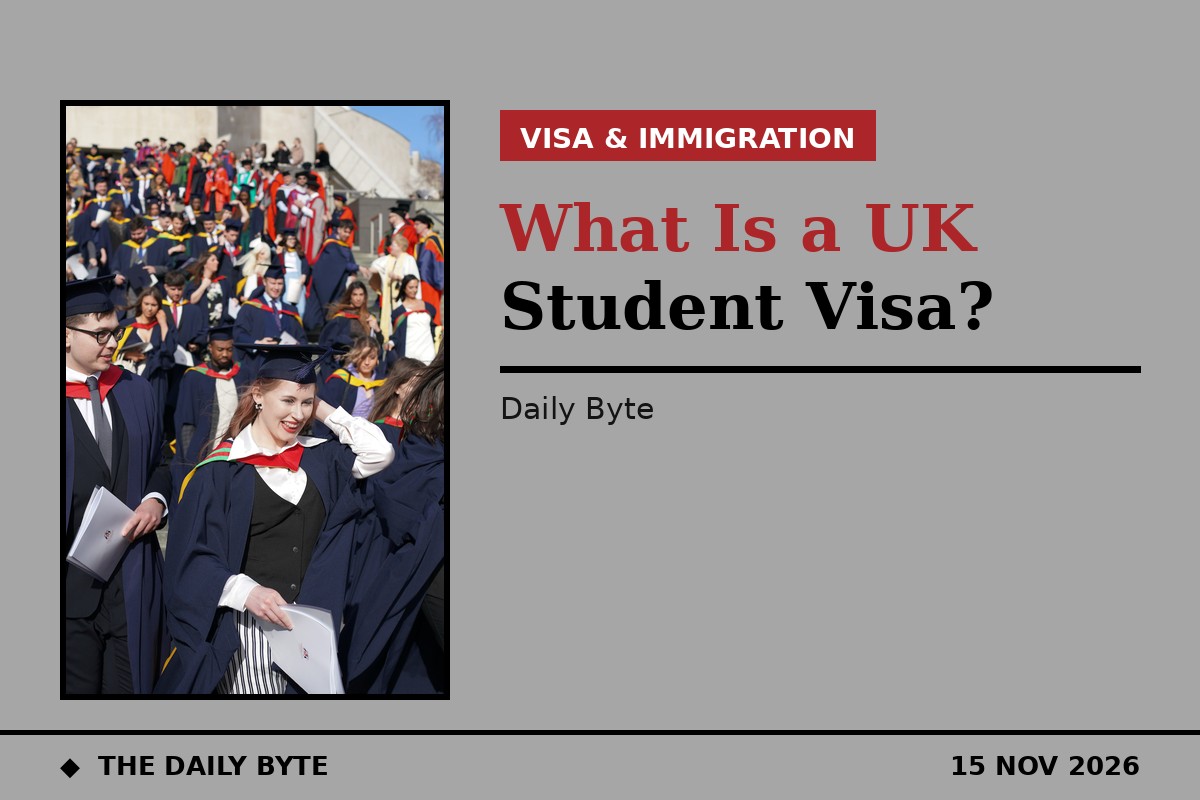
A UK Student visa lets you study in the United Kingdom if you are 16 or over, have an unconditional offer of a place on a course with a licensed student sponsor, can show enough money to pay for your course and support yourself, and can prove your English. It is a points-based visa: you need 70 points — 50 for your offer of a place, 10 for English and 10 for your finances — and it replaced the old Tier 4 (General) student visa.
This guide explains the Student visa in full, using the official GOV.UK guidance as it stood on 15 November 2026: who can apply, what a CAS is, how much money you must show, what it costs, how long it takes, what you can and cannot do, and what happens after your course ends. One warning up front: the maintenance figures rise on 30 November 2026, so always check the official GOV.UK page before you apply. This article is general information, not immigration advice.
Who can apply for a UK Student visa?
You can apply for a Student visa if you are 16 or over and you have been offered a place on a course by a licensed student sponsor, have enough money to support yourself and pay for your course, and can speak, read, write and understand English. If you are 16 or 17, you need evidence of consent from your parents, and you may be eligible for a Child Student visa instead.
A licensed student sponsor is a university, college or school approved by the Home Office. Before you pay a deposit or accept an offer, check that your provider is on the official Register of Student Sponsors on GOV.UK — an offer from an unlicensed provider cannot support a visa application. Your course must also qualify: a full-time course leading to a qualification at degree level or above, a full-time course below degree level with at least 15 hours a week of organised daytime study, a part-time course above degree level, or an English language course at CEFR level B2 or above.
What is a CAS and why do you need one?
Once your sponsor offers you an unconditional place, it sends you a reference number called a Confirmation of Acceptance for Studies, or CAS. The CAS is not a paper certificate; it is a reference number you enter on your visa application, and it confirms your course, its fees and your sponsor's details to the Home Office.
You cannot apply for the visa before you receive your CAS, and you must apply within six months of receiving it. The amount of course fees you need to show is the figure on your CAS: you must have enough money to pay for one academic year of your course, up to nine months. If you are studying or researching a sensitive subject at postgraduate level, you may also need an Academic Technology Approval Scheme (ATAS) certificate before you apply.
How much money do you need to show?
The financial requirement is the part of the application that most often goes wrong, and it has two parts: your unpaid first-year course fees, and your living costs. The living-cost figures are set by the Home Office, not by your university, and they depend on where you study. London means the City of London and the 32 London boroughs, so check where your course is actually taught rather than where the university's head office sits.
| Where you study | Per month (until 29 Nov 2026) | Per month (from 30 Nov 2026) | Up to 9 months |
|---|---|---|---|
| In London | £1,529 | £1,570 | £13,761 now; £14,130 from 30 Nov |
| Outside London | £1,171 | £1,203 | £10,539 now; £10,827 from 30 Nov |
The higher figures come from the Statement of Changes to the Immigration Rules HC 584, published on 3 September 2026. The date you apply decides which rate you must meet, not your CAS issue date or your course start date. You must also prove extra money for each family member you bring with you.
The 28-day rule
Having the right amount is not enough: the money must have been in your account, or your parent's account if you are relying on their funds, for at least 28 consecutive days, and the end of that 28-day period must fall within 31 days of the date you apply. If your balance dips below the required amount on any day in that window, the clock resets. A student loan or financial sponsorship also counts, but you will need evidence from the loan or sponsorship company.
Two groups do not need to prove they have the money: people who have been living in the UK with a visa for at least 12 months before they apply, and student union sabbatical officers. Nationals of a long list of countries under the differential evidence requirement — including Pakistan, India, China, the USA, Canada and most of Europe — do not need to submit financial evidence with the application, but UK Visas and Immigration can still ask for it before deciding, so the money should be ready either way.
What does a UK Student visa cost?
You pay three things, and each dependant who joins you pays them too: the application fee, the immigration health surcharge, and the maintenance money above. The surcharge gives you access to the NHS while you are in the UK.
| Cost | Amount |
|---|---|
| Application fee (outside or inside the UK) | £558 |
| Immigration health surcharge | £776 per year of your visa |
| Maintenance money | £1,529 a month in London or £1,171 outside London, for up to 9 months, plus unpaid first-year course fees |
You may be able to pay extra for a faster decision; GOV.UK tells you whether that is available when you apply. Fees change, so confirm the current figures on GOV.UK before you pay.
What is the English language requirement?
You will usually need to prove you can read, write, speak and understand English to a level on the Common European Framework of Reference for Languages (CEFR) scale. The level depends on what you are studying.
| Level of study | English level required |
|---|---|
| Degree level or above | CEFR B2 (upper-intermediate) |
| Below degree level | CEFR B1 (intermediate) |
You can prove your English with a Secure English Language Test (SELT) from an approved provider, a UK school qualification such as a GCSE or A level in English, or a degree taught in English. If you are studying at degree level or above with a Higher Education Provider, the provider can assess your English itself, but the assessment must still be equivalent to CEFR B2. You do not need to prove your English if you are a national of a listed English-speaking country — including Ireland, the USA, Canada, Australia and New Zealand — or if you already proved it in a previous visa application.
How long does it take, and how long can you stay?
When you can apply depends on where you apply from. From outside the UK, the earliest you can apply is six months before your course starts; from inside the UK, three months before. You must apply before your current visa expires, and your new course must begin within 28 days of your current visa expiring.
| Applying from | Usual decision time |
|---|---|
| Outside the UK | Within 3 weeks |
| Inside the UK | Within 8 weeks |
How long you can stay depends on your course. If you are 18 or over and your course is at degree level, you can usually stay for up to five years; if it is below degree level, you can usually stay for up to two years. You can arrive in the UK up to one week before your course starts if it lasts six months or less, or up to one month before if it lasts more than six months — but you must not travel before the start date given on your visa.
What can you do on a Student visa — and what you cannot do?
You can study on a further or higher education course, work as a student union sabbatical officer, and take a traineeship through the Erasmus+ programme with a participating licensed sponsor. You may also be able to work while you study, but how much depends on what you are studying and whether it is term time, and your visa will state the conditions.
You cannot claim public funds (benefits) and pensions, work as a professional sportsperson or sports coach, or be self-employed. That last rule catches out students who plan to freelance or take on contract work alongside their studies: self-employment is prohibited outright on this visa.
What happens after your course?
You may be able to extend your Student visa to continue studying, switch to a Student visa from another visa type, or switch to a Graduate visa after successfully completing your course. The Graduate visa lets you stay and work in the UK for two years if you apply on or before 31 December 2026, for 18 months if you apply on or after 1 January 2027, and for three years if you completed a PhD or other doctoral qualification. The shorter 18-month period is a recent change, so check the current Graduate visa guidance before planning around it.
Your partner and children may be able to join you as dependants, but dependant rules are restricted, so check the GOV.UK dependants guidance for your course type before assuming your family can come.
What documents will you need?
When you apply you must provide a current passport or other valid travel document and your CAS. Depending on your circumstances you may also need proof of your money, a valid ATAS certificate, your tuberculosis test results if your country of residence requires one, proof of parental consent and your relationship to your parent or guardian if you are under 18, and written consent from a financial sponsor if one has funded your fees or living costs in the last 12 months. You apply online through GOV.UK, prove your identity through the UK Immigration: ID Check app or at a visa application centre, where your fingerprints and photograph are taken.
Frequently asked questions
How much money do I need for a UK Student visa?
You must show your unpaid first-year course fees plus living costs of £1,529 a month in London or £1,171 a month outside London, for up to nine months — £13,761 or £10,539. From 30 November 2026 the monthly figures rise to £1,570 and £1,203. The money must be held for 28 consecutive days.
How long does a UK Student visa take?
Usually within three weeks if you apply from outside the UK, and within eight weeks if you apply from inside the UK. You can apply up to six months before your course starts from outside the UK.
Can I work on a UK Student visa?
You may be able to work, but how much depends on your course and whether it is term time. You cannot be self-employed, work as a professional sportsperson or coach, or claim public funds.
Can my family come with me on a Student visa?
Your partner and children may be able to join you as dependants, but the rules are restricted and depend on your course type. Check the GOV.UK guidance on dependants before you apply.
Can I stay in the UK after my course finishes?
Yes — you may be able to switch to a Graduate visa, which allows two years if you apply on or before 31 December 2026, 18 months from 1 January 2027, or three years after a PhD.
Do I need a TB test for a UK Student visa?
It depends on where you have lived. Some countries require a tuberculosis test as part of the application; GOV.UK lists the countries and the approved clinics.
Sources: GOV.UK, “Student visa” overview and guidance (gov.uk/student-visa), read and verified 15 November 2026; Home Office Statement of Changes to the Immigration Rules HC 584 (3 September 2026) for the 30 November 2026 maintenance rise; Home Office immigration and nationality fees table. All figures are as published by GOV.UK — re-check the official page before applying, because fees and financial requirements change.