What Is an Election Recount? Rules Explained
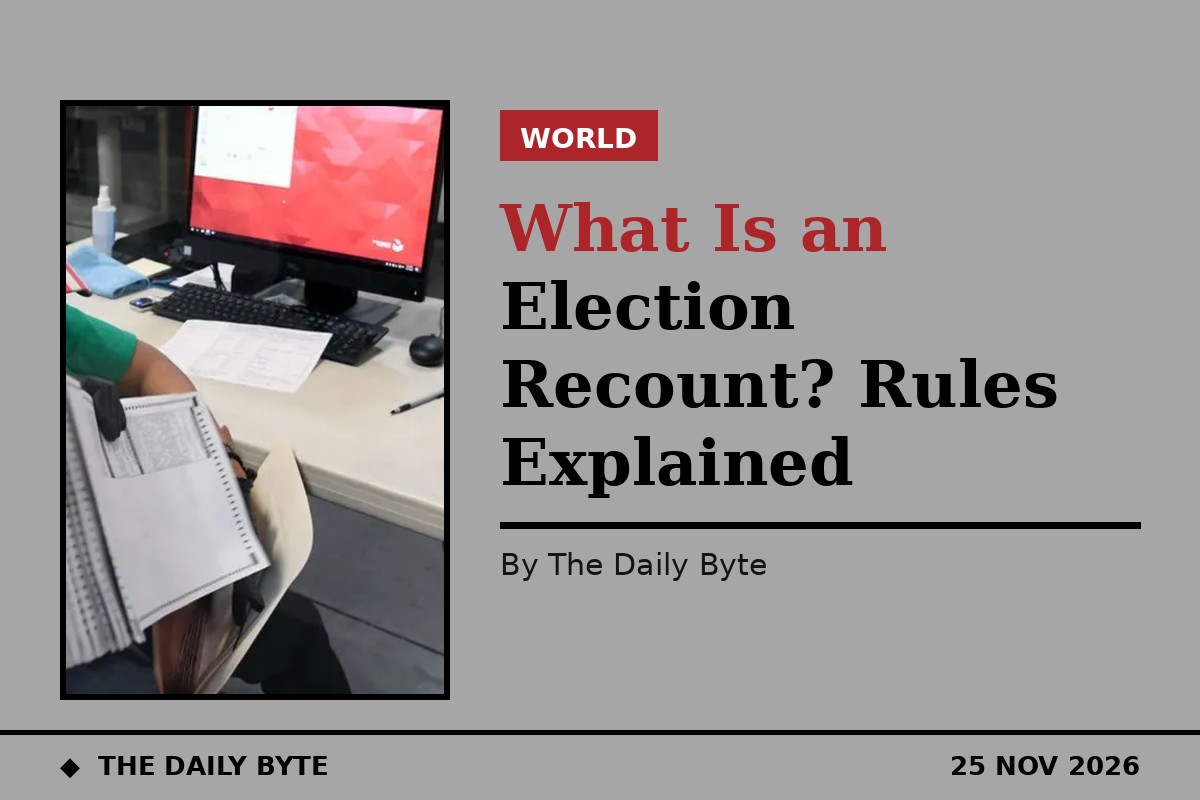
An election recount is a second count of the ballots cast in a close contest, carried out to check the accuracy of the first count. It is not a new election: nobody votes again. Officials re-examine the ballots that were already cast, either by running them through counting machines a second time or by counting them by hand, under rules set by state law. There is no single US recount procedure; every state writes its own rules on when a recount happens, who can ask for one, how it is conducted and who pays for it.
Recounts are in the news now because five US House races from the 3 November 2026 midterm elections were still uncalled when Congress left Washington for the Thanksgiving recess on 21 November, nearly three weeks after polling day. Recounts have been requested in two of the closest: North Carolina's 5th District, where Republican Virginia Foxx trails Democrat Chuck Hubbard by roughly 300 votes, and Minnesota's 1st District, where Republican Brad Finstad trails Democrat Jake Johnson by a similar margin. Two Louisiana districts will instead be decided by runoffs on 12 December. This explainer sets out how recounts work, what triggers them, and whether they ever change the result.
What triggers a recount?
There are three routes to a recount. The first is an automatic recount, which starts without anyone asking for it because state law says a margin that narrow must be rechecked. According to the National Conference of State Legislatures (NCSL), whose recount guidance was last updated on 19 October 2026, 26 states plus Washington DC and Puerto Rico have automatic recount rules. The triggers run from a margin of 1 per cent of the votes cast down to an exact tie, and 0.5 per cent is the most common. In a race with a million votes cast, a 0.5 per cent trigger means a gap of 5,000 votes or fewer starts a recount automatically, while a gap of 5,001 votes does not. Some states write the trigger as a fixed number of votes instead of a percentage.
The second route is a requested recount, where a losing candidate, a voter, a group of voters or another party asks for one. NCSL says 41 states and Washington DC permit this in some form. In 12 of those states the result must fall within a specified margin before a candidate can make the request; in others, such as California, any candidate or voter may ask regardless of the margin. In Minnesota there is no threshold requirement, but only the losing candidate may request a recount. The third route is a court-ordered recount, which is the only route in Illinois, Mississippi and Tennessee, where state law does not provide a direct requested-recount process.
North Carolina, where one of the two live recounts is happening, has no automatic recount for a congressional race. Instead, a candidate who trails by 1 per cent or less in a non-statewide race may request one, with the request due by noon on the second business day after the county canvass, the official certification of the results. Foxx requested a recount on 17 November, according to local station WBTV. Finstad requested a recount in Minnesota on 19 November, according to Minnesota Public Radio. In Tennessee's 4th District, where Democrat Victoria Broderick leads Republican Scott DesJarlais by roughly 280 votes, DesJarlais conceded on 16 November, though the Associated Press had still not called the race.
How are the ballots counted the second time?
The method depends on the state and on the voting equipment used. In some places the paper ballots are fed through the tabulators again; in others teams of election workers count them by hand, working in pairs under observation by representatives of the candidates. North Carolina's rules allow a candidate whose first recount was a machine recount that did not change the result to ask for a second, hand-to-eye recount, and to ask for a sample recount of 3 per cent of precincts first if that suggests a significant change. Partial recounts, covering only some precincts, are not allowed in North Carolina. The exact procedure, and the deadline for finishing, comes from the state election office, and observers and the media are generally allowed to watch.
Before any recount begins, officials first determine the legally required scope, deadline and counting method, secure a counting location, train the recount teams and set the rules for candidates and observers. Ballots are handled under chain-of-custody procedures, and the recount covers the contest or the scope defined by the law or the recount order, not the whole ballot. A recount also does not revisit who was allowed to vote: provisional ballots and mail ballots are decided during the canvass, the official process in which counties check and certify results, before a recount is requested. That is why the timetable matters. In North Carolina's 5th District, for example, county boards worked through provisional ballots, including about 300 in Watauga County alone, and the county canvass certifying the results took place on 13 November, before the recount clock started.
Who pays for a recount?
An automatic recount is paid for by the state or county that conducts it, because the law, not a candidate, ordered it. A requested recount is different: in most states the person asking for it must post a deposit towards the cost. If the recount reverses the result, the deposit is refunded. If it does not, the requester generally pays most of the costs. North Carolina is an exception in one respect: the state pays for a requested recount in a non-statewide race where the margin qualifies, which is why the Foxx recount does not fall on the candidate's campaign. The deposit rule is deliberate. It keeps recounts available to a candidate who genuinely believes the count was wrong, while discouraging requests made simply to delay certification.
Do recounts ever change the result?
Rarely, and that is the consistent finding of the people who run elections. The National Conference of State Legislatures, reviewing recounts in its December 2020 newsletter, headlined its findings 'Recounts Provide Reassurance, Rarely Reversal', noting that in three statewide recounts it examined, the original margin of victory had been less than 0.05 per cent. A recount is a check on the count, not a second election, and modern counting, with paper ballots and machine tabulation, is usually accurate to within a handful of votes. A margin of roughly 300 votes in a House race where about 278,000 ballots were cast, as in North Carolina's 5th, is about a tenth of one per cent, which is exactly the territory in which recounts are requested, and also the territory in which they most often confirm the first count.
That does not make recounts pointless. Their purpose is confidence, not drama. A close result that has been counted twice, in public, with observers from both sides watching, is much harder to dispute afterwards than a result counted once. And recounts do occasionally find real errors: a misread batch of ballots, a tabulator fault, or ballots that were wrongly set aside. When they do, the corrected result stands, and the deposit is refunded to the candidate who asked. The 2026 races also show the limits of the process. Even if both requested recounts confirm the leaders, the House picture barely moves: Democrats passed the 218 seats needed for a majority on 4 November, and the five uncalled races decide only the size of their majority when the new Congress convenes in early January 2027, not which party controls the chamber.
What is the difference between a recount, a canvass and an audit?
The three terms describe three different steps, and they are often confused. The canvass is the official process in which election officials check, certify and declare the results: counting provisional and mail ballots, reconciling the number of ballots cast with the number of voters who signed in, and signing off the totals. It happens after every election, whether the race is close or not.
An audit, often called a risk-limiting audit, is a statistical check. Officials hand-count a randomly chosen sample of ballots and compare the sample with the machine count; if the sample matches, the result is confirmed to a known level of confidence without counting every ballot. A recount is the full re-count of the contest in question, ordered because the margin is small or because a candidate asked for one. A race can be audited and recounted, and in some states the two have to be run as separate exercises, which election officials say can be a headache when both are ordered for the same contest.
What is a runoff, and how is it different?
A runoff is not a recount at all. It is a second election, held because no candidate won outright in the first round. Louisiana uses this system for its congressional races: if no candidate clears 50 per cent, the top two finishers meet again. That is what is happening in Louisiana's 5th and 6th Districts, where the runoffs are scheduled for 12 December. Voters vote again, campaigns campaign again, and the winner is whoever gets the most votes on the day. A recount, by contrast, re-examines votes that have already been cast. The distinction matters because a runoff can produce a genuinely different result, while a recount almost always confirms the first count.
General information only, not legal advice. Recount rules, deadlines and thresholds are set by state law and can change, so anyone involved in a contest should check the current rules with the state or local election office.
Frequently asked questions
Who can ask for a recount?
It depends on the state. In most states the losing candidate can, and in many states voters, groups of voters or political parties can too. In three states, Illinois, Mississippi and Tennessee, only a court can order one.
Does a recount mean something went wrong?
No. A recount is a routine check that the law requires or allows when a race is very close. Most recounts confirm the original result.
Can a candidate ask for only part of a district to be recounted?
Some states allow partial recounts, but North Carolina does not: a requested recount there covers the whole contest.
How long does a recount take?
State law sets the deadline, and it varies. The request itself is usually due within a few days of the canvass, and the count must be finished in time for the results to be certified before the winners take their seats.
What happens if the recount changes the winner?
The corrected result is certified instead of the first one, the candidate who requested the recount gets their deposit back, and the new winner is seated.