What Is the Border Security, Asylum and Immigration Act 2025? Explained
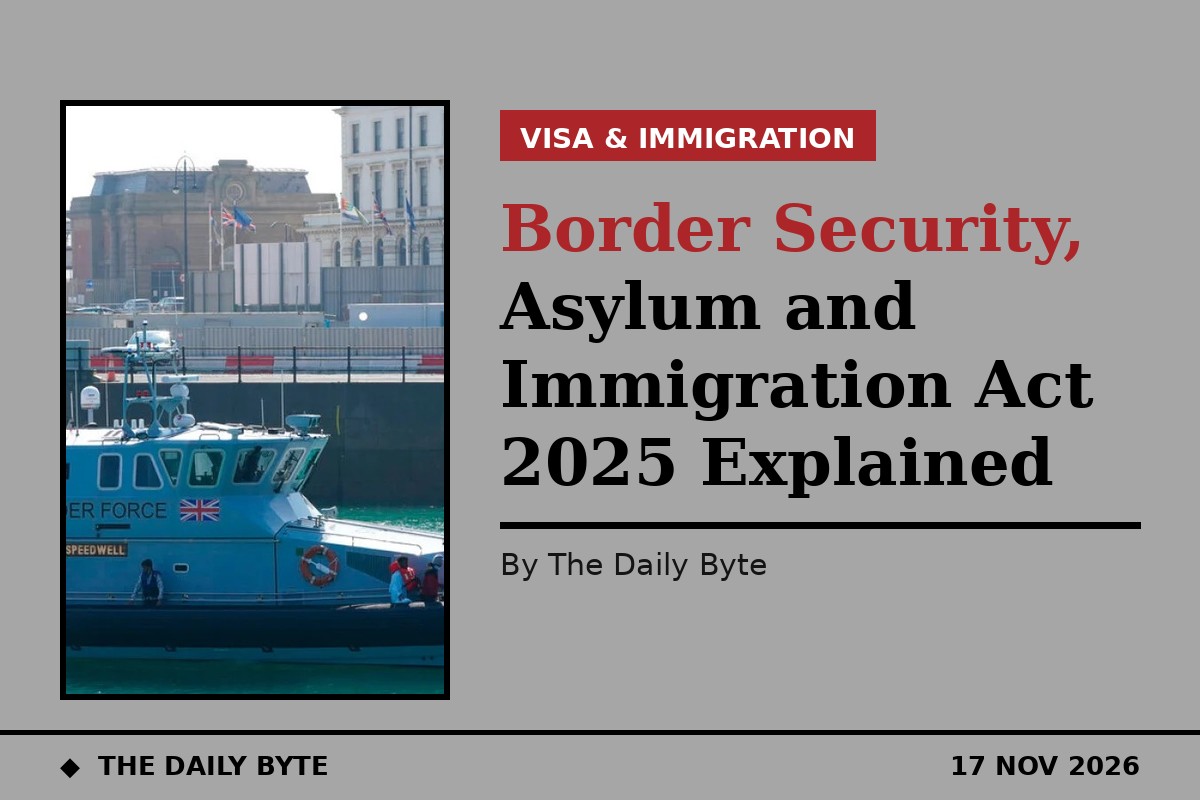
The Border Security, Asylum and Immigration Act 2025 is the UK law that gives police, Immigration Enforcement and the National Crime Agency (NCA) new powers and new criminal offences to disrupt the gangs that organise small boat crossings of the English Channel. It received Royal Assent on 2 December 2025 and became law the same day. In short, it is a law aimed at the smugglers rather than at people applying through legal immigration routes: it creates offences for supplying small boat parts, for researching crossings and for hiding people in vehicles, and it lets officers use mobile phone data to trace the networks behind the boats.
The Act was one of the new government's flagship pieces of legislation. It was introduced as the Border Security, Asylum and Immigration Bill in January 2025, passed through Parliament during the year, and completed its journey when it received Royal Assent on 2 December 2025. The Home Office described it at the time as giving law enforcement "stronger powers than ever before to intercept, detain and arrest people smugglers". The Crown Prosecution Service welcomed the package, saying it gives prosecutors another tool to fight organised immigration crime, particularly dangerous Channel crossings.
What is the Border Security, Asylum and Immigration Act 2025?
The Act is a package of measures designed to make it easier to investigate, arrest and prosecute people smugglers, and harder for smuggling gangs to operate. Much of it draws on powers normally associated with counter-terrorism law, because ministers argued that smuggling gangs are organised criminal networks that need to be disrupted early, before migrants are put into boats.
The Home Office said the new powers could help speed up investigations that might previously have taken months or even years to prove. The NCA said it had around 100 investigations under way into the gangs or individuals involved when the Act became law. The government also reported that nearly 900 organised immigration crime networks had been dismantled, that there had been nearly 4,000 organised immigration crime disruptions since the Border Security Command was launched, and that smuggling arrests, convictions and seizures of criminal cash and assets had risen by 33% over the previous year.
The Act also puts the Border Security Command on a statutory footing, repeals the Safety of Rwanda Act 2024 and most of the Illegal Migration Act 2023, and strengthens the regulation of immigration advice. Each of those parts is explained below.
The new criminal offences
The centrepiece of the Act is a set of new criminal offences aimed at the practical business of people smuggling. The maximum penalties are significant, and they are worth setting out in full because they show what Parliament decided should count as a crime.
Supplying small boat parts. It is now a criminal offence to supply, offer to supply or handle articles such as small boat parts — for example engines, air valves and inflation pumps — where they are intended for use in people smuggling. Offenders risk up to 14 years in prison, the heaviest penalty in the Act.
Researching crossings. It is a criminal offence to download, research or make a record of information linked to people smuggling, such as departure dates, timings and locations of small boat crossings, research on how to make a small boat, or intelligence on where French police might be stationed at the border. Offenders could receive up to five years in prison. This is the measure that most closely mirrors counter-terror law, where gathering information useful to an offence is itself criminalised, and it is the one that allows officers to act before a crossing takes place — for example, where someone has downloaded a route map for a crossing.
Hiding people in vehicles. It is a criminal offence to import, manufacture or supply compartments that modify a vehicle, such as a fake floor in a van or lorry, to hide migrants underneath. Offenders could receive up to five years in prison.
Endangering lives during a crossing. It is a criminal offence to put lives in danger during a small boat crossing through physical aggression or by refusing rescue attempts. Offenders could face up to six years in prison.
Promoting crossings online. It is a criminal offence to create or post material online that promotes small boat crossings or services to facilitate illegal migration. This targets the social media advertising and messaging through which smugglers recruit customers and sell crossings.
Mobile phone powers
The Act gives Immigration Enforcement, the NCA and the police powers to gather intelligence from the mobile phones of people who have arrived illegally, in order to track down and arrest the smugglers behind their journey. Phones can be seized during property, vehicle or premises searches during enforcement raids, and officers will no longer need to arrest someone first before seizing a device in those circumstances.
The thinking behind this is straightforward: a phone can contain the contact details of an agent, payment records, messages about pick-up points and the route taken, and photographs of the boat or the gang's operatives. The Home Office argued that easier and faster access to that data would help law enforcement gather evidence to prosecute smugglers and gain intelligence to disrupt their activities, rather than waiting for a lengthy investigation to build the same picture from scratch.
The Border Security Command on a statutory footing
The Act places the UK's Border Security Command on a statutory footing. That means the Command now has a formal legal basis, and its lead — Border Security Commander Martin Hewitt — can convene partners across law enforcement, including the NCA, to set strategic priorities for securing Britain's borders.
The Act also sets out that bespoke working arrangements will be formally agreed between the Command and the UK Intelligence Community, so that intelligence officers and law enforcement can work together more closely to identify and disrupt the criminal networks behind people smuggling. Commander Hewitt said the Act "lets us go further and faster to target, disrupt and intercept criminal networks", and pointed to the 33% surge in smuggling arrests, convictions and seizures as evidence of the work already under way.
What the Act changes for asylum and immigration advice
Although the headlines focused on smuggling, the Act also makes changes to the wider asylum and immigration system. Three are important.
First, it repeals the Safety of Rwanda Act 2024 and most provisions of the Illegal Migration Act 2023. Those were the previous government's laws: the Rwanda Act was designed to allow asylum seekers to be sent to Rwanda, and the Illegal Migration Act sought to prevent people arriving by irregular routes from claiming asylum in the UK. Both are now largely off the statute book, and the new Act replaces that approach with the enforcement and disruption powers described above.
Second, it excludes foreign sex offenders from protections under the Refugee Convention. Any conviction of a crime that qualifies a foreign national for the sex offenders register will lead to them being denied refugee status.
Third, it grants the Immigration Advice Authority (IAA) enhanced legislative powers for regulation and enforcement. The IAA is the body that regulates people and organisations giving immigration advice in the UK. The new powers are intended to strengthen its ability to tackle poor immigration advice by those who are regulated, improving protection for people seeking advice. These particular powers are not yet in effect: the IAA has said they are subject to further planning and preparation before implementation, and it has published a factsheet summarising what they will mean for advisers, organisations and their clients.
What the Act does not do
It is important to be clear about the limits of the Act. It does not create a new legal route to the UK, and it does not change the visa rules for people applying through the normal immigration system — for example, Skilled Worker, student or family visas. Those routes continue to operate under their own rules, and anyone considering them should check the official GOV.UK pages, because immigration rules change frequently.
The Act also does not, on its own, stop small boat crossings. Its purpose is to make the business of smuggling harder, riskier and less profitable, by taking away the tools smugglers use and by letting investigators act earlier. Whether crossings fall depends on enforcement, on cooperation with France and other countries, and on the wider asylum system — including how quickly claims are decided and removals carried out. The Home Secretary has said the measures go alongside plans to scale up removals and deportations of people with no right to remain, as part of what she called the most sweeping reforms to tackle illegal migration in modern times.
What happens next
Royal Assent made the Act law on 2 December 2025, but as with most Acts of Parliament, individual measures are brought into force in stages. The Home Office and the IAA have said that some powers, including the IAA's new regulatory powers, need further preparation before they take effect. Anyone affected by the Act — whether they work in law enforcement, give immigration advice, or are involved in a case where the new offences may apply — should check the current position on GOV.UK and on legislation.gov.uk, where the full text of the Act (chapter 31 of 2025) is published, and seek regulated legal advice where needed.
This article is general information about a new law, not personal immigration or legal advice. Immigration and asylum rules change often, and individual cases depend on their own facts, so always check the official GOV.UK page and consider speaking to a regulated immigration adviser or solicitor before acting.
Frequently asked questions
Is the Border Security, Asylum and Immigration Act 2025 already law? Yes. It received Royal Assent on 2 December 2025 and became the Border Security, Asylum and Immigration Act 2025. Some individual powers, such as the Immigration Advice Authority's new regulatory powers, are still being prepared and are not yet in effect.
Does the Act affect people applying for a UK visa legally? No. The Act targets people smuggling gangs and the tools they use. Legal visa routes, such as work, study and family visas, operate under their own rules, which are set out on GOV.UK.
What is the maximum sentence for supplying small boat parts? Up to 14 years in prison for supplying, offering to supply or handling articles such as engines, air valves and inflation pumps intended for people smuggling.
Can police take a migrant's phone under the Act? Yes. Immigration Enforcement, police and the NCA can gather intelligence from the mobile phones of people who have arrived illegally, and phones can be seized during property, vehicle or premises searches without an arrest being made first.
What happened to the Rwanda plan? The Act repeals the Safety of Rwanda Act 2024 and most of the Illegal Migration Act 2023, ending the previous government's approach of sending asylum seekers to Rwanda and of barring claims from people who arrived by irregular routes.
Sources: GOV.UK, Major new act to disrupt smuggling gangs (Home Office, 2 December 2025); EIN, Border Security, Asylum and Immigration Act receives Royal Assent (2 December 2025); GOV.UK, Border Security, Asylum and Immigration Act receives Royal Assent (Immigration Advice Authority).