What Is Great British Energy? The UK's Publicly Owned Clean Power Company Explained
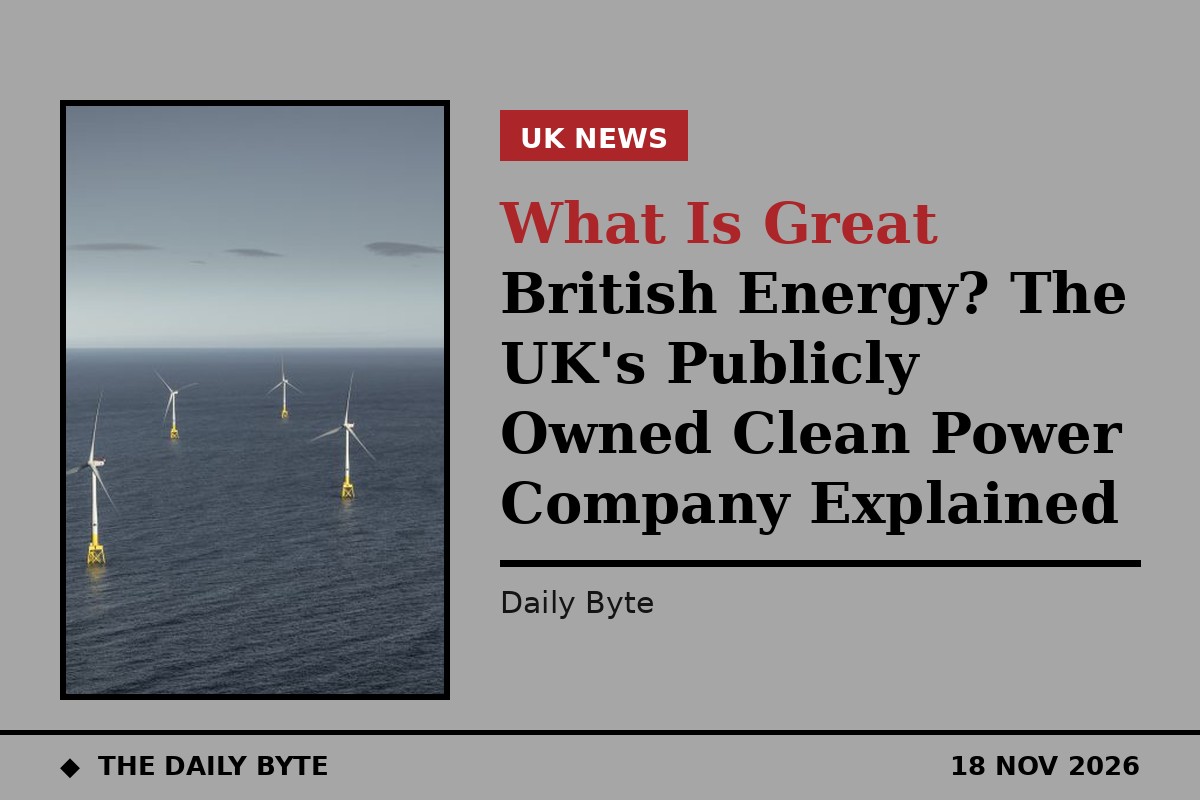
Great British Energy is a publicly owned energy investment company set up by the UK government to invest in, own and help build clean power projects across the country, from offshore wind and solar to community energy schemes. It was created by the Great British Energy Act 2025, is headquartered in Aberdeen, and has been given £8.3 billion of capital to spend over the course of this Parliament. Its first five-year strategic plan, published on 4 December 2025, sets out targets of at least 15 gigawatts of clean energy capacity, £15 billion of private finance mobilised and more than 10,000 jobs supported by 2030.
What is Great British Energy?
Great British Energy, usually shortened to GB Energy or GBE, is a state-owned company whose job is to speed up Britain's shift to clean, home-grown energy. Rather than generating power itself at first, it works as a developer and an equity investor: it puts public money into renewable projects alongside private investors, takes a lasting public stake in the assets, and reinvests the returns into more capacity, more jobs and more projects.
The company was a central Labour commitment before the 2024 general election and was formally established by the Great British Energy Act 2025, which received Royal Assent on 15 May 2025. It is sponsored by the Department for Energy Security and Net Zero, but it is designed to operate independently, overseen by its own board rather than run day-to-day by ministers. Its purpose, as the government puts it, is to drive clean energy deployment, create jobs, boost energy independence, and ensure taxpayers, billpayers and communities share in the benefits of clean, secure, home-grown energy.
GBE is part of a bigger plan. It supports the government's Clean Power 2030 Action Plan, which aims for a clean-power electricity system by 2030, and the longer-term target of net zero across the economy by 2050.
Who owns and runs Great British Energy?
Great British Energy is publicly owned. It is sponsored by the Department for Energy Security and Net Zero and is run as a standalone company outside government, with an independent board providing oversight. Its chief executive is Dan McGrail, the former chief executive of RenewableUK, who was appointed as permanent chief executive in July 2025. Its chair is Juergen Maier, the former chief executive of Siemens UK.
There is also a sister organisation, Great British Energy – Nuclear, or GBE–Nuclear, which is a separate publicly owned company responsible for nuclear projects. The two are capitalised together under the same £8.3 billion envelope, and the government's statement of strategic priorities, published in September 2025, confirmed that the two entities operate as separate and allied publicly owned companies.
How is Great British Energy funded?
The government has committed £8.3 billion of capital to Great British Energy and Great British Energy – Nuclear over the lifetime of the Parliament elected in 2024. Part of the funding comes from the Energy Profits Levy, the windfall tax on oil and gas companies, which was raised from 75% to 78% and is expected to raise £1.2 billion over the Parliament, with the rest coming from what the government describes as responsible borrowing. An initial £100 million of capital funding was provided to kick-start GBE's work in 2025/26.
The model is meant to become self-sustaining. The company's statement of strategic priorities says it should work towards becoming a financially sustainable and self-financing organisation. Its strategic plan says the portfolio it builds should be generating income by 2030, with the returns reinvested into new capacity, and that it will be on a pathway to company-wide profitability in the longer term. The aim is also to crowd in private money: GBE's own spending is intended to mobilise £15 billion of private finance over time.
What is in the five-year strategic plan?
GBE published its first strategic plan on 4 December 2025, as a response to the Energy Secretary's statement of strategic priorities. The plan sets out what the company will deliver from its spending between now and 2030:
- at least 15 GW of clean energy generation and storage assets, enough to power the equivalent of almost 10 million homes;
- £15 billion of private finance mobilised over time, driven by GBE's investments and long-term partnerships;
- support for more than 1,000 local and community energy projects, expanding public participation and local control in the energy system;
- more than 10,000 jobs directly supported through GBE-backed and funded projects, including in areas historically dependent on oil and gas;
- an income-generating portfolio, with income reinvested into more capacity and more opportunity.
The plan also gives more detail on the £1 billion Energy, Engineered in the UK programme, a major initiative to strengthen the UK's industrial base and deliver the Industrial Strategy by building a resilient, long-term supply chain for clean energy and supporting high-quality jobs. Energy Secretary Ed Miliband said the plan showed what a publicly owned energy company would deliver: an abundance of clean, home-grown energy for British people and thousands of good jobs across the country.
What are the three investment priorities?
The strategic plan organises GBE's work into three priority areas for investment. GBE Local is about making sure communities and public services directly benefit from the clean energy infrastructure in their area, including through community and local energy projects. Onshore Energy is about unlocking the energy potential of the UK's land and strengthening grid stability, covering onshore wind, solar and storage. Offshore Energy is about accelerating the UK's leadership in deep-water offshore wind and driving long-term growth in the sector, including floating offshore wind.
What has Great British Energy invested in so far?
GBE has already started deploying funds. Its first projects have included £180 million to install solar panels to lower bills for hundreds of schools and hospitals, £10 million for mayoral strategic authorities to invest in renewable energy projects, and £300 million to support domestic offshore wind supply chains.
Its early investments also include the Pentland floating offshore wind farm off the coast of Caithness and a hydrogen manufacturing project in Sheffield, and it has worked in Scotland through the Scottish Government's Community and Renewable Energy Scheme, with funding supporting 70 local projects. GBE has said it is exploring a partnership with Trydan Gwyrdd Cymru, the Welsh state-owned renewable energy developer, to develop public land in Wales and deliver up to 1 GW of new renewable capacity by 2040.
Where is Great British Energy based?
Great British Energy is headquartered in Aberdeen, at Marischal Square, a decision announced in September 2024 and presented by the government as recognition of the city's historic role in oil and gas and its growing importance in offshore wind and other renewable technologies. The headquarters were formally opened by King Charles in 2026. Smaller sites are planned in Glasgow and Edinburgh.
The Aberdeen base has attracted criticism as well as praise. The company says it is currently recruiting around two people a week for its Aberdeen base and expects its workforce there to reach about 300 by 2030, a figure some critics say falls short of earlier expectations. Chief executive Dan McGrail has said the company should not be judged solely on the number of people it employs directly, arguing that its investments would create thousands more jobs across the energy sector. He has said its first three major investments were expected to support around 1,500 jobs indirectly. The 10,000-jobs target in the strategic plan refers to jobs supported through GBE-backed projects across the UK, not to headcount at the Aberdeen headquarters.
Will Great British Energy cut my energy bill?
This is the question GBE is asked most often, and the answer needs care. Great British Energy is not a household energy supplier. It does not sell electricity or gas to homes, it does not send out bills, and it does not set tariffs. If you are a household customer, your supplier and your bill are unaffected by GBE directly.
What the company says it will do is different and longer-term. By investing in home-grown clean power, it aims to reduce Britain's exposure to volatile international gas prices, which have driven bill rises in recent years, and to build an energy system that delivers for billpayers over time. GBE's own description of its purpose includes an aim to lower bills, create good jobs and secure Britain's energy independence, but those are aims for the system as a whole, not a promise about any individual household's next bill. Anyone looking for help with bills today should look at the schemes that already exist, such as the Warm Home Discount and the energy price cap, rather than to GBE.
How does it fit with the rest of the energy system?
GBE does not work alone. It partners with the Crown Estate and Crown Estate Scotland, which manage the seabed rights for offshore wind, to develop projects and streamline approvals. It works alongside the National Wealth Fund and the Scottish National Investment Bank, which provide complementary finance for the energy transition, and with the National Energy System Operator, which plans the electricity system. Its sister body, GBE–Nuclear, handles the nuclear side of the publicly owned energy push.
The company also has to work within the planning and grid-connection systems that decide how fast new projects can actually be built. Its plan was developed in collaboration with industry and community partners, including through market engagement workshops held in Edinburgh, London, Belfast and Cardiff.
What happens next?
The next steps are delivery. The Energy, Engineered in the UK programme was due to be formally launched in December 2025, and the focus now is on turning the strategic plan's targets into projects on the ground: more solar on public buildings, more offshore wind capacity, more community schemes and more supply-chain investment. The test of GBE will be whether the 15 GW portfolio, the £15 billion of private finance and the 10,000 jobs materialise by 2030, and whether the company reaches the income-generating, self-financing position its plan promises.
Sources: Great British Energy, Accelerating the UK's clean energy future; Civil Service World, Great British Energy: What do we know so far about the green power company?. Great British Energy Act 2025.
Frequently asked questions
Is Great British Energy an energy supplier? No. It is a publicly owned investment company. It invests in and co-owns clean energy projects, but it does not sell electricity or gas to households and does not set energy bills.
Who owns Great British Energy? It is publicly owned, sponsored by the Department for Energy Security and Net Zero, and run as a standalone company with its own board, chief executive Dan McGrail and chair Juergen Maier.
Where is Great British Energy headquartered? In Aberdeen, Scotland, at Marischal Square, with smaller sites planned in Glasgow and Edinburgh. The headquarters were formally opened by King Charles in 2026.
How much money does Great British Energy have? The government has committed £8.3 billion of capital to Great British Energy and Great British Energy – Nuclear over this Parliament, funded in part by the Energy Profits Levy on oil and gas companies.


