What Is Imjin Barracks? NATO HQ Explained
By The Daily Byte
·12 Nov 2026
·10 min read
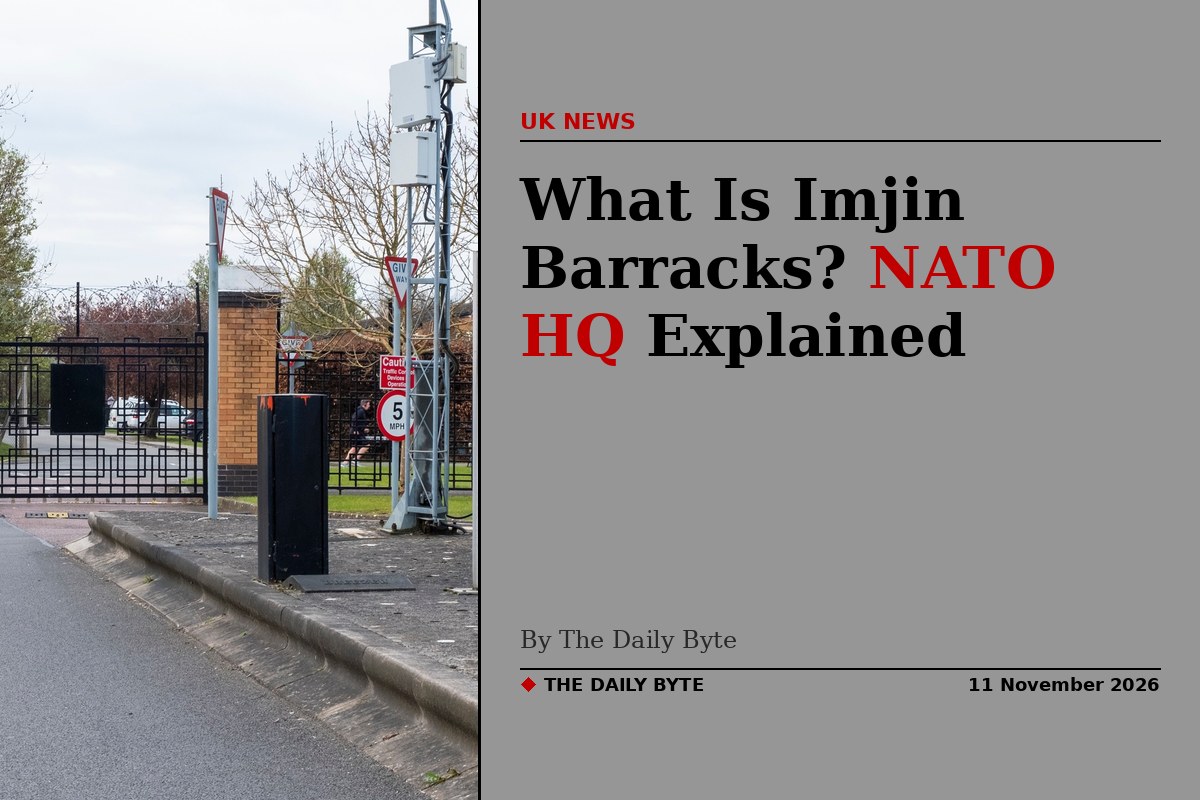
Imjin Barracks is a British Army base near Innsworth, on the outskirts of Gloucester, and it is the home of the headquarters of NATO's Allied Rapid Reaction Corps (ARRC). It is a multinational command headquarters, not a US base and not a base full of front-line combat troops. Officers from 20 NATO nations work there, planning and, if ordered, commanding land operations for the alliance. It is in the news on 11 November 2026 because a 41-year-old senior US Army soldier was arrested near Gloucester on 10 November on suspicion of espionage offences linked to Russia, and the BBC understands he was based at the barracks.
## What is Imjin Barracks?
Imjin Barracks is a British Army installation at Innsworth in Gloucestershire, just north of Gloucester. Its address is Imjin Barracks, Gloucester GL3 1HW. The Allied Rapid Reaction Corps describes it as the UK's largest NATO base, and it is the headquarters of the ARRC, a British-led NATO corps of 20 nations.
The site was formerly RAF Innsworth, a non-flying Royal Air Force station that operated between 1940 and 2008. When the RAF left, the Army took over the site, refurbished it, and renamed it Imjin Barracks. The ARRC moved there in 2010 from the Rheindahlen Military Complex in Germany, where it had been based since 1994.
As well as the ARRC headquarters, the barracks is home to the Headquarters of 1st (UK) Signal Brigade and the Gurkha ARRC Support Battalion, the units that provide the communications and support the headquarters needs to function. It is a working military base. It is not open to the public as a visitor attraction, and there are no public tours of the headquarters.
## What is the Allied Rapid Reaction Corps?
The Allied Rapid Reaction Corps is a British-led NATO corps headquarters. NATO's own description is that it is 'ready to command NATO land forces when and where they are needed', and that it sits 'at the heart of the British Army's contribution to the Alliance'. In practical terms, the ARRC is a headquarters, not a standing army. It does not own large numbers of troops of its own. Instead, it is a rapidly deployable headquarters that can act as a joint, land or corps headquarters for operations and crisis response, taking command of forces assigned to it by NATO nations when it is activated.
The corps was formed in 1992, as the Cold War ended, as the Alliance's first Rapid Reaction Corps. It commanded the land forces of IFOR, NATO's first major deployment, in Bosnia, and it commanded the first KFOR troops to enter Kosovo in 1999. That history is why the ARRC is often described as one of NATO's high-readiness headquarters: it is designed to deploy at short notice to command a crisis response, rather than to sit as a purely administrative office.
The headquarters has several hundred permanent staff from its contributing nations, and it can expand sharply when it deploys, drawing in officers and specialists from across the alliance. Its commander reports through NATO's command structure, and it falls under the operational command of the Supreme Allied Commander Europe, NATO's senior military commander, in peacetime.
## Why is it called Imjin Barracks?
The barracks is named after the Battle of the Imjin River, fought in April 1951 during the Korean War. The name was chosen because of the connection with the Gloucestershire Regiment, which formed part of the United Nations contingent in Korea and fought in that battle. The regiment, known as the 'Glorious Glosters', held its position on the Imjin River against overwhelming odds, and the battle became one of the most famous actions in the regiment's history.
The name was thought appropriate for a multinational headquarters because it links the base to a battle in which British soldiers fought alongside allies from other nations under a United Nations command. The Gloucestershire Regiment's legacy is still visible in the area: the regiment was based in Gloucester, and the city and county have long-standing ties to the soldiers who served in Korea.
## Why is Imjin Barracks in the news today?
On Tuesday 10 November 2026, British counter-terrorism police arrested a 41-year-old senior US Army soldier near Gloucester on suspicion of offences under the National Security Act 2023. The Metropolitan Police said the arrest was made on suspicion of offences under section 1 of the Act, which covers obtaining or disclosing protected information, and section 3, which covers assisting a foreign intelligence service. The police said: 'The country to which the allegations relate is Russia.'
The man has not been named, and no charge had been announced as of Wednesday 11 November. He was being held at a police station in London, and officers were searching two addresses in Gloucestershire. The investigation was carried out by Counter Terrorism Policing working closely with US authorities, the US military and the FBI. FBI Director Kash Patel described the arrest as an 'important arrest' involving allegations of espionage that are 'of the utmost concern to the United States and our allies'. Brigadier General Sean Stinchon, commanding general of the US Army's Counterintelligence Command, described the suspect as a senior soldier.
The BBC understands that the soldier was based at Imjin Barracks in Innsworth, the headquarters of NATO's Allied Rapid Reaction Corps. A senior NATO official confirmed to CNN and NBC News that he was assigned to the ARRC, and a US official told CNN he was a field-grade officer, a rank bracket that covers major, lieutenant colonel and colonel. The Metropolitan Police have not confirmed the posting, and no details of his role or of the information he is suspected of passing on have been released. The allegations have not been proven, and the man is presumed innocent unless and until proven guilty.
Police said the case is not connected to any other ongoing counter-terrorism investigation. That separates it from the suspected Iran-linked plot near RAF Fairford in September 2026, in which several men were arrested. The Kremlin has denied any Russian involvement in the Gloucester case. Kremlin spokesman Dmitry Peskov said Moscow did not know what the arrest was connected to and had 'nothing to do with it'.
## What is the National Security Act 2023?
The National Security Act 2023 is the UK law under which the soldier was arrested. It replaced parts of the old Official Secrets Acts and created a set of modern espionage offences designed for threats from foreign states. Section 1 makes it an offence to obtain, copy, retain or disclose protected information for a purpose prejudicial to the safety or interests of the UK. Section 3 makes it an offence to assist a foreign intelligence service.
The Act received Royal Assent on 11 July 2023, and its core measures came into force on 20 December 2023. It gives police extended powers in national security cases, including the ability to hold a suspect for up to 14 days without charge, according to BBC reporting on the case. That is longer than the standard detention limits in ordinary criminal cases, and it reflects the time investigators say they need in complex espionage inquiries.
An arrest under the Act is not a charge and not a conviction. After arrest, investigators must decide whether there is enough evidence to ask prosecutors to charge the suspect, and a court must agree to any extension of detention. If charged, the case would be tried in a criminal court, where the prosecution would have to prove the offences beyond reasonable doubt.
## Is Imjin Barracks a US base?
No. Imjin Barracks is a British Army installation, and the ARRC is a British-led NATO headquarters. But NATO headquarters are multinational by design, and US personnel serve in them alongside officers from other allied nations. That is why a US Army soldier could be assigned to the ARRC in Gloucester without the base being American.
The same pattern applies across NATO. The alliance's headquarters in the UK and in Europe are staffed by officers from many member states, and personnel are posted to them for tours of duty in the same way they are posted to their own national units. The US also has its own bases in the UK, such as RAF Mildenhall and RAF Lakenheath in Suffolk, which are operated by the US Air Force. Imjin Barracks is not one of those. It is a British base hosting a NATO headquarters, and the presence of American officers there is part of normal allied staffing.
## What happens next?
The immediate question is whether the arrested soldier will be charged. As of 11 November, no charge had been announced, and the man remained in custody in London. Under the National Security Act, police can apply to a court to hold him for up to 14 days without charge while they continue their inquiries, including the searches of the two Gloucestershire addresses.
If prosecutors decide there is enough evidence, the case would move to a charging decision and then, if charged, to a trial. If there is not enough evidence, the man would be released without charge. Either way, the case is likely to raise questions about vetting and security at multinational headquarters, where officers from many nations have access to sensitive planning material. Those questions will be for the investigation and any subsequent proceedings to answer, not for speculation while the inquiry is still running.
## Key facts
| Question | Answer |
|---|---|
| Where is Imjin Barracks? | Innsworth, near Gloucester, Gloucestershire, GL3 1HW |
| What is based there? | Headquarters, Allied Rapid Reaction Corps (HQ ARRC) |
| What is the ARRC? | A British-led NATO corps headquarters of 20 nations |
| When was the ARRC formed? | 1992, as NATO's first Rapid Reaction Corps |
| When did it move to Gloucester? | 2010, from Rheindahlen in Germany |
| What was the site before? | RAF Innsworth, a non-flying RAF station, 1940 to 2008 |
| Why the name Imjin? | After the Battle of the Imjin River, Korea, April 1951, fought by the Gloucestershire Regiment |
| Why is it in the news? | A 41-year-old senior US Army soldier was arrested nearby on 10 November 2026 on suspicion of National Security Act offences linked to Russia |
## Frequently asked questions
**Where is Imjin Barracks?**
Imjin Barracks is at Innsworth, on the northern edge of Gloucester in Gloucestershire. Its postcode is GL3 1HW.
**What does the Allied Rapid Reaction Corps do?**
It is a rapidly deployable NATO headquarters that can command land forces in a crisis. It plans and prepares in peacetime, and it takes command of assigned forces when NATO activates it.
**Is Imjin Barracks a US base?**
No. It is a British Army base and the home of a British-led NATO headquarters. US officers serve there as part of the multinational staff, as do officers from other NATO nations.
**Has the arrested soldier been charged?**
No. As of 11 November 2026, the 41-year-old man had been arrested on suspicion of offences under sections 1 and 3 of the National Security Act 2023, but no charge had been announced. The allegations have not been proven.
**Can the public visit Imjin Barracks?**
No. It is a working military base and a NATO headquarters, not a visitor attraction. There are no public tours.
*Sources: [NATO Allied Rapid Reaction Corps](https://arrc.nato.int/about-us); [SOFX, reporting the Metropolitan Police statement and CNN/NBC News](https://www.sofx.com/uk-detains-u-s-army-officer-on-russia-spy-suspicion-at-high-readiness-nato-hq/); background on the barracks from [Wikipedia: Imjin Barracks](https://en.wikipedia.org/wiki/Imjin_Barracks).*
Source
NATO Allied Rapid Reaction Corps — https://arrc.nato.int/about-us