What Is the NHS Pension Scheme? Changes Explained
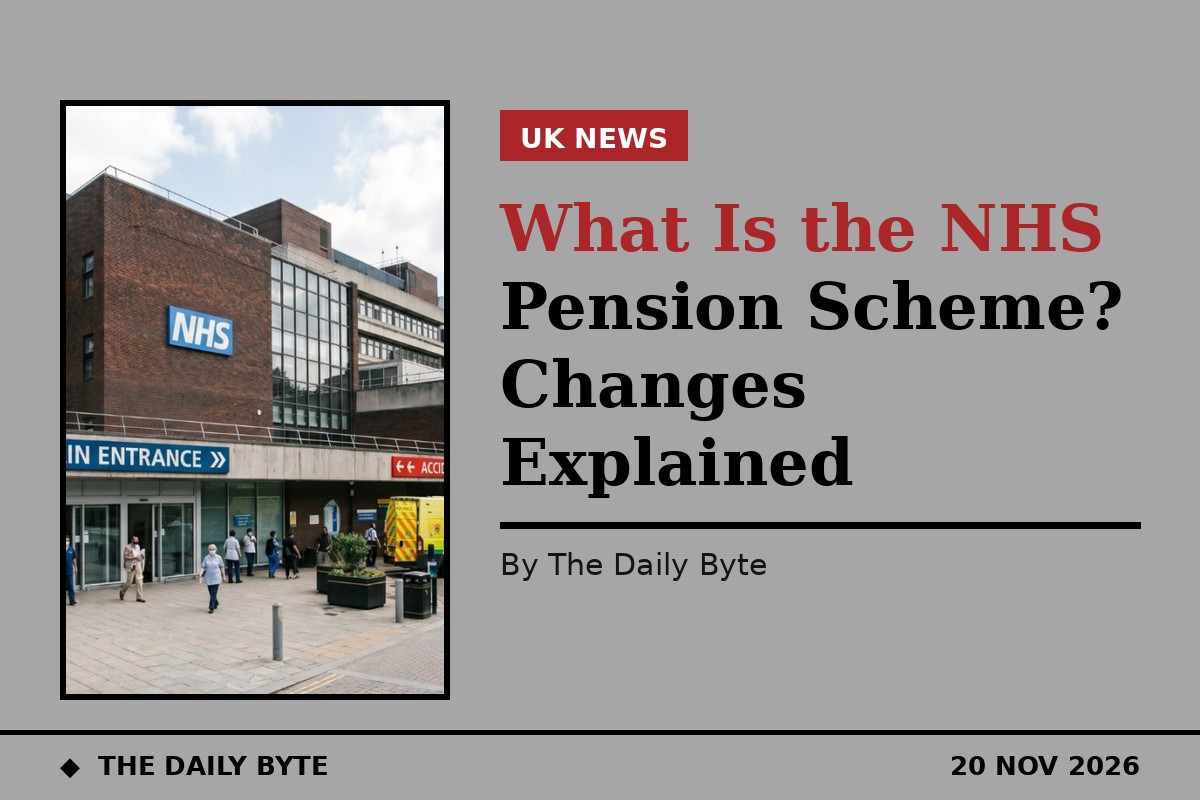
The NHS Pension Scheme is one of the largest pension schemes in Europe, and it covers the retirement savings of hundreds of thousands of doctors, nurses, paramedics, porters, cleaners, managers and other staff who keep the health service running. It is also, for many members, one of the most confusing parts of working for the NHS. There are three different sections, two different ways of working out what you get, and a set of rules that change every few years. This week the scheme is back in the news because the Department of Health and Social Care has opened a public consultation on a package of changes that would take effect from April 2027. This guide explains what the scheme is, how it works, what you pay in, what your employer pays in, and exactly what is proposed to change.
What is the NHS Pension Scheme?
The NHS Pension Scheme is a defined benefit pension scheme for people who work for the NHS. Defined benefit means that the pension you receive in retirement is worked out from a formula based on your pay and your years of service, rather than from the value of an investment pot that rises and falls with the stock market. The government describes it as offering the security of a guaranteed income in every year of retirement, and its terms are among the most generous available from any UK pension scheme. The scheme is administered by the NHS Business Services Authority, usually shortened to NHSBSA, which keeps members' records, collects contributions, pays pensions and sends out annual benefit statements.
There are in fact two schemes that together make up what everyone calls the NHS Pension Scheme. The first is the current 2015 scheme, which is open to new members and is where all active members now build up their pension. The second is the older, closed legacy scheme, which is divided into the 1995 section and the 2008 section. Nobody new joins the legacy scheme, but many long-serving staff still hold benefits built up in it, and those benefits are protected. The scheme is set out in three sets of regulations, made in 1995, 2008 and 2015, with further regulations covering additional voluntary contributions, injury benefits and the McCloud remedy.
The consultation opened this week applies to England and Wales. It proposes technical changes to the scheme regulations, and the Department of Health and Social Care has been clear that the proposals do not introduce any new policies and will not affect member benefits. That distinction matters, because the headline change in the package, a cut in the employer contribution rate, looks dramatic at first glance. The consultation closes on 14 January 2027, and anyone with an interest in the scheme, including members, employers and trade unions, can respond.
The three sections of the scheme explained
The 1995 section is the oldest part of the scheme. It is a final salary scheme, which means the pension is based on the member's pay at or near retirement rather than on pay across their whole career. For each year of service, a member builds up one eightieth of their final pensionable pay as annual pension, plus an automatic lump sum of three eightieths for each year. The normal pension age in the 1995 section is 60, which is the age at which benefits can be taken without reduction.
The 2008 section is also a final salary scheme, but with different terms. Members build up one sixtieth of their final pensionable pay for each year of service, with no automatic lump sum, and the normal pension age is 65. Members can choose to give up some annual pension for a lump sum when they retire, at a rate of twelve pounds of lump sum for every one pound of annual pension surrendered.
The 2015 scheme works differently. It is a career average revalued earnings scheme, usually shortened to CARE. Instead of looking at final pay, it looks at every year of membership. Each year, a member banks one fifty-fourth of that year's pensionable pay as annual pension. Each year's slice is then revalued, or increased, every April, broadly in line with inflation plus 1.5 percent, until the member retires. The normal pension age in the 2015 scheme is the member's State Pension age, which for most people working today is 67. The earliest age at which benefits can be taken is currently 55, rising to 57 from 6 April 2028, and taking a pension early reduces it permanently.
Since 1 April 2022, every active member of the NHS Pension Scheme has been a member of the 2015 scheme, whatever section they were in before. That change was part of the McCloud remedy, which is explained in a separate guide, and it means all pension built up since then follows the 2015 scheme rules. Benefits built up in the 1995 and 2008 sections before that date are preserved, and members who moved across kept a final salary link, so their legacy benefits are still calculated using their pensionable pay at retirement rather than at the point of transfer.
How much do members pay into the scheme?
Members pay a percentage of their pensionable pay into the scheme, and the percentage depends on how much they earn. There are six tiers for 2026/27, and the tier is set by actual annual pensionable pay, not by full-time equivalent pay, so part-time staff pay the rate that matches what they actually earn. The tiers are 5.2 percent on pay up to 13,259 pounds, 6.5 percent on pay from 13,260 to 28,854 pounds, 8.3 percent on pay from 28,855 to 35,155 pounds, 9.8 percent on pay from 35,156 to 52,778 pounds, 10.7 percent on pay from 52,779 to 67,668 pounds, and 12.5 percent on pay above 67,668 pounds. Contributions are taken from pay before tax, which reduces the amount of income tax a member pays.
On top of what the member pays, the employer pays a much larger contribution. For 2026/27 the employer contribution rate is 23.7 percent of pensionable pay. That is one of the highest employer rates anywhere in the UK, and it is a major reason the scheme is valued so highly by NHS staff. The employer rate is not a payment into an individual pot. The NHS Pension Scheme is unfunded, which means pensions are paid out of current contributions and government funding rather than from a large invested fund, and the employer rate is set after a periodic actuarial valuation that estimates how much the scheme will need to pay out.
What is changing from April 2027?
The headline proposal in the consultation is a new employer contribution rate from 1 April 2027. Following the latest actuarial valuation of the scheme, which is a review carried out every four years, the employer rate would fall from 23.7 percent to 15.5 percent. The Department of Health and Social Care says the most significant factor behind the reduction is a change in the discount rate set by HM Treasury, which is used to work out contribution rates for unfunded public service pension schemes. A higher discount rate lowers the estimated present cost of future pension payments, and so lowers the contribution rate needed today.
Importantly, the cut does not change what members pay or what members get. Employee contribution rates are not part of this change, and the department says the proposals will not affect member benefits. What changes is how the employer's share is funded. Employers who previously had their employer contributions fully funded by the government will continue to pay 14.3 percent of pensionable pay from 1 April 2027, with the government paying the remaining 1.2 percent centrally. Including the 0.08 percent administration charge, their total contribution will be 14.38 percent. Employers without that funding support will pay a total of 15.58 percent, including the administration charge. The government has previously funded increases in the employer contribution rate on behalf of participating employers, and it says it will now reduce that central funding in line with the lower rate.
The consultation also proposes recognising two new types of leave for pension purposes. Bereaved Partner's Paternity Leave would count as pensionable service, with the changes applying from 6 April 2026, so they automatically cover leave already taken after that date. Bereavement leave would also count, with those changes applying from 6 April 2027, when that type of leave is expected to become available. Members on either type of leave would be able to pay contributions for the period, so the time away does not create a gap in their pension record.
Inheritance tax on pension death benefits from April 2027
The most complicated part of the consultation concerns inheritance tax. In Budget 2024, the government announced changes to make the tax treatment of inherited wealth more consistent. From 6 April 2027, most unused pension funds and certain pension death benefits will count towards the value of a person's estate for inheritance tax purposes. The Finance Act 2026 put that change into law by amending the Inheritance Tax Act 1984, and it applies to deaths on or after 6 April 2027. Before that date, these pension benefits do not form part of a deceased member's estate for inheritance tax purposes.
Not every NHS death benefit is caught. Death in service lump sums and dependants' pensions are excluded benefits, which means they are not chargeable to inheritance tax. The lump sums that may be chargeable are those payable after the death of a deferred member, a pensioner member or a pension credit member, on or after 6 April 2027. The Finance Act calls these amounts notional pension property, and they are treated as forming part of the deceased member's estate when working out whether inheritance tax is payable. A lump sum death benefit paid to a surviving spouse or civil partner remains exempt from inheritance tax, while a lump sum paid to a surviving qualifying partner, a nominated person or the deceased member's estate may be included. Inheritance tax is generally charged at 40 percent on the value of an estate above the applicable tax-free threshold, after allowances and exemptions are applied.
The consultation proposes the practical machinery to make the new rules work. Personal representatives, the people legally appointed to settle a deceased member's estate, will have to identify the relevant lump sum death benefits, get valuations from the NHSBSA, include the notional pension property in the inheritance tax account, and report and pay any tax due. If they know or reasonably believe tax may be due, they can issue a withholding notice, which lets the NHSBSA hold back up to 50 percent of the relevant lump sum for up to 15 months, or a payment notice, which asks the NHSBSA to pay the tax directly to HM Revenue and Customs. Once a valid payment notice is accepted, the NHSBSA must pay the tax, with any late-payment interest, within 35 days. If the scheme administrator pays a lump sum in breach of a valid withholding notice, or fails to comply with a valid payment notice, it may become jointly liable for the tax. These are administrative changes that follow from the Finance Act, not a new NHS policy, but they will matter a great deal to bereaved families and to the people who administer estates.
What is the McCloud remedy, and why is it in this consultation?
Readers of the consultation document will also notice references to the public service pensions remedy, better known as the McCloud remedy. This is the fix for the age discrimination found by the Court of Appeal in 2018, when transitional protections introduced with the 2015 pension reforms let older workers stay in the legacy schemes while younger workers were moved into the new schemes. The remedy closed the legacy schemes on 31 March 2022, moved all active members into the 2015 scheme, and gave eligible members a choice between legacy and 2015 scheme benefits for service between 1 April 2015 and 31 March 2022. The latest consultation proposes technical changes to the remediable service regulations and the injury benefit regulations, to take effect from 1 April 2027, so that the remedy keeps working as intended. A separate explainer in this series sets out the McCloud remedy in full.
How to have your say
The consultation is open until 14 January 2027. Responses can be made through the consultation page on GOV.UK, where the draft amending regulations have also been published so that respondents can see exactly how the proposed changes would be written into law. The department is particularly interested in hearing from scheme members, NHS employers and representative bodies, but anyone with a view can respond. After the consultation closes, the department will finalise its proposals and lay the amending regulations, with the changes taking effect from 1 April 2027, except for the inheritance tax provisions, which follow the Finance Act timetable of 6 April 2027, and the Bereaved Partner's Paternity Leave provisions, which apply from 6 April 2026.
For NHS staff, the practical message is reassuring but worth understanding. Your contribution rate is not changing, your pension is still worked out the same way, and the employer rate cut is a funding change, not a benefit cut. The change that could affect your family is the inheritance tax treatment of lump sum death benefits from April 2027, particularly if you are a deferred or pensioner member. Checking your annual benefit statement, keeping your nomination details up to date with the NHSBSA, and reading the consultation document before it closes on 14 January 2027 are the sensible next steps.