What Is Ofqual? England's Exams Regulator
Ofqual is the regulator that stands behind every GCSE and A level result in England. Its full name is the Office of Qualifications and Examinations Regulation, and it is the independent body responsible for regulating qualifications, examinations and assessments in England. It is in the news after fining the exam board AQA 350,000 pounds over errors in braille exam papers. This guide explains what Ofqual is, what it does, and what powers it has when things go wrong.
The short answer is that Ofqual does not set exams, mark papers or hand out certificates. It regulates the organisations that do. It sets the rules the exam boards must follow, approves qualifications before a board can offer them, monitors standards over time so that a grade means roughly the same thing from one year to the next, and can investigate and punish a board that breaks the rules. It is a non-ministerial government department, which means it is part of government but operates independently of ministers on day-to-day decisions about exams.
What is Ofqual?
Ofqual was established in interim form on 8 April 2008 as part of the Qualifications and Curriculum Authority, known as the QCA, taking over the regulatory functions that the QCA had previously carried out itself. It became an independent non-ministerial department on 1 April 2010. Its remit and responsibilities are set out in law by the Apprenticeships, Skills, Children and Learning Act 2009 and the Education Act 2011.
Its headquarters are at Earlsdon Park in Coventry. Its chief executive and chief regulator is Sir Ian Bauckham, and its chair is Susan Tranter. Its stated role is to maintain standards and confidence in qualifications. Parliament created it to secure standards in qualifications and apprenticeship end-point assessments, promote public confidence in qualifications and national assessments, oversee national assessments and assure their validity, improve public understanding of the qualifications available, secure that qualifications are provided efficiently and represent value for money, and raise awareness of the benefits of regulated qualifications.
Ofqual regulates exams, qualifications and tests in England only. Education is devolved, so Scotland, Wales and Northern Ireland have their own arrangements. That matters for anyone comparing systems: a GCSE is an English, Welsh and Northern Irish qualification, but the regulator behind it in England is Ofqual, and the rules can differ across the border.
What does Ofqual actually do?
Ofqual's work falls into four main areas. First, it sets the rules. Every awarding organisation that wants to offer a regulated qualification must follow Ofqual's conditions of recognition, which cover how a qualification is designed, assessed and graded. Second, it approves qualifications before a board can offer them, checking that they meet its standards. Third, it monitors standards over time, publishing data on grade outcomes so that patterns across boards and years are visible to schools, researchers and the public. Fourth, it investigates and can sanction a board over marking errors, security breaches or unfair treatment of students.
The scale of the job is large. As of May 2023, Ofqual regulated 236 awarding organisations, which issued 11 million certificates across 11,400 active qualifications in the last reported academic year. Those include GCSEs and AS and A levels, a broad range of vocational and technical qualifications, and apprenticeship end-point assessments. Ofqual-regulated qualifications are organised into eight levels, from Level 1, the most basic, to Level 8, the highest, which covers doctorates. GCSEs sit at Levels 1 and 2, A levels at Level 3, higher national certificates and diplomas at Levels 4 and 5, and bachelor's, master's and doctoral degrees at Levels 6 to 8.
Who does Ofqual regulate?
Ofqual regulates the awarding organisations, not the schools. The main exam boards in England are AQA, Pearson Edexcel, OCR and WJEC, which offers its Eduqas brand in England. These are the organisations that write the exam papers, set the grade boundaries and issue the results. Ofqual sets the rules they must follow and checks that they follow them. The Joint Council for Qualifications, a separate body, regulates the actual administration of GCSE and A level examinations, such as the timetable and the rules for exam halls.
That separation is the point of the system. England has several independent, competing exam boards, and Ofqual exists to keep them honest and comparable. A school that chooses AQA over Pearson Edexcel for GCSE maths is not choosing a laxer or stricter regulator, because both boards answer to the same Ofqual rules on comparability. A grade from one board is intended to represent the same standard as the same grade from another. That is why Ofqual publishes data on grade outcomes and monitors standards over time: if one board's grades drifted away from the others, it would show up.
Ofqual works closely with the Department for Education on general qualifications such as GCSEs and A levels, and with the department responsible for business and skills on vocational qualifications such as NVQs and BTECs. Ministers set overall policy, such as which subjects exist and the broad grading structures, while Ofqual operates independently of day-to-day political control over how individual exams are regulated.
What powers does Ofqual have?
Ofqual's powers are real, and it uses them. Its tools include requiring a board to re-mark affected scripts, imposing conditions on how a board runs future exam series in a subject, fining a board for breaches of its conditions of recognition, and in the most serious cases restricting or withdrawing a board's ability to offer a qualification at all. These are not hypothetical powers: Ofqual has used monetary penalties against boards over specific failures, including marking and administrative errors, as part of its published enforcement record.
The fine on AQA is the latest example. Ofqual fined the board 350,000 pounds after errors in braille exam papers, a failure that matters because braille papers are how blind and partially sighted students sit the same exams as everyone else. An error in a braille paper does not just inconvenience a student; it can make the exam itself unfair or impossible to complete. The fine is a reminder that Ofqual's enforcement covers the whole exam, including the formats used by a small number of students, not only the standard papers taken by hundreds of thousands.
Ofqual has also been active on newer risks. It has warned about cheating in coursework using artificial intelligence, and has said the penalties for it can be life-altering for students. That warning reflects a problem that did not exist when Ofqual was created: coursework that once had to be written by hand can now be produced in seconds by a chatbot, and the regulator has to decide where the line falls between using AI as a tool and passing off its output as your own work.
The 2020 grading controversy
The most difficult episode in Ofqual's history came in 2020, during the Covid-19 pandemic. With exams cancelled, Ofqual was involved in the system used to award GCSE and A level grades without exams. A statistical model was used to calculate grades, but it downgraded many students below the grades their teachers had predicted, and the results caused widespread complaints from students, schools and parents. The government reversed course, and grades were ultimately based on teachers' assessments instead. The episode damaged confidence in the regulator and in the exam system, and it is still cited whenever Ofqual's independence and judgement are questioned. It also showed the limits of a regulator's power: Ofqual could design a system it believed was fair, but it could not survive the political consequences when the public disagreed.
Why does Ofqual matter?
Ofqual matters because qualifications are only useful if people trust them. A GCSE or an A level is a currency: employers use it to judge job applicants, universities use it to decide admissions, and students use it to plan their lives. If the currency is debased, if a grade 7 from one board means something different from a grade 7 from another, or if a grade 7 this year means something different from a grade 7 five years ago, the whole system loses its value. Ofqual's job is to protect that currency.
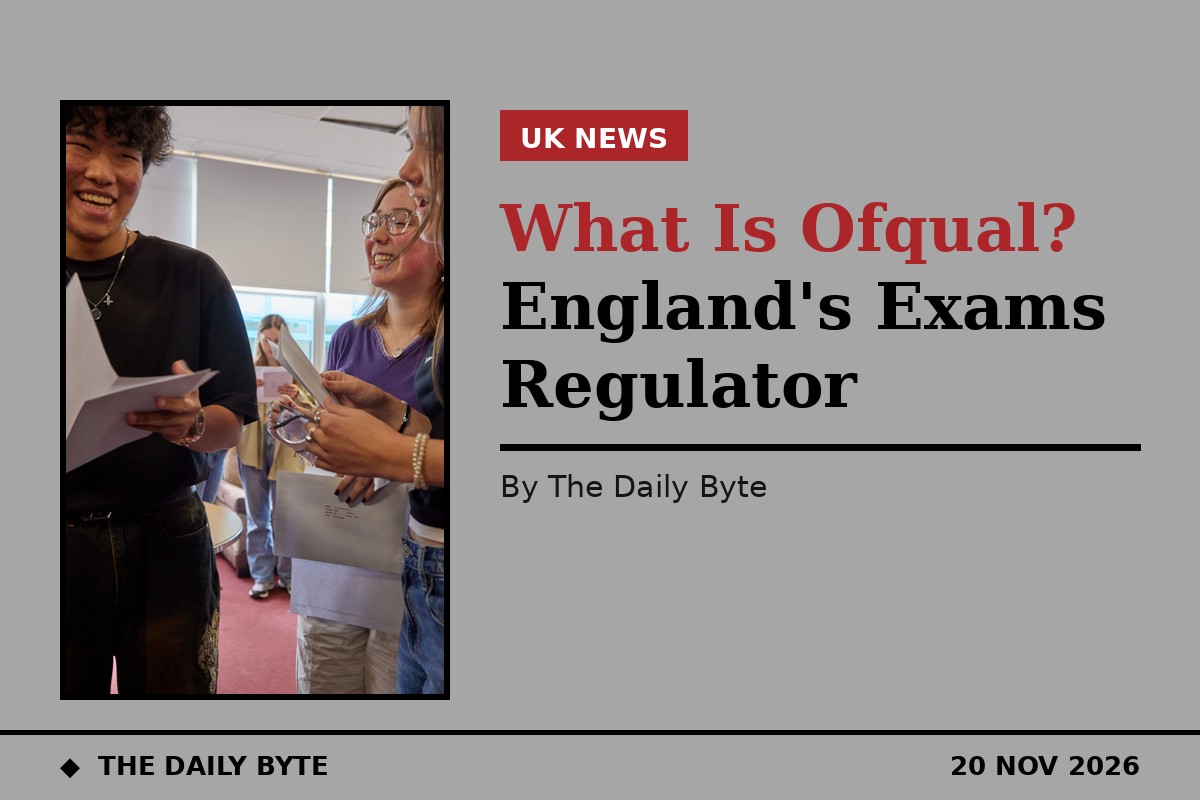
It does that work mostly out of the headlines. The regulator only becomes news when something goes wrong: a marking error, a security breach, a fine, or a grading crisis. The AQA fine is a case in point. For most students, Ofqual is invisible, and that is how it is supposed to be. But every result day in England, when hundreds of thousands of teenagers open their envelopes or check their phones, the grades they see have passed through a system that Ofqual regulates, from the design of the qualification to the standard of the marking. That is what the Office of Qualifications and Examinations Regulation is, and that is why it exists.


