What Is the Rosebank Oil Field? Explained
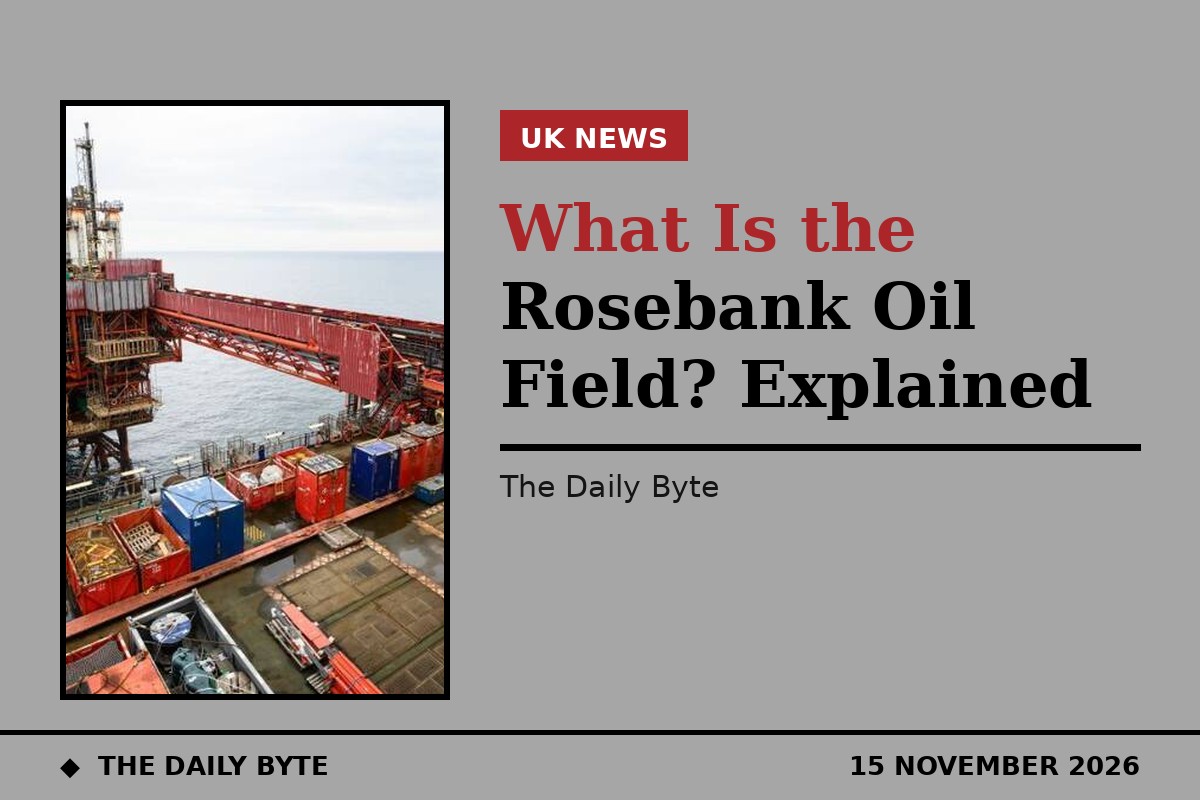
Rosebank is the UK's largest undeveloped oil and gas field, lying about 80 miles north-west of the Shetland Islands in the North Atlantic, with an estimated 300 million barrels of recoverable oil. It was first approved in September 2023, but that approval was ruled unlawful by a Scottish court in January 2025, and a fresh decision now rests with Energy Secretary Miatta Fahnbulleh. On 15 November 2026, the Sunday Times reported that 75 Labour MPs had signed a letter opposing the field, making it the first major rebellion of Prime Minister Andy Burnham's premiership.
This explainer sets out what Rosebank is, where it sits, who owns it, why its approval was quashed, what the arguments on each side are, and when a decision is expected. It is based on reporting and official material available on 15 November 2026, and it distinguishes throughout between verified facts, reported claims, and the views of supporters and opponents.
What is the Rosebank oil field?
Rosebank is an offshore oil and gas field in deep water west of Shetland, discovered in 2004. It is described by its operator and by the trade press as the largest remaining undeveloped oil and gas reservoir in UK waters. The field holds an estimated 300 million barrels of oil equivalent in recoverable resources, according to the operator, Adura, a figure also cited by Bloomberg and Rigzone in November 2026. Some campaign groups cite a higher figure of nearly 500 million barrels of oil equivalent for the field's total reserves; the difference reflects the distinction between oil that is judged recoverable under the current development plan and the larger volume of oil and gas thought to be in place.
About 90 per cent of Rosebank's reserves are oil rather than gas, which matters to the debate, because oil from the field would largely be sold on the world market rather than piped directly to British homes. Energy Secretary Miatta Fahnbulleh drew exactly that distinction in October 2026, describing the neighbouring Jackdaw field as "a gasfield that caters for the domestic market" while Rosebank "is an oilfield that is mainly for export".
Development would use a floating production, storage and offloading vessel, known as an FPSO, a large ship-shaped facility that processes oil at sea and stores it until tankers carry it away. Subsea installation work began in summer 2024, according to Adura, and drilling began in the first quarter of 2026. First oil had been targeted for 2026-27 if the project proceeds.
Where is Rosebank and who owns it?
Rosebank lies roughly 80 miles, or about 130 kilometres, north-west of Shetland, in the North Atlantic rather than in the central North Sea. The water is deep, the weather is harsh, and the field sits far from existing pipelines, which is one reason the development is expensive and technically demanding.
The field is owned 80 per cent by Adura and 20 per cent by Ithaca Energy. Adura is itself a joint venture between Shell and Equinor, the Norwegian energy company, which each hold half of Adura. Equinor is majority-owned by the Norwegian state. Adura was formed in 2025 when Shell and Equinor combined their UK offshore oil and gas assets, and it is now the biggest oil and gas producer in the UK North Sea.
The operator estimates that the project would involve £6.6 billion of direct investment in UK-based businesses. Supporters of the project also point to jobs, with reports in November 2026 citing an estimate of about 1,600 jobs linked to the development. Opponents dispute the scale of the benefit to the UK, arguing that most of the oil would be exported and that the jobs would be short-lived compared with the decades of emissions the field would produce.
Why was Rosebank's approval ruled unlawful?
The Conservative government, together with the regulator, the North Sea Transition Authority, granted consent for Rosebank in September 2023, and Equinor took a final investment decision to proceed with phase one. That approval was then challenged in court by Greenpeace and Uplift, a campaign group.
In January 2025, the Court of Session in Edinburgh ruled that the consents for Rosebank and for the Jackdaw gas field were unlawful. The ruling followed the UK Supreme Court's decision in the Finch case, which held that the environmental assessment of a fossil-fuel project must take account of the emissions produced when the fuel is eventually burned, known as downstream or Scope 3 emissions, and not only the emissions from extracting it.
The government and the regulator accepted that the original decisions were unlawful in light of the Finch ruling. That did not ban Rosebank outright. It meant the project needed a fresh environmental assessment that counted the full climate impact of burning its oil and gas, and a fresh decision by ministers. Equinor resubmitted its environmental statement in October 2025, including Scope 3 emissions, and a public consultation on the resubmitted material followed.
What happened with Jackdaw, and why does it matter?
Jackdaw is a gas field about 150 miles east of Aberdeen. Its consent was quashed in the same January 2025 ruling as Rosebank's, and it went through the same fresh assessment process. On 21 October 2026, Fahnbulleh approved production consent for Jackdaw, and gas has since begun flowing from the platform.
The Jackdaw decision matters for Rosebank in two ways. First, it showed that the new, tighter environmental assessment process can lead to approval. Second, it showed how the Energy Secretary is distinguishing between projects: gas for the domestic market was approved, while an oil field mainly for export remains under consideration. At the same time as the Jackdaw approval, the Guardian reported that Fahnbulleh was "leaning towards" rejecting Rosebank, with sources saying she was "minded to reject" it. The Department for Energy Security and Net Zero described those reports as speculation and said each project would be assessed on its own merits, and Fahnbulleh has said the decision is hers alone under a tight, quasi-judicial framework designed to withstand court scrutiny.
Why is Rosebank so controversial?
The argument against Rosebank is, in essence, a climate argument. Campaigners estimate that burning the field's oil and gas would produce more than 200 million tonnes of carbon dioxide over its lifetime, with Uplift putting the total lifetime greenhouse gas figure at 254 million tonnes of CO2 equivalent. Opponents say that is incompatible with the UK's commitment under the Paris Agreement to limit warming to 1.5 degrees, and with the UK's legally binding target of reaching net zero greenhouse gas emissions by 2050. They also argue that approving Rosebank would damage Britain's credibility as a climate leader, a point made in the Labour MPs' letter reported on 15 November 2026, and that it would not reduce household energy bills, because the oil would be sold at world prices.
The head of the International Energy Agency, Fatih Birol, has said that fields like Rosebank "would not change much for the UK's energy security" or lower bills, according to campaign material published in 2026. Opponents also note that production would run until about 2051, a year after the net zero target date, if the field goes ahead on the current timetable.
The argument for Rosebank is, in essence, an energy-security and jobs argument. Supporters say the UK will still need oil and gas for years to come, even as it moves to clean energy, and that it is better to produce that oil at home, with British jobs and tax revenue, than to import it from abroad. They point to the £6.6 billion of investment and to the jobs linked to the project, and argue that refusing Rosebank would not reduce demand for oil, only move production elsewhere. Cabinet ministers have been lobbying the Prime Minister and the Energy Secretary to approve the field, according to Bloomberg's reporting on 6 November 2026, and some ministers privately believe the decision is heading in their favour, although officials have cautioned that no decision has been taken.
What is the Labour rebellion about?
On 15 November 2026, the Sunday Times reported that 75 Labour MPs had signed a private letter opposing approval of Rosebank, with organisers hoping the number could reach 100. That would be about a quarter of Labour's 404 MPs in the House of Commons. The BBC had reported on 11 November that more than 60 of about 400 Labour MPs had backed a letter that had not yet been sent.
The letter is expected to be delivered to Prime Minister Andy Burnham within the next fortnight, and it is modelled on the campaign by Labour MPs that forced the previous government to abandon planned cuts to disability benefits. It argues that approving Rosebank would destroy Britain's credibility as a global climate leader and would not reduce energy bills. The campaign is being organised with the involvement of Sera, the Labour-affiliated environmental organisation, and MPs from the party's 2024 intake are playing a significant role.
The Sunday Times also reported that Burnham faces the prospect of government resignations if Rosebank is approved, with one parliamentary private secretary weighing stepping down. The cabinet itself is reported to be divided: Fahnbulleh is said to be minded to reject the field, while Chancellor John Healy is reported to favour the plans. None of those reported positions is a formal decision, and the decision formally rests with the Energy Secretary, not the Prime Minister, because it is a quasi-judicial planning decision.
When will a decision be made?
No decision date has been announced. The decision is expected before the end of 2026, according to reporting in October and November 2026, and officials have said it is unlikely to come in the next few weeks. Burnham has said only that a decision will be "taken in due course".
Whatever the decision, it is likely to be challenged. If Rosebank is approved, climate campaigners are expected to consider a further legal challenge, and the government has been put on notice that approval may breach international law. If it is rejected, the operator and industry groups are likely to argue that the decision damages investment in the North Sea. Either way, Rosebank has become the clearest test of how the government balances its climate commitments against its arguments about energy security and jobs.
Frequently asked questions
Is Rosebank the UK's largest undeveloped oil field? Yes. It is widely described, including by its operator and by the trade press, as the largest remaining undeveloped oil and gas field in UK waters, with about 300 million barrels of recoverable oil.
Has Rosebank been approved? Not currently. Its September 2023 approval was ruled unlawful in January 2025, and a fresh decision is awaited, expected before the end of 2026.
Where is Rosebank? About 80 miles north-west of the Shetland Islands, in deep water in the North Atlantic.
Who owns Rosebank? Adura, the Shell-Equinor joint venture, holds 80 per cent, and Ithaca Energy holds 20 per cent.
Would Rosebank lower UK energy bills? Opponents and the head of the International Energy Agency argue it would not, because the oil would mostly be exported and sold at world prices. Supporters argue it would support UK jobs, investment and energy security.
Sources: Rigzone, Uplift and Offshore Magazine. Reporting on the Labour letter is from the Sunday Times, as reported by Bloomberg via Energy Connects and by the BBC on 11 November 2026.


