What Is the Crime and Policing Act 2026? New Police Powers Explained
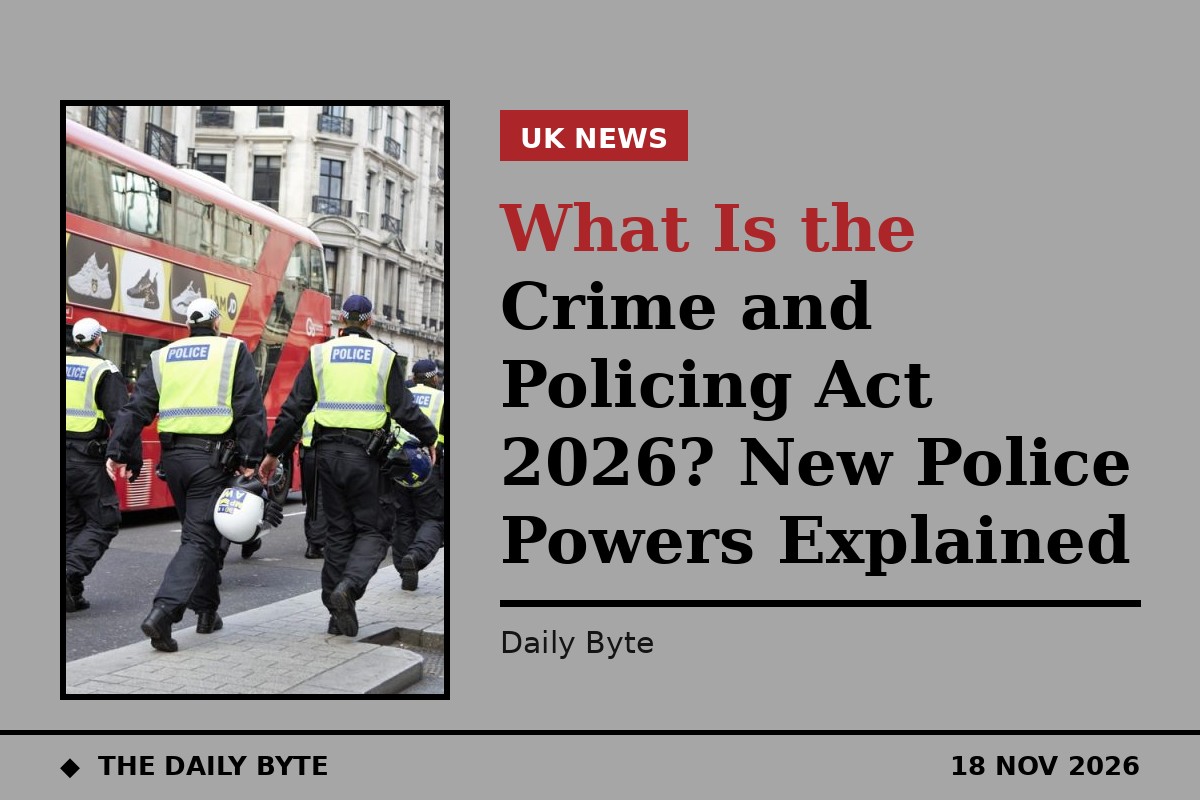
The Crime and Policing Act 2026 is the wide-ranging law that rewrites large parts of policing and criminal justice in England and Wales. It received Royal Assent on 29 April 2026, becoming the Crime and Policing Act 2026 (2026 c. 20), and its measures are being switched on in stages — with anti-social behaviour powers already in force since 26 October 2026 and further provisions due to start between 24 November 2026 and 15 January 2027.
The Act was introduced as a Bill on 25 February 2025 and took 14 months to pass through Parliament. The government presents it as the biggest overhaul of crime-fighting powers in a generation, and as the centrepiece of its Safer Streets Mission to halve knife crime and violence against women and girls within a decade and to rebuild public confidence in policing. It covers anti-social behaviour, retail crime, knife crime, police powers, violence against women and girls, child protection, terrorism and the management of offenders — which is why, a year after it became law, new parts of it are still coming into force almost every week.
This guide explains what the Act does, which parts are already in force, and what is still to come.
What are respect orders?
Respect orders are the Act's headline replacement for the old anti-social behaviour toolkit. They are civil orders that can be imposed on adults aged 18 or over who persistently behave anti-socially, and breaching one is a criminal offence. They sit alongside new youth injunctions for younger offenders, housing injunctions, and extended closure powers that let police and councils shut down premises linked to serious disorder more quickly.
These anti-social behaviour measures came into force on 26 October 2026, together with revised Home Office statutory guidance for frontline professionals. The aim, according to the government, is to give police, councils and social housing providers faster, stronger tools to deal with persistent nuisance that blights neighbourhoods — from threatening behaviour on estates to drug dealing from a single address.
For social housing providers in particular, the new orders matter because they can be used against serious anti-social behaviour by tenants and others in their areas, with the closure powers extended so that a property used for disorder can be closed for longer.
What does the Act do about shoplifting and assaults on shop workers?
The Act creates a standalone criminal offence of assaulting a retail worker, answering a long-running demand from shop workers' unions and retailers who said abuse and violence in stores had become routine. It also repeals section 176 of the Anti-social Behaviour, Crime and Policing Act 2014, the provision that downgraded the police response to so-called low-value shop theft — the rule often described as the £200 shoplifting threshold.
Repealing that provision means low-value theft is no longer treated as a lesser matter by the police. Combined with the new assault offence, the package is intended to make town centres and high streets safer for staff and shoppers alike.
What new powers do the police get?
The Act gives the police several new tools for tackling theft and organised crime. Officers gain a power to enter premises without a warrant to search for and seize stolen goods — for example, a mobile phone that can be located through GPS tracking technology. Drug testing on arrest is expanded, and the police get greater access to the Driver and Vehicle Licensing Agency database to help identify criminals.
The Act also bans articles used to commit serious crime, including SIM farms — banks of SIM cards used to send scam messages at scale — and electronic devices used in vehicle theft. A further power, due to start on 30 November 2026, lets police, the National Crime Agency, HM Revenue and Customs, the Financial Conduct Authority and Gambling Commission enforcement officers apply to a Crown Court judge for an order forcing an internet provider to block an address, or a domain registry to suspend a name, for up to 12 months.
On police accountability, the Act gives chief officers of police forces the right to appeal the result of misconduct boards to the Police Appeals Tribunal, and grants firearms officers facing criminal proceedings anonymity up to the point of conviction.
What does the Act change on violence against women and girls?
The Act introduces a new criminal offence of administering a harmful substance, covering spiking — adding a drug to someone's drink or otherwise giving them a harmful substance without their knowledge. It strengthens the management of offenders in the community, with enhanced notification requirements for registered sex offenders, including a bar on them changing their names where there is a risk of sexual harm. Victims of stalking get a right to know the identity of the perpetrator.
Three new pornography offences came into force on 6 November 2026: possessing or publishing realistic pornography depicting strangulation or suffocation, and so-called incest porn. The same date brought in offences relating to adults appearing to be under 16 in pornographic material. These new offences are also classed as priority offences under the Online Safety Act, which means online platforms with UK users must proactively detect and remove the material.
The Act also criminalises the making, adapting, supplying or offering to supply so-called nudification tools — software used to create fake sexual images of real people. On non-consensual intimate images, it creates new offences of taking an intimate image without consent, including taking a screenshot of one, allows courts to make deletion orders for such images, and places duties on online platforms to ensure they are taken down within 48 hours.
How does the Act protect children and vulnerable adults?
One of the most significant changes implements a recommendation of the Independent Inquiry into Child Sexual Abuse: a new duty to report child sexual abuse. The Act creates a new offence of cuckooing, where a person takes control of someone else's home to use it for criminal activity — often targeting vulnerable adults — although as of early November 2026 no commencement date had been set for that offence. It also creates a new offence of child criminal exploitation, makes grooming behaviour a statutory aggravating factor in sentencing, and introduces a power to issue statutory guidance to tackle honour-based abuse.
Further provisions commencing from 24 November 2026 widen the offence of possessing paedophile manuals to cover advice or guidance about creating child sexual abuse images.
What is still to come into force?
The Act commences in stages through regulations, and not every part is in force yet. The fifth set of commencement regulations, made on 3 November 2026, sets start dates for six groups of provisions running from 24 November 2026 to 15 January 2027. They include the widened paedophile manual offence on 24 November, changes to domestic abuse protection orders on 25 November, stalking protection orders that can be made after an acquittal, a successful appeal or a finding of insanity or disability on 26 November, and the internet address and domain suspension orders on 30 November.
Because commencement is staggered, anyone affected by a particular measure should check whether that specific provision has been switched on. The GOV.UK collection page for the Act and the text of the Act on legislation.gov.uk are the authoritative places to check.
What else is in the Act?
The Act's scope is deliberately broad. It amends terrorism legislation, including a new youth diversion order for young people arrested for terrorism-related activity, and implements changes recommended by the Independent Reviewer of Terrorism Legislation. It amends the Proceeds of Crime Act 2002 on confiscation, extends the criminal liability of companies and other bodies, and changes the law on stalking, public order and protests.
One part of the Act decriminalised abortion in England and Wales by disapplying the relevant sections of the Offences Against the Person Act 1861 and the Infant Life (Preservation) Act 1929 when applied to a person's own pregnancy.
Why is the Act controversial?
While the anti-social behaviour, retail crime and violence against women and girls measures attracted broad support, the protest and public order provisions were opposed during the Bill's passage by a coalition of civil society groups including the Trades Union Congress, Amnesty International UK, Greenpeace, Liberty, the Palestine Solidarity Campaign, the National Education Union and the Quakers in Britain. Critics argued those provisions would restrict the right to protest; the government said they were needed to keep public order.
There has also been scrutiny of the staggered commencement programme itself, with some provisions — such as the duty on senior coroners to notify Ofcom when a child's online activity may be relevant to their death — still without a start date more than six months after Royal Assent.
Does the Act apply across the whole UK?
The Act's territorial extent is England and Wales, with some parts extending to Scotland and Northern Ireland. The new pornography offences that came into force on 6 November 2026, for example, apply in England and Wales, with separate provision made for Scotland. Devolved administrations and the relevant UK departments are responsible for implementing the parts that touch devolved matters.
Frequently asked questions
When did the Crime and Policing Act become law? It received Royal Assent on 29 April 2026, after being introduced as a Bill on 25 February 2025.
Is the whole Act in force? No. It is being switched on in stages by commencement regulations. Anti-social behaviour measures started on 26 October 2026 and the new pornography offences on 6 November 2026, with further provisions due between 24 November 2026 and 15 January 2027. Some provisions still have no start date.
What is a respect order? A civil order for adults aged 18 or over aimed at persistent anti-social behaviour. Breaching a respect order is a criminal offence.
Does the Act make it a crime to assault a shop worker? Yes. It creates a standalone offence of assaulting a retail worker and repeals the old rule that downgraded the police response to low-value shop theft.
Sources: GOV.UK, Crime and Policing Act 2026; Wikipedia, Crime and Policing Act 2026; Legal 500, The Crime and Policing Act 2026: What Social Housing Providers Need To Know.