What Is the ECO? Economic Cooperation Organisation Explained
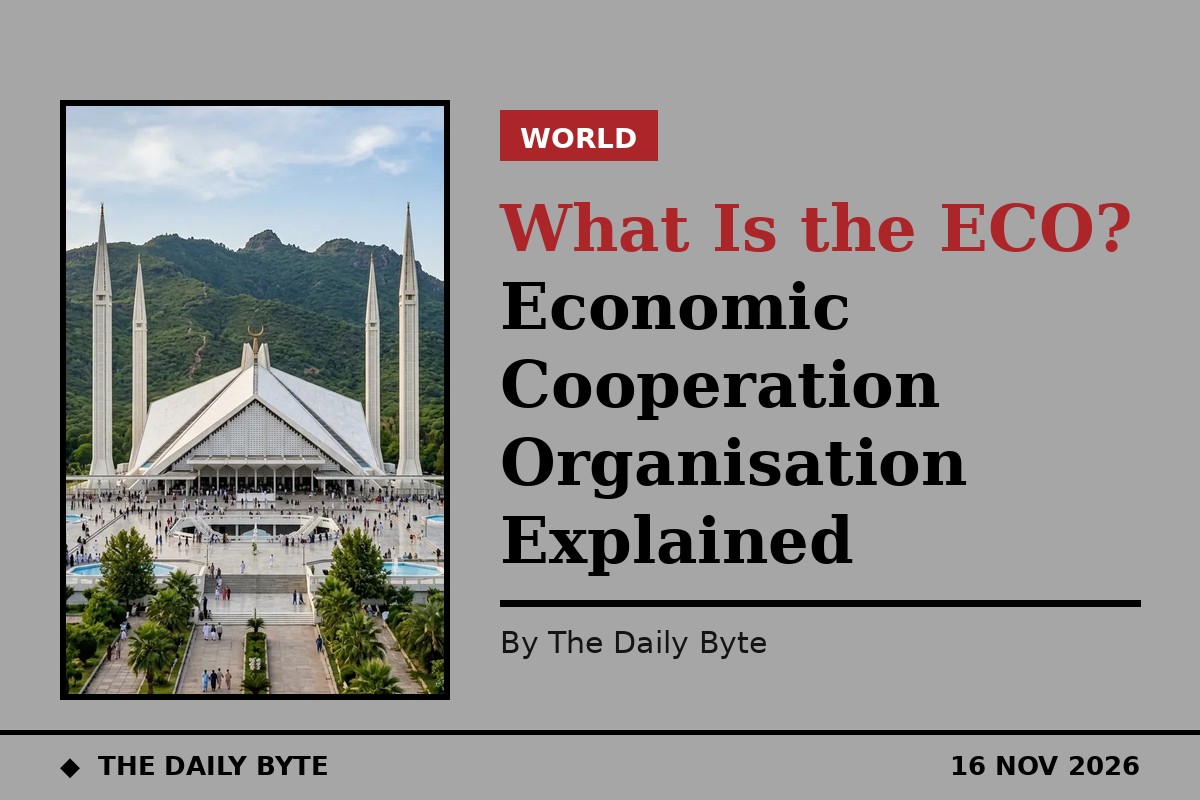
The Economic Cooperation Organization, usually shortened to the ECO, is a 10-country regional bloc spanning South Asia, Central Asia, the Caucasus and the Middle East, whose members work together on trade, transport, energy and investment. It is in the news because its foreign ministers met in Islamabad on 15 and 16 November 2026, with Pakistan chairing the organisation for 2026-27. This guide explains what the ECO is, who belongs to it, how it works, and what it can — and cannot — do.
Why is the ECO in the news now?
Islamabad hosted the 30th meeting of the ECO Council of Ministers on 15 and 16 November 2026. The meeting was chaired by Pakistan's Deputy Prime Minister and Foreign Minister, Ishaq Dar, and attended by foreign ministers and heads of delegation from the member states, along with representatives of the ECO Secretariat and its subsidiary bodies. Pakistan took over the chairmanship of the organisation for 2026-27 at the meeting, under the theme "Reviving Regionalism for a Resilient ECO".
The chairmanship's stated priorities are strengthening regional connectivity and deepening regional integration, with the aim of boosting trade, transport links and economic partnership between member states. A meeting of senior officials from the member states was held first, to review the organisation's activities and finalise the agenda and draft outcome documents for the ministers. The Council of Ministers is the ECO's main policy and decision-making body, so its meetings are where the bloc's direction is set — even if the practical results often take much longer to appear.
Which countries are members of the ECO?
The ECO has 10 member states. Three of them — Iran, Pakistan and Türkiye — founded the organisation. The other seven joined when it expanded in the early 1990s, after the break-up of the Soviet Union.
| Member state | Joined |
|---|---|
| Afghanistan | 1992 |
| Azerbaijan | 1992 |
| Iran | Founder (1985) |
| Kazakhstan | 1992 |
| Kyrgyz Republic | 1992 |
| Pakistan | Founder (1985) |
| Tajikistan | 1992 |
| Türkiye | Founder (1985) |
| Turkmenistan | 1992 |
| Uzbekistan | 1992 |
The organisation also has observers. The Turkish Cypriot State attends as an observer, as do the Organization of Turkic States and the Energy Charter. The ECO itself holds observer status at the United Nations and works with a number of UN bodies. Its permanent headquarters are in Tehran, Iran, and its current Secretary General is Asad M. Khan.
How did the ECO begin?
The ECO's roots go back to 1964, when Iran, Pakistan and Türkiye — then known as Turkey — set up the Regional Cooperation for Development, or RCD. The idea was that three neighbouring countries with deep historical and cultural ties could achieve more by cooperating on development than by working alone. The RCD made limited progress, and in 1985 the three countries reshaped it as the Economic Cooperation Organization.
The big change came in 1992. As the Soviet Union broke apart, the newly independent republics of Central Asia and the Caucasus, along with Afghanistan, sought to join. Seven new members were admitted, and their participation formally began after they acceded to the Treaty of Izmir at an extraordinary meeting of the Council of Ministers in Islamabad on 28 May 1992. The organisation's membership has stayed at 10 ever since.
The Treaty of Izmir is the ECO's founding charter. It was originally signed in Izmir, Türkiye, on 12 March 1977 by Iran, Pakistan and Türkiye, amended in 1990 and 1992, and revised in its current form on 14 September 1996. The treaty sets out the organisation's objectives and rules, including that a new member can be admitted only by a unanimous vote of the Council of Ministers. The ECO became operational in January 1991, with its headquarters in Tehran.
What does the ECO actually do?
The ECO describes itself as an intergovernmental regional organisation established to promote multidimensional regional cooperation and the socio-economic growth of its member states. In practice, its work is organised around a set of priority areas: trade and investment, transport and connectivity, energy, environment, economic growth and productivity, agriculture, tourism, and social welfare and human resources development.
Transport and connectivity are usually at the top of the agenda. The member states sit on some of the world's most important overland trade routes, linking South Asia with Central Asia, the Caucasus, the Middle East and, beyond them, China and Europe. ECO projects have included work on road and rail corridors, transit arrangements for goods, and cooperation between customs authorities. Energy is another recurring theme, since the region includes major oil and gas producers such as Iran, Kazakhstan, Azerbaijan and Turkmenistan, as well as large energy importers such as Pakistan and Türkiye.
The organisation also runs specialised agencies and affiliated bodies that work on specific subjects, from trade and development banking to science, education and culture. Its long-term planning is set out in documents such as ECO Vision 2025, adopted by heads of state and government at the 13th ECO Summit in Islamabad in March 2017, and work is now under way on a successor framework, the Strategic Goals of Economic Cooperation 2035, which the Council of Permanent Representatives considered in Tehran in November 2026.
How is the ECO run?
The ECO is run by its member governments, not by an independent authority. Its main bodies are:
- The Council of Ministers — foreign ministers of the member states. It is the main policy and decision-making body, meeting regularly to set direction and approve the organisation's work.
- The Council of Permanent Representatives — ambassadors of the member states based in Tehran, who handle business between ministerial meetings. Its 312th meeting was held at the ECO Secretariat in Tehran on 8 November 2026.
- The Regional Planning Council — senior planning officials who review programmes and prepare recommendations for the ministers.
- The Secretariat — based in Tehran and headed by the Secretary General, which runs the organisation day to day and supports its subsidiary bodies.
- The Summit — meetings of heads of state and government, held periodically to give political direction at the highest level.
Because decisions are taken by governments working together, the ECO moves at the pace of its members' agreement. That is normal for an intergovernmental body, but it also means progress can be slow when members disagree or when political tensions get in the way.
What is Pakistan trying to achieve as chair?
Pakistan holds the ECO chairmanship for 2026-27, and the theme it has chosen is "Reviving Regionalism for a Resilient ECO". The emphasis, as set out by Pakistan's Foreign Office before the Islamabad meeting, is on strengthening regional connectivity and deepening regional integration, so that trade and transport links between member states become faster, cheaper and more reliable.
For Pakistan, the chairmanship is also a diplomatic opportunity. Hosting the Council of Ministers brought foreign ministers and senior officials from across the region to Islamabad, including delegations from Türkiye, Azerbaijan, Kazakhstan, Turkmenistan and Iran, and representatives of the Shanghai Cooperation Organisation and the Organisation of Islamic Cooperation. It is a chance for Islamabad to present itself as a convenor of regional cooperation at a time when its own economy needs wider markets and more reliable transit routes to Central Asia.
Whether the chairmanship delivers lasting results will depend on follow-through. Ministerial meetings produce declarations and work programmes; the test is whether customs procedures are simplified, transit corridors are completed, and trade actually grows as a result.
How is the ECO different from ASEAN and the EU?
People often compare the ECO with other regional blocs, but the differences matter. The table below sets out the basics.
| Feature | ECO | ASEAN | European Union |
|---|---|---|---|
| Members | 10 | 11 | 27 |
| Region | South and Central Asia, Caucasus, Middle East | Southeast Asia | Europe |
| Founded | 1985 (roots in 1964) | 1967 | 1957 (as the EEC) |
| Nature | Intergovernmental forum | Intergovernmental forum | Supranational union with binding law |
| Free movement of people | No | No | Yes, within the EU |
| Common market / customs union | No | No (ASEAN Economic Community instead) | Yes |
Like ASEAN, the ECO is an intergovernmental organisation: its members cooperate voluntarily and keep their sovereignty. Unlike the EU, it does not make laws that bind its members, it has no common currency, and it does not allow free movement of people between member states. Its ambitions are economic — more trade, better transport, shared energy projects — rather than political union.
What are the limits on what the ECO can achieve?
The ECO's record is often described as one of big ambitions and modest delivery, and there are real reasons for that. The member states are at very different stages of economic development, from large economies such as Türkiye and Iran to smaller, landlocked states such as Tajikistan and the Kyrgyz Republic. Their trade is often oriented outwards — towards China, the EU, Russia or the Gulf — rather than towards each other.
Geography also matters. Landlocked members depend on transit through their neighbours to reach ports, which makes transport agreements and customs cooperation essential but also politically sensitive. Security problems, sanctions affecting some members, and political differences between members have all slowed joint projects in the past. The situation in Afghanistan, a member state, is another long-running complication for regional plans.
None of that makes the organisation irrelevant. Its supporters argue that a standing forum where these 10 countries meet, plan transport corridors and negotiate transit rules has value in itself — and that regional trade would be even thinner without it. The question the Islamabad meeting raises is whether Pakistan's chairmanship can turn that argument into concrete improvements in how goods, energy and people move across the region.
Frequently asked questions
What does ECO stand for?
The Economic Cooperation Organization. It is sometimes written as the Economic Cooperation Organisation, using the British spelling, which is why both versions appear in official material.
Is Pakistan a founder member of the ECO?
Yes. Pakistan founded the ECO's predecessor, the Regional Cooperation for Development, with Iran and Türkiye in 1964, and was one of the three countries that established the ECO itself in 1985.
Where is the ECO headquartered?
In Tehran, Iran. The organisation became operational in January 1991 with its permanent headquarters there.
Is the ECO the same as the OIC or the SCO?
No. The Organisation of Islamic Cooperation (OIC) is a much larger body of Muslim-majority countries, and the Shanghai Cooperation Organisation (SCO) is a separate Eurasian security and economic grouping led by China and Russia. Some countries belong to more than one of these organisations, and their representatives attend each other's meetings, but they are distinct bodies with different members and purposes.
Does ECO membership mean visa-free travel?
No. ECO membership does not give citizens of one member state the right to travel visa-free to another. Visa rules are set by each country, so travellers should always check the requirements of the country they plan to visit.
Sources: Economic Cooperation Organization — Member States and ECO Celebrates 30 Years of its Expansion; Pakistan Foreign Office statements on the 30th Council of Ministers meeting, reported by Feature Pakistan and NextUp News. For a comparison with Southeast Asia's bloc, see our explainer What is ASEAN? Southeast Asia bloc explained.