What Is the Hillsborough Law? Duty of Candour, Legal Aid and Where the Bill Stands
By The Daily Byte
·20 Nov 2026
·9 min read
The Hillsborough Law is the name given to the Public Office (Accountability) Bill, a law now moving through Parliament that would place a legal duty of candour on public authorities and officials, making it a criminal offence for them to mislead inquiries, inquests and investigations. It would also give bereaved families funded legal representation at inquests where the state is involved, and replace the old common-law offence of misconduct in public office with modern statutory offences. As of 18 November 2026, the Bill has passed the House of Commons and is at committee stage in the House of Lords. It is not yet law.
The Bill is one of the most significant accountability measures to come before Parliament in years, and it has been decades in the making. This guide explains what it is, why it is called the Hillsborough Law, what it would actually do, who it would cover, and how far it has got.
## Why is it called the Hillsborough Law?
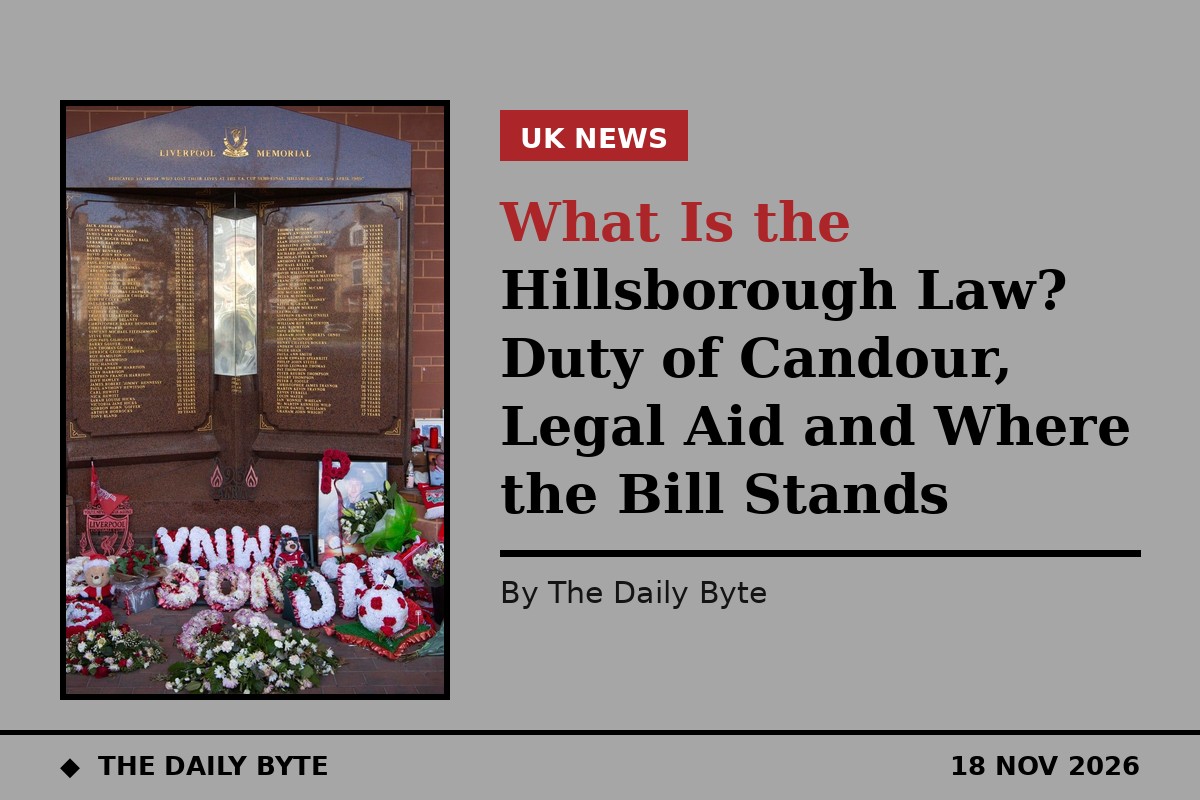
The Bill takes its name from the Hillsborough disaster of 15 April 1989, when a crush at the Leppings Lane end of Hillsborough Stadium in Sheffield, during the FA Cup semi-final between Liverpool and Nottingham Forest, killed 97 Liverpool supporters. Ninety-six died in the disaster and its immediate aftermath, and Andrew Devine, who suffered severe brain damage that day, died in July 2021 and was ruled by a coroner to be the 97th victim.
What followed the disaster mattered as much as the disaster itself. South Yorkshire Police blamed supporters for the crush, and the Hillsborough Independent Panel later found that more than 100 statements given by junior officers had been amended before being handed to the inquiry, to remove or alter comments unfavourable to the police. Bereaved families spent 25 years fighting for a fresh inquest, which in 2016 finally concluded that the 96 victims had been unlawfully killed. Bishop James Jones, who chaired the Independent Panel, set out the lessons in his 2017 report to Parliament, "The Patronising Disposition of Unaccountable Power".
The campaign for a Hillsborough Law was led for years by bereaved families and by Andy Burnham, the former MP who introduced an earlier version as a Private Member's Bill in 2017. Labour put the commitment in its 2024 general election manifesto, and the government introduced the Public Office (Accountability) Bill in the House of Commons on 16 September 2025. The government's own factsheet on the Bill says plainly what it is for: what happened after Hillsborough — police officers lying and changing witness statements, families facing inquests without funded legal representation while public bodies hired multiple legal teams, and a 25-year fight for the truth — must never happen again. The same factsheet says the Bill also responds to failings seen at Grenfell Tower, in the infected blood and Horizon scandals, and in other cases. Read the factsheet here: [Ministry of Justice, Duty of Candour factsheet](https://thegovernmentsays-files.s3.amazonaws.com/attachments/189/1895113-1-Duty_of_Candour_Fact_Sheet.pdf).
## What the duty of candour would require
At the heart of the Bill is a new legal duty of candour and assistance. Clause 2 would require public authorities and public officials to act "with candour, transparency and frankness" in their dealings with inquiries and investigations at all times. In practice, that means giving information and evidence honestly, proactively, and without favouring their own position — and correcting the record if errors come to light later.
The duty would apply at statutory inquiries set up under the Inquiries Act 2005, at non-statutory inquiries set up by ministers, and at coroners' investigations and inquests. It would also give chairs of non-statutory inquiries formal powers to compel evidence for the first time. The duty is aimed at the public sector, but it would also reach some private bodies: those delivering public functions, those with relevant health and safety responsibilities, and public-sector contractors of the kind involved in the Horizon scandal.
Crucially, the duty would be backed by criminal sanctions. The government's factsheet says those who do not comply face prosecution, with penalties including an unlimited fine and up to two years' imprisonment. The Bill would also require every public body to put in place a professional duty of candour for its staff, set out in a code of ethics based on the Nolan Principles of public life: selflessness, integrity, objectivity, accountability, openness, honesty and leadership.
## A new offence of misleading the public
Alongside the duty of candour, the Bill creates a new offence aimed squarely at those who set out to mislead the public or cover up the truth. It would apply where a public authority or public official acts with the intention of misleading the public — or is reckless as to that possibility — and knows, or ought to know, that what they are doing is seriously improper.
The offence is designed to capture the most serious cases: officials intentionally spreading a false narrative to protect their own reputation, causing harm, as happened after Hillsborough. It is separate from the duty of candour, which covers failures to help investigations find the truth, and it carries its own criminal penalties.
## Legal aid for bereaved families: parity of arms
The second major part of the Bill is about levelling the playing field at inquests. It would expand non-means-tested legal aid to bereaved families for inquests in England and Wales where a public authority is an "interested person" — in other words, where the state is involved in the death being examined.
This addresses one of the starkest inequalities exposed by Hillsborough. At the inquests, bereaved families had no funding for legal representation, while public bodies were free to appoint multiple legal teams to protect their own interests. The Bill's supporters call the reform "parity of arms": families should be able to take part properly in the process that examines how their loved one died.
Preparations are already under way. The Legal Aid Agency opened a procurement process for a new dedicated inquest category of legal aid in August 2026, ahead of Royal Assent, so providers are ready when the law comes into force. In the first round of the tender, 53 of 55 firms that applied passed the initial assessment, with a second round now being assessed and applications open until around 31 March 2027. The government's impact assessment estimated the reform could expand the availability of legal aid from around 200 to 400 cases a year to approximately 11,400, at an estimated cost of £65 million to £108 million a year. The new contracts would only begin once the legislation is brought into force, and would run until 30 June 2028. See the analysis from Weightmans here: [Hillsborough Law: inquest legal aid tender — 53 firms pass](https://dwfgroup.com/en/news-and-insights/insights/2026/9/hillsborough-law-the-lords-debate-and-what-it-means-for-organisations-in-scope).
## Replacing misconduct in public office
The Bill would also abolish the common-law criminal offence of misconduct in public office — a centuries-old offence that campaigners and lawyers have long criticised as vague and inconsistently applied — and replace it with two new statutory offences. The change is intended to give prosecutors, public officials and the public a clearer, modern definition of when a public official's wrongdoing is a crime, rather than relying on case law built up over hundreds of years.
## Where the Bill stands now
The Bill's passage through Parliament has been slower than its supporters hoped. It was introduced in the Commons on 16 September 2025 and passed its second reading on 3 November 2025 with broad cross-party support. Progress then stalled in January 2026, when the government postponed its report stage and third reading amid a dispute over how the duty of candour would apply to the intelligence and security services. After the government tabled amendments, the Bill completed its report stage and passed its third reading in the Commons on 14 July 2026.
It then moved to the House of Lords, where it had its second reading on 1 September 2026, with more than 40 peers speaking in support from all sides of the House. Committee stage sittings followed on 12, 19 and 21 October 2026. The Bill is still in committee in the Lords, and to become law it must still complete its remaining Lords stages, receive Royal Assent, and be brought into force through commencement regulations, which could happen on a phased basis. Legal advisers tracking the Bill expect Royal Assent in late 2026 or early 2027.
## The row over the intelligence services
The most contested part of the Bill has been how the duty of candour should apply to the intelligence services, Defence Intelligence, the National Crime Agency and counter-terrorism police. Under the Bill as it reached the Lords, staff in those bodies report through the head of their own service rather than directly to an inquiry, and campaigners have argued that amounts to a carve-out that undermines the principle that the duty applies to everyone. The government says the arrangements are needed to protect national security while keeping intelligence staff within the scope of the duty.
The row flared up again in November 2026, when The Grayzone reported on leaked emails which it said showed MI5 had lobbied against the legislation for years. The reports were covered on 15 November 2026. The episode underlined how sensitive the intelligence-services question remains, and it is likely to be debated again as the Bill continues through the Lords.
## Frequently asked questions
**Is the Hillsborough Law in force yet?**
No. As of 18 November 2026, the Public Office (Accountability) Bill is still going through the House of Lords. It will only become law once it has completed all its parliamentary stages and received Royal Assent.
**Who would the duty of candour apply to?**
Public authorities and public officials, including the police, the NHS, local councils, government departments and other state bodies, as well as some private bodies that deliver public functions or hold relevant health and safety responsibilities.
**Would it apply across the whole UK?**
The government has said the Bill should ideally apply UK-wide, and legislative consent has been sought from the devolved legislatures. The legal-aid changes for inquests apply in England and Wales.
**What happens next?**
The Bill continues its committee stage in the House of Lords. Once it clears the Lords, it returns to the Commons if peers amend it, then goes for Royal Assent. The government has said it wants to bring the provisions into force as quickly as possible after that. Families and campaigners will be watching the Lords stages closely — after a campaign lasting more than 35 years, the law they fought for is closer than ever, but it is not yet on the statute book.
For the official record of the Bill's progress, see the UK Parliament page: [Public Office (Accountability) Bill, UK Parliament](https://bills.parliament.uk/bills/4019).
Source
UK Parliament — https://bills.parliament.uk/bills/4019 

