What Is the Immigration and Asylum Bill?
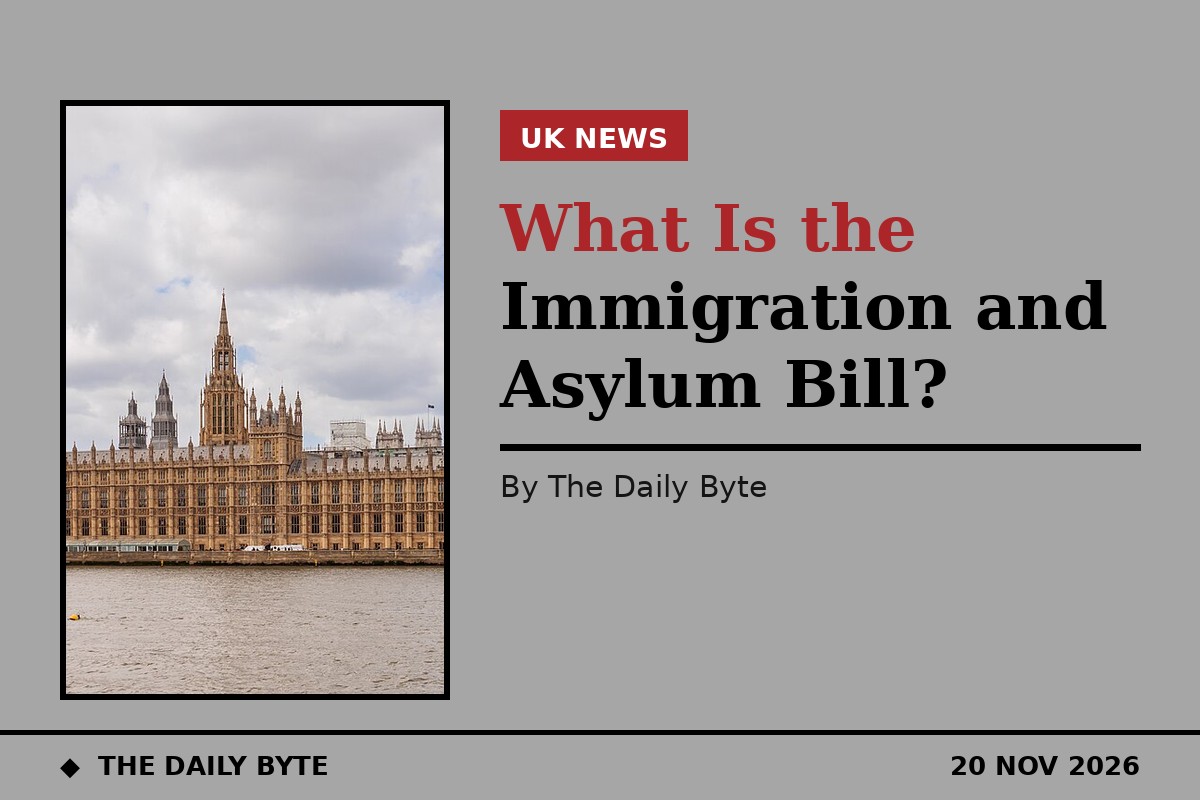
The Immigration and Asylum Bill is the UK government’s main piece of asylum and immigration reform law. It would rewrite how asylum appeals work, shorten the first grant of refugee leave, change how human rights claims are weighed in immigration cases, and overhaul parts of the modern slavery system. On 17 November 2026, MPs backed it at its third reading in the House of Commons by 290 votes to 94, and the Bill has now moved to the House of Lords. It is not law yet, and it can still be changed.
Home Secretary Shabana Mahmood introduced the Bill to deliver the reforms set out in the government’s “Restoring Order and Control” statement of November 2025. The government says the current system was never designed for the numbers it now faces: more than 460,000 people have claimed asylum in the UK since 2021, and the appeals backlog grew from 30,000 in June 2023 to 156,000 in June 2026, with the average wait for an appeal decision standing at 65 weeks. This explainer sets out what the Bill is, what it would change, and what still has to happen before any of it takes effect.
What happened in the Commons?
The Bill was introduced to Parliament on 30 June 2026. After its second reading and committee stage, it returned to the Commons on 17 November for its final Commons stages. At third reading, MPs voted 290 to 94 in favour, a government majority of 196. Fourteen Labour MPs voted against the Bill, including Diane Abbott, John McDonnell, Nadia Whittome and Bell Ribeiro-Addy, who have argued that parts of the package go too far. The Bill was introduced to the House of Lords on 18 November, when it received its first reading there.
Passing the Commons is a major step, but it is not the end of the process. A Bill only becomes law after it has passed both Houses of Parliament and received Royal Assent. Until then, every clause in it is a proposal, not a rule anyone has to follow.
What would the Bill change?
The government’s own impact assessment groups the Bill’s measures under five headings: appeals reform, recovering asylum support costs, reform of Article 8 of the European Convention on Human Rights, modern slavery, and wider measures to strengthen the asylum and immigration system. The changes below are the ones that matter most to the people the system deals with.
A new Independent Immigration Appeals Authority
The centrepiece is a new Independent Immigration Appeals Authority, usually shortened to IIAA. It would replace parts of the current appeal arrangements with a body staffed by trained adjudicators whose decisions are fully independent of the Home Office. The government says the new body will be built into the end-to-end immigration system so that appeals can be dealt with quickly and cases can flow through to removal where appeals fail.
The most important practical change is a single appeal route. At present, new claims and new evidence can be brought forward in stages, which the government says allows cases to be dragged out. Under the Bill, there would be one route, so that fresh claims and late evidence cannot be drip-fed to stall a removal. Appeals involving people who are detained and readily removable would be fast-tracked. The government presents this as the answer to a backlog that has grown fivefold in three years; critics of the package argue that speed must not come at the cost of fair hearings, and the Lords are expected to test that argument closely.
Shorter first grants of refugee leave
Under the Bill, a grant of refugee status would initially last two and a half years instead of five. The government has said the shorter grant would be renewed only if it is impossible for the refugee to return home. Supporters of the change say protection should last for as long as it is needed and no longer; refugee organisations have warned that shorter grants make it harder for people to settle, learn English, find work and rebuild their lives, because their future in the UK stays uncertain for longer.
One definition of a protection claim
The Bill would introduce a single definition of a protection claim, combining refugee status and humanitarian protection into one core protection model. The aim, according to the government’s factsheet, is to simplify decision-making and the appeals process: instead of deciding which of two kinds of protection applies, caseworkers and adjudicators would apply one test. The Bill would also add interpretive measures drawn from the Refugee Convention, so that people who have committed a particularly serious crime are not classed as “lawfully staying” in the UK. In the year ending March 2026, there were 42,943 grants of refugee status and 3,851 grants of humanitarian protection, so the change would affect how a large number of successful cases are categorised.
How Article 8 would be applied
Article 8 of the European Convention on Human Rights protects the right to respect for private and family life, and it is frequently raised in immigration and deportation cases. The Bill would define how Article 8 is to be applied in immigration decisions, in line with Strasbourg case law, so that the public interest carries proper weight and inconsistent decisions are harder to reach. The government says this will stop human rights law being used to frustrate removals, including the deportation of foreign national offenders. The provision is one of the most contested parts of the Bill: lawyers and campaigners argue that Parliament should not be writing its own reading of the Convention into statute, while ministers say Parliament is entitled to state how the balance should be struck.
Modern slavery reform
The Bill would rewrite parts of the modern slavery framework to set out the government’s obligations more clearly. The stated aim is to stop the system being misused while keeping essential protections for genuine victims. The measures would include better identification and support for children, higher expectations on businesses to report on modern slavery in their supply chains, and stronger enforcement powers. Most of the modern slavery changes would apply in England and Wales, where the substance of the Modern Slavery Act 2015 is reserved, with some reforms also reaching Scotland and Northern Ireland.
Asylum support costs and faster removals
Two further changes concern money and removals. First, people who have received taxpayer-funded accommodation and other asylum support would be required, for the first time, to contribute towards the costs of that support once they are financially able to do so. Second, the Bill is designed to speed up the removal of people with no right to be in the UK. An amendment approved in the Commons would allow a removal to go ahead once appeal rights have been exhausted, without a further five-working-day waiting period, in qualifying circumstances. The Bill also extends some removal timeframes to six months, so that a failed removal attempt does not force the whole notice process to start again.
What about settlement?
MPs also debated the government’s linked Earned Settlement proposals alongside the Bill. Under those proposals, the standard qualifying period for indefinite leave to remain would rise from five years to ten years for most people. There would be faster routes for higher earners, while people on health and social care visas who meet their visa conditions and earn at least £25,000 a year would keep the five-year route. The settlement changes are part of the wider package the government is pursuing, and the detail is still being worked through; anyone affected should check the official position on GOV.UK, because immigration rules change and this article is not personal immigration advice.
What happens next in the Lords?
The Bill now faces the House of Lords, where it will go through a second reading, committee stage, report stage and third reading. Peers can amend it, and if the Lords change the Bill, it returns to the Commons in a process known as ping-pong until both Houses agree on the same text. Only then does it go for Royal Assent and become an Act of Parliament. There is no fixed date for that, and the government’s timetable will depend on how much opposition the Bill meets in the Lords and on parliamentary time. Even after Royal Assent, many of the changes would need secondary legislation and guidance before they bite in practice.
Why the numbers matter
The government’s factsheet gives the scale of the system the Bill is aimed at. Of the 86,000 people who claimed asylum in the year ending June 2026, 40 per cent, or about 34,000, arrived in a small boat, while 41 per cent, about 35,000, arrived first by legal means, on a visa or with other leave, before claiming asylum. Around 93,300 asylum seekers are currently receiving state-funded support, most of them living in asylum accommodation. At its peak in 2023, there were 400 asylum hotels across the country, at a daily cost of £9 million to the taxpayer. At the same time, around 229,000 people have received initial asylum decisions since July 2024, and the number waiting for an initial decision is 77 per cent lower than the peak in June 2023. The government presents those figures as proof that faster decisions are possible; the Bill is its attempt to apply the same logic to appeals, where the backlog has moved in the opposite direction.
The bottom line
The Immigration and Asylum Bill is the government’s attempt to make the asylum system faster and harder to delay: one appeal route, a new independent appeals body, shorter initial refugee leave, a single protection test, a statutory reading of Article 8, modern slavery reform, and quicker removals. It has cleared the Commons by a large majority, but it is still only a Bill. The House of Lords will now examine it line by line, and the final version, if it becomes law at all, may look different from the one MPs approved on 17 November 2026. For the latest position, check the Bill’s page on GOV.UK.


